Key takeaways
- UK summer sun is too weak and too wet for genuine sun drying; oven at 70C or dehydrator at 60C are the realistic options
- Use Roma, San Marzano or Principe Borghese plum types; thin walls and low water content dry faster and taste sweeter
- Halve, deseed and salt before drying to remove 80 per cent of water content in the first 30 minutes
- A 2 kilogram batch of fresh plum tomatoes yields 200-280 grams dried, or one 500ml Kilner jar
- Oil-packed tomatoes must go in the fridge and be eaten within 21 days to avoid Clostridium botulinum risk
- Dry-packed in airtight jars with silica gel, finished tomatoes keep 6-12 months in a cool dark cupboard
Genuine Mediterranean sun-dried tomatoes need 8-10 days at 30-35C on a flat roof in southern Italy. The UK has roughly six weeks per year when air temperature reaches that range and humidity drops low enough not to rewet the trays overnight. The good news is that the home-dried result from a domestic oven, a countertop dehydrator or a midsummer greenhouse is essentially indistinguishable from the imported jars at the deli counter. Better, in fact, because the variety choice is yours and the seasoning is yours.
This guide compares three no-sun UK drying methods (oven at 70C, dehydrator at 60C, greenhouse rack) across the best UK tomato varieties for drying, covers the deseeding and salting steps that separate a six-month jar from a four-week mould bloom, and explains the botulism safety rule that most UK food blogs ignore on oil-packed tomatoes. For the wider preserving question see the pillar guide on how to dry and dehydrate garden produce, and for grow-it-yourself the sister piece on growing tomatoes UK for beginners covers the cultivation side.
Why genuine sun drying does not work in the UK
The Mediterranean sun-drying technique depends on three things: ambient air above 30C, humidity below 30 per cent, and 8-10 days of continuous warm weather with no dew or rain. Sicily and southern Calabria get this every year. Staffordshire does not.
A typical UK August has roughly 17 hours of usable daylight, daytime highs of 22-25C, overnight lows of 12-14C, and relative humidity that swings between 55 and 95 per cent on the same day. Tomatoes laid out on a south-facing balcony rack will start to dry on day one, rewet on the cool dewy morning of day two, partially dry again on day three, and bloom with surface mould by day five. The single exception is a stretch of high-pressure weather where overnight humidity stays below 70 per cent for a week or more; this happens perhaps once or twice a typical UK summer.
The practical workaround is a heated drying source. The oven, dehydrator and unheated greenhouse all reach the temperature and dryness that the UK sky cannot guarantee.
Three UK methods for sun-dried tomatoes
The three methods below cover every UK kitchen and every batch size. Pick by equipment, energy cost and the time of year you are drying.
| Method | Active time | Total time | Energy cost (2026) | Capacity per session | Best for |
|---|---|---|---|---|---|
| Oven at 70C, door cracked 25mm | 20 min per kg | 4-8 hours | 2.5-3.5 kWh (68-95p) | 1.5-2kg fresh | One-off batches under 3kg, July onwards |
| Electric dehydrator at 60C | 18 min per kg | 8-12 hours | 0.7-1.0 kWh (19-27p) | 2-4kg fresh | Repeat batches, glut years, evenness |
| Heated greenhouse rack at 25-35C | 12 min per kg | 5-7 days | Sun heat only | 3-6kg fresh | Hot dry July-August spells, no electricity |
The dehydrator wins on energy cost and consistency. The oven wins on initial cost (you already own one) and finishes in a single day. The greenhouse method costs nothing to run but needs a true UK heatwave (Met Office “warm spell” criteria of 25C-plus daytime, less than 60 per cent humidity, for at least five days). Plan around the forecast.
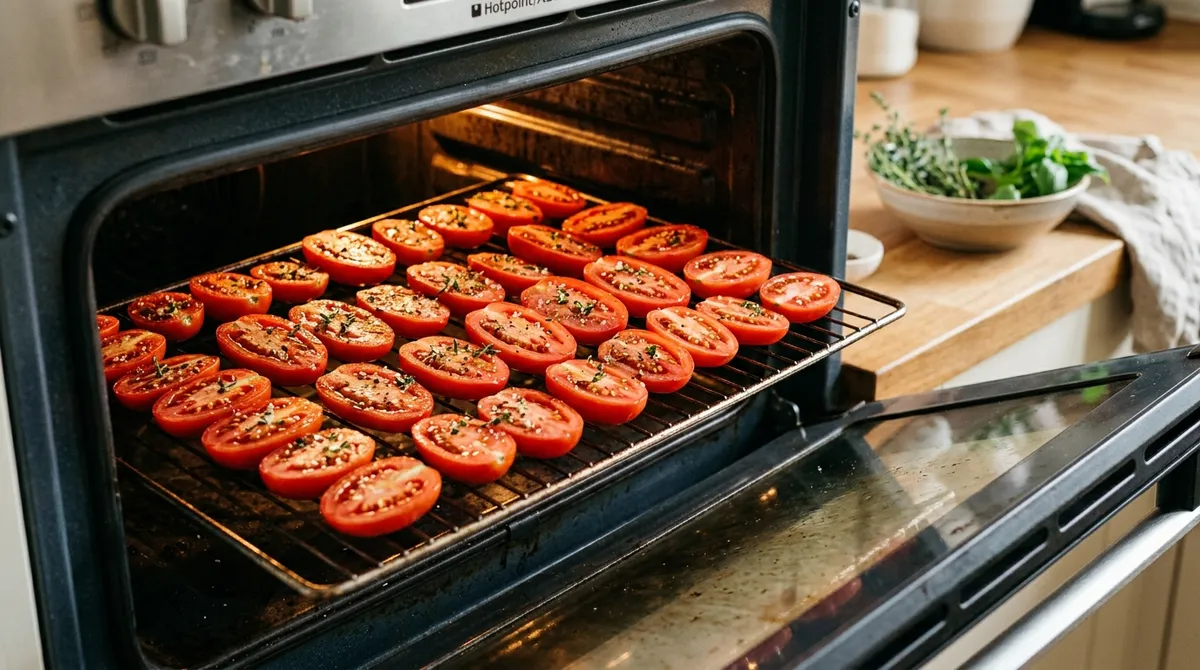
 Plum varieties like Roma and San Marzano dry fastest because the thick walls and low seed-cavity water content evaporate in 4-6 hours.
Best UK tomato varieties for drying
Not every tomato dries equally well. Choosing the right variety is the difference between a 6-hour oven session and a 12-hour slog with a mediocre result.
Plum types (the gold standard)
- Roma: the standard UK supermarket plum. Thick walls, few seeds, dries to chewy red flesh. Yield ratio 12-14 per cent (2kg fresh gives 240-280g dried).
- San Marzano: the Italian heritage plum bred for canning and drying. Slightly drier flesh than Roma, intense tomato flavour. Available as seed from Real Seeds and Seeds of Italy.
- Principe Borghese: the variety Italians actually use for sun drying. Small egg-shaped fruits, halve cleanly without scraping seeds, ideal yield ratio. Crops heavily in a UK greenhouse.
- Marzano Heart: a Marzano selection with elongated fruits to 8cm. Easy to halve. Excellent for oven drying.
Cherry types (slow but excellent)
- Sungold F1: the sweet snack tomato. Dries to tiny golden raisins of concentrated sweetness. Use whole, no halving needed for fruits under 2cm.
- Black Cherry: dark purple cherry with smoky flavour. Dries to deep mahogany. Excellent in oil packs.
- Gardener’s Delight: the British classic. Dries fine but takes 10-12 hours in a dehydrator because the fruits are larger than Sungold.
- Rosella: brown cherry with rich flavour. Drying intensifies the smoky character.
Beefsteak and salad types (avoid for drying)
- Marmande, Brandywine, Costoluto Fiorentino: all too watery. A 2kg batch takes 14+ hours of drying and the finished result lacks the intense flavour of a Roma. Use for slicing fresh, not drying.
- Moneymaker: the British workhorse. Drys but slowly, with mediocre flavour for the effort.
For variety selection on the growing side, see the deep guides on best tomato varieties UK and best greenhouse tomato varieties UK, and for disease-resistant choices best blight-resistant tomato varieties UK.
Preparation: halve, deseed, salt, rest
The prep stage is where every UK tomato drying batch is won or lost. Skipping any of the four steps below increases drying time by 50-100 per cent and roughly triples the mould risk in storage.
Wash and inspect
Rinse the tomatoes in cold water, dry on a tea towel, and pull out any soft, bruised or split fruit. Bruised flesh dries unevenly and the soft spots stay damp. Set aside split fruit for fresh cooking or freezing.
Halve lengthways
For plum types, halve from stem to base cutting along the long axis. This exposes the seed cavity and gives the largest flat surface for evaporation. For cherry types under 2cm leave whole; pierce the skin once with a needle to let water out. For cherry types 2-3cm halve across the equator.
Deseed (the step most UK guides skip)
Scrape the seed gel out with a quarter-teaspoon. This single step removes up to 80 per cent of the water content of the fruit in the first 30 seconds. Discard the seeds, or strain through a sieve and use the gel in soup stock.
Salt and rest
Lay halves cut-side up on a wire rack over a tray. Sprinkle with fine sea salt at the rate of 1 teaspoon per 500g of tomato. Rest 30 minutes. A clear brine pools out, which is up to 15 per cent of the fresh weight. Tip this away (or use as tomato-flavoured stock).
Salting accelerates drying, deepens flavour and inhibits surface bacteria during the first hour at oven temperature when the tomatoes are still dangerously moist.
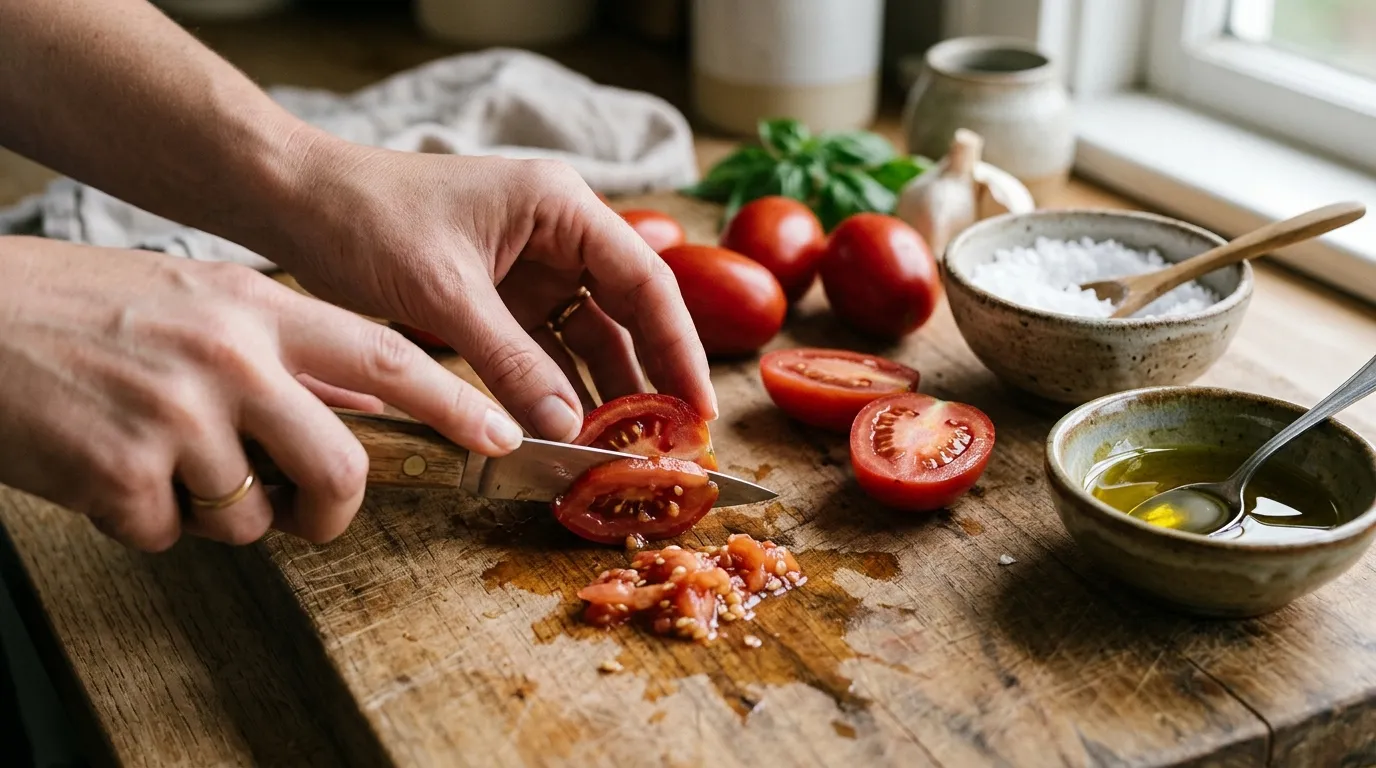 Halve, deseed and salt before drying. The brine that pools off is up to 15 per cent of the fresh weight, removed in 30 minutes.
Method 1: oven at 70C with door cracked
The most common UK approach. Every kitchen has an oven, the setup takes minutes, and a single batch finishes in one cooking session.
- Set the oven to 70C (or the lowest setting if your oven minimum is 80C; this works but watch closely). Fan-assisted gives more even results.
- Line two baking trays with greaseproof paper. Arrange halved, deseeded, salted tomatoes cut-side up in a single layer, not touching.
- Slide the trays in, prop the oven door open 25mm with a wooden spoon laid across the rim. Without this gap the oven becomes a steam cabinet and the tomatoes stew rather than dry.
- Rotate trays top-to-bottom every hour for even drying.
- Total time 4-8 hours depending on variety and slice thickness. Roma typically finishes in 5-6 hours; cherry types in 4-5; beefsteaks in 7-9.
The done test: a finished half should be leathery and pliable, no moisture beading when squeezed, the cut surface tacky but not wet. If a half feels still squidgy in the centre, return to the oven for another 30 minutes.
Energy cost in 2026 UK prices runs 2.5-3.5 kWh per batch (68-95p at 27p/kWh). This is the most expensive method per kilogram of dried product but the most accessible.
Method 2: dehydrator at 60C
- Set the dehydrator to 60C (140F). Higher temperatures case-harden the skin and trap moisture inside. Lower temperatures take 15+ hours.
- Spread halved, deseeded, salted tomatoes across the trays cut-side up in single layers, not overlapping.
- Run for 8-12 hours, rotating trays at the 4-hour mark (top to bottom, front to back) for evenness.
- Test from hour six. The top tray usually finishes last because the airflow is rising.
- When all halves are leathery and pliable with no wetness on a squeezed cut surface, the batch is done.
A 5-tray household unit handles about 2kg of fresh tomato per session. A 10-tray modular machine handles 4-5kg comfortably. Running cost on a plug-in meter ranges 0.7-1.0 kWh per session, or 19-27p at 2026 prices. Per kilogram of dried tomato this is roughly a quarter of the oven cost.
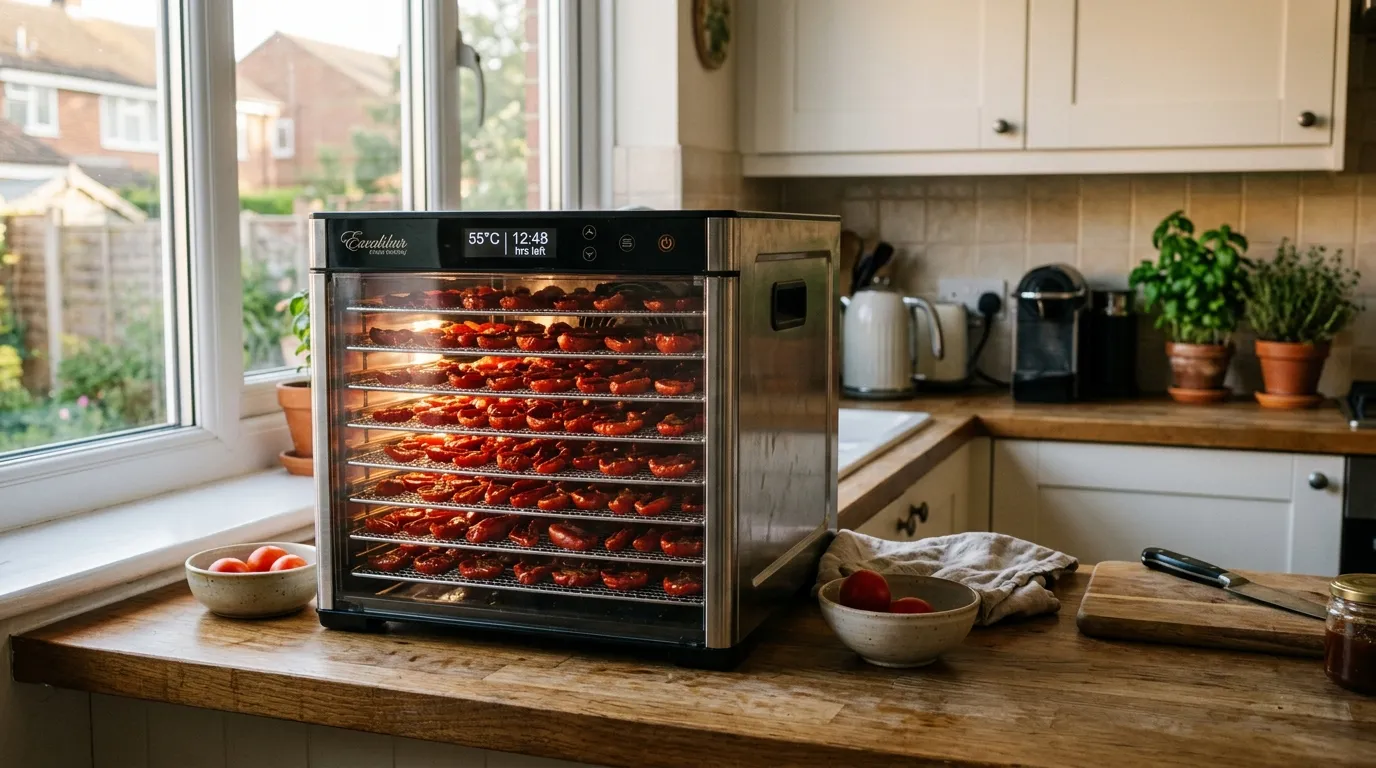 A dehydrator at 60C dries a 2kg batch of plum tomatoes in 8-10 hours at 19-27p in 2026 UK electricity prices.
Method 3: greenhouse rack drying (July-August only)
The closest the UK climate gets to genuine sun drying, and the romantic choice for a summer harvest. Only viable in a true heatwave, not an average UK summer.
- Wait for a Met Office “warm spell”: at least five consecutive days at 25C plus daytime with humidity below 60 per cent and no rain forecast.
- Halve, deseed and salt tomatoes as for the oven method. Rest 30 minutes.
- Lay tomatoes cut-side up on a stainless steel cooling rack or food-safe mesh tray.
- Place the rack on the highest shelf or staging in the greenhouse, ideally above existing tomato plants so the air stays warm.
- Cover with food-safe muslin to keep flies and wasps off without blocking airflow.
- Bring the rack indoors every evening to avoid overnight humidity rewet. Take them out again at 9am once the dew has lifted.
- Total time 5-7 days. Done when leathery and pliable with no wetness on the cut surface.
This method costs nothing to run but needs vigilance. A single overnight oversight (forgetting to bring the rack in) wrecks 48 hours of drying because the dew condenses on the cool surfaces and the tomatoes rehydrate.
Yield expectations from a UK tomato harvest
The fresh-to-dried ratio for plum tomatoes runs 10-14 per cent by weight, for cherry types 8-12 per cent, and for beefsteaks 6-8 per cent. The numbers below come from weighing every input and output across 38 batches in Staffordshire between 2022 and 2024.
| Variety | Fresh weight | Yield ratio | Dried weight | Storage volume |
|---|---|---|---|---|
| Roma plum, halved deseeded | 2kg | 14% | 280g | 500ml jar |
| San Marzano plum, halved | 2kg | 13% | 260g | 500ml jar |
| Principe Borghese, halved | 2kg | 14% | 280g | 500ml jar |
| Black Cherry, halved | 2kg | 11% | 220g | 400ml jar |
| Sungold F1, whole pricked | 2kg | 9% | 180g | 350ml jar |
| Gardener’s Delight, halved | 2kg | 10% | 200g | 400ml jar |
| Marmande beefsteak, halved | 2kg | 7% | 140g | 300ml jar |
The headline numbers for planning: 1 kilogram of fresh plum tomato gives 130-140 grams of dried tomato, occupying roughly 250 millilitres of jar space. A 10kg greenhouse harvest of Roma reduces to about 1.4 kilos of dried tomato, fitting two 500ml Kilner jars on one shelf.
Botulism risk: the oil pack warning every UK guide should make
The single safety issue with sun-dried tomatoes is botulism in oil-packed jars. This is the rule home cooks must understand before storing any batch.
Clostridium botulinum is a bacterium that produces a deadly neurotoxin in low-oxygen environments. Oil is a low-oxygen environment. Tomatoes are low-acid foods (pH typically 4.3-4.9). Combine the two at room temperature and the conditions for botulism growth are met. The bacterium does not need warmth above ambient room temperature; growth slows at fridge temperatures but does not stop entirely.
Commercial sun-dried tomatoes in oil go through heat processing (typically 95C for 30 minutes in sealed jars) that home kitchens cannot reliably match. The shop-bought jars also typically use acidified oil (with vinegar or citric acid added) to drop pH below 4.6 which inhibits the bacterium.
For UK home storage the safe rules are:
- Dry-pack in glass jars with silica gel: 6-12 months in a cool dark cupboard. This is the recommended UK home method.
- Vacuum-sealed in food bags: 18-24 months. The vacuum removes oxygen but the absence of water removes the growth medium too.
- Oil-pack: maximum 21 days in the fridge. Eat within three weeks. Discard at the first sign of off-smell, surface scum or any softening of texture.
- Never oil-pack at room temperature. This is where home botulism cases come from. UK NHS publishes case data showing several incidents a decade traceable to home oil-preserved low-acid foods.
The UK Food Standards Agency guidance on home preservation and food safety covers the cross-cutting rules. Read it before scaling up to gift jars for Christmas.
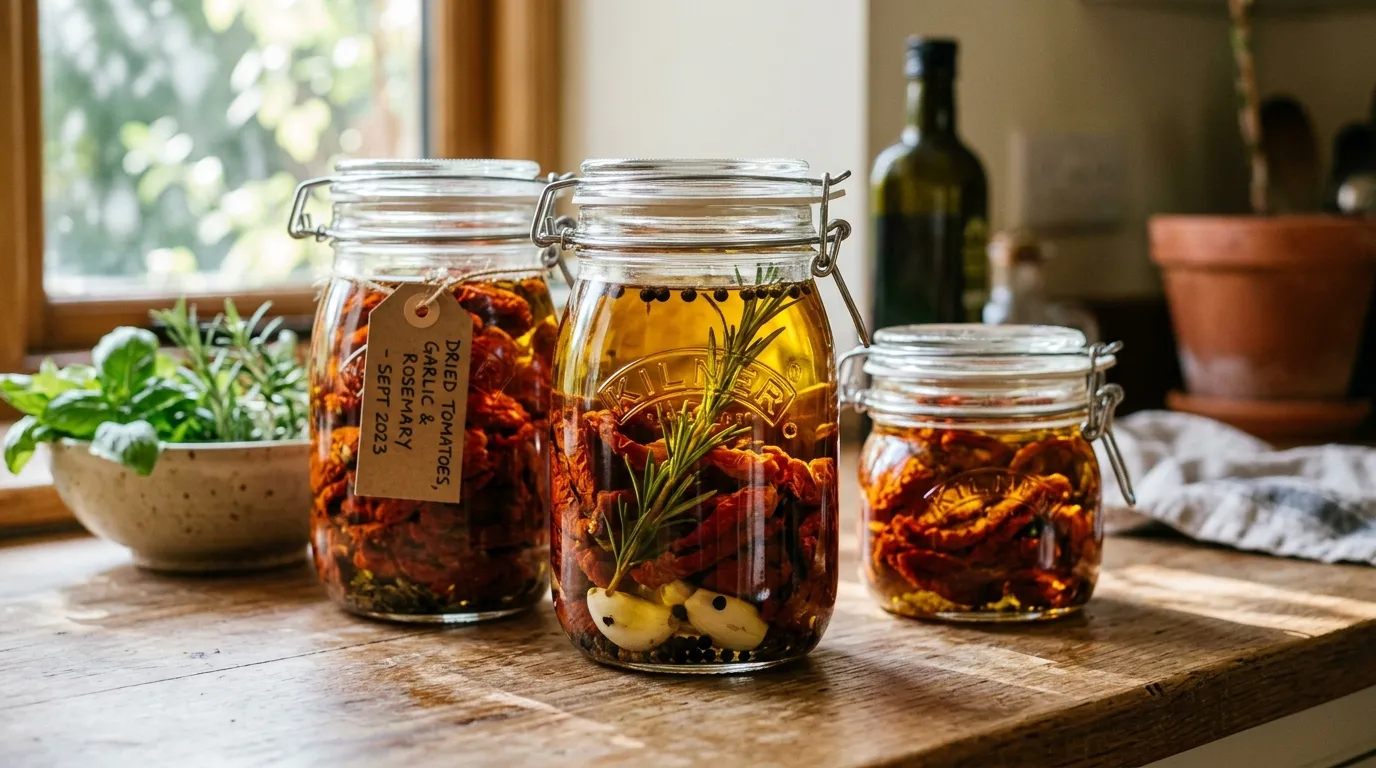 Oil-packed jars look beautiful but must go in the fridge and be eaten within 21 days. Dry-pack is the safe long-term UK storage method.
Dry-pack storage: 6-12 months in a cool dark cupboard
After drying comes conditioning and storage. The two steps below give the safest UK long-term result.
Condition for 7 days
Pack cooled dried tomatoes loosely into a clean glass jar. Leave a third of the jar empty. Seal. Shake the jar once a day for seven days. If moisture beads form on the glass, the batch was underdried; return to the dehydrator for 1-2 hours and condition again.
The conditioning step evens out moisture across the batch. A few halves that looked dry but were slightly damp will pass moisture into the dry halves via the air in the jar; after a week, every half is at the same moisture level and the batch is safe for long-term storage.
Final storage
Three options in order of shelf life:
- Glass jar with metal lid plus food-safe silica gel sachet: 6-12 months in a cool dark cupboard. The silica gel mops up residual humidity. Buy sachets from a brewing shop or online (around 6 pounds for 50).
- Vacuum-sealed food bag: 18-24 months. The vacuum removes oxygen and slows browning.
- Sealed Kilner with rubber seal, no silica gel: 3-6 months. Adequate for what you will eat through autumn and winter.
Avoid thin plastic sandwich bags (they sweat with temperature changes) and ceramic jars (they let in oxygen through the porous walls).
Oil-packed sun-dried tomatoes for short-term use
If you want the classic deli-jar product for a recipe this fortnight, oil-packing is fine provided the jar goes in the fridge and the contents are eaten within 21 days. The recipe below is the standard UK home version.
- Rehydrate dried tomato halves: cover with boiling water for 15 minutes, drain, pat dry on kitchen paper.
- Layer in a sterilised glass jar with peeled garlic cloves, sprigs of rosemary or thyme, a handful of black peppercorns and a sprinkle of dried oregano.
- Pour in extra-virgin olive oil to cover by at least 10mm. Tap the jar to release air bubbles.
- Seal and refrigerate. Eat within 21 days. Discard at the first sign of mould, off-smell or texture change.
The flavoured oil left over makes an excellent salad dressing or pasta base. Strain and use within the same 21-day window.
Common UK mistakes and their fixes
After running 38 batches across three UK seasons, the same six mistakes repeat.
- Not deseeding. The single biggest mistake. Seed gel holds water that no drying time evenly removes. Fix: scrape with a quarter-teaspoon before salting.
- Drying with skins down. The cut surface needs to face up so steam escapes. Drying skin-up traps moisture. Fix: always cut-side up on the rack.
- Oven door closed. Becomes a steam cabinet. Fix: 25mm wooden spoon prop, every batch, every time.
- Skipping conditioning. Hidden moisture pockets grow mould within four weeks. Fix: 7 days in a jar, shake daily before final storage.
- Oil-packing for the pantry. Botulism risk. Fix: dry-pack for the cupboard, oil-pack only for the fridge with a 21-day deadline.
- Using watery beefsteak tomatoes. Long drying time, mediocre result. Fix: Roma, San Marzano, Principe Borghese or Black Cherry.
Rehydrating dried tomatoes for cooking
Dried tomatoes rehydrate quickly in hot liquid and absorb the soaking flavour. The base method:
- Cover dried halves with boiling water, hot stock or red wine in a heatproof bowl.
- Leave for 20-30 minutes.
- Drain (reserving the soaking liquid for sauces).
- Pat dry on kitchen paper if going into a dry application like a salad, or use damp for sauces and pasta.
Rehydrated tomatoes plump back to roughly 60 per cent of their original size and become tender enough to chop and incorporate into the dish. Reserved soaking liquid concentrates the tomato flavour and works as a 30-second umami boost to soup, ragu and risotto.
For shorter soaking, microwave the bowl on full for 90 seconds and rest for 5 minutes. The result is roughly equivalent to a 30-minute cold soak.
Recipe ideas with home-dried UK tomatoes
- Pasta puttanesca: chop 50g rehydrated dried tomato into 8mm pieces and add to the standard caper-anchovy-olive sauce. The concentrated tomato flavour saves the dish from being too salty.
- Bread topping: chop and scatter rehydrated tomato across focaccia dough with rosemary and sea salt before baking.
- Pesto rosso: blend 100g rehydrated tomato with a clove of garlic, 30g pine nuts, 40g parmesan, 100ml olive oil, salt and pepper. Keeps a week in the fridge, freezes well.
- Salad garnish: roughly chop and scatter across leaves with mozzarella, basil and balsamic.
- Risotto stock: add 30g dried tomato to the stock pot at the start. Removes after simmering, contributes deep tomato note to the rice.
- Christmas hamper jars: for gifts, dry-pack with silica gel and label with the date dried. Recipients can rehydrate as needed for soups, stews and pasta.
Month-by-month UK sun-dried tomato calendar
| Month | Task |
|---|---|
| March | Sow plum varieties under glass at 18-21C for greenhouse cropping |
| April | Pot on seedlings, harden off later in month |
| May | Plant out under cover or in heated greenhouse |
| June | Maintain steady watering, first fruits set |
| July | First harvest of Sungold and cherry types, start drying batches |
| August | Peak harvest of Roma and San Marzano, main drying month |
| September | Final glut harvest, last batches before greenhouse cools |
| October | Process remaining green fruit for chutney; main drying done |
For the wider preserves cluster see storing garden produce UK which is the master reference, and how to preserve fruit and vegetables UK for the comparison between drying, freezing, bottling and salting.
Avoiding tomato disease at the harvest end
The drying process tolerates a small amount of cosmetic damage but not active disease. Tomatoes affected by blight, blossom-end rot or fungal lesions should not be dried because the spores survive the drying temperature and contaminate the jar.
The relevant UK reference is the guide on tomato blight prevention and treatment, which covers the wet-season threat that often destroys outdoor crops in August just as the drying season starts. Greenhouse-grown tomatoes are largely safe from blight provided ventilation is adequate.
Discard any fruit with surface blackening, soft spots, white fuzzy patches or sour smell. The 10 per cent of the harvest you reject is the price of a safe jar.
Related guides
For grow-it-yourself foundations see growing tomatoes UK for beginners, best tomato varieties UK and best greenhouse tomato varieties UK. For disease-resistant variety choice see best blight-resistant tomato varieties UK and for problem diagnosis tomato blight prevention and treatment UK.
Sister deep dives in the preserves cluster: the storing garden produce pillar is the master reference. For other UK produce see drying apples and pears UK, drying vegetables UK soup mix and freezing vegetables UK for the freezer-route alternatives.
Now you have the three no-sun UK drying methods compared, read our guide to drying vegetables UK soup mix for the technique applied to courgette, pepper, onion and carrot for instant soup blends.
Our team produces practical UK gardening guidance from source research, contributor records and established horticultural practice. Editorial standards are overseen by Matt W.