Key takeaways
- Three beds, each takes turns growing legumes, brassicas, then roots
- Lime the brassica bed only. Manure the legume bed only
- Potatoes need a 4th bed or a different scheme
- Move all beds one step each autumn after harvest
- Best for plots 50-200m². For larger plots, use the 4-year cycle
- Rotation cuts club root, eelworm and disease cycles
A 3-year crop rotation is the simplest crop-rotation scheme that still delivers real disease and soil-fertility benefits on a UK vegetable plot. Three beds, three plant groups, one step clockwise each autumn. This guide shows the exact plan, the lime and manure schedule, where potatoes fit, and the disease control benefits compared with no rotation at all.
How a 3-Year Crop Rotation Works
The principle: each plant family takes nutrients from the soil and gives back something different. Rotating breaks pest and disease cycles and balances soil fertility.
| Year | Bed A | Bed B | Bed C |
|---|---|---|---|
| Year 1 | Legumes (beans, peas) | Brassicas (cabbage family) | Roots (carrots, beetroot, onions) |
| Year 2 | Brassicas | Roots | Legumes |
| Year 3 | Roots | Legumes | Brassicas |
| Year 4 | Repeat as Year 1 | Repeat as Year 1 | Repeat as Year 1 |
Each bed takes 3 years to come back to the same plant family. This gives most UK soil-borne pests and diseases enough time to die out between crops on that bed.
The three plant groups:
| Group | What grows | Soil need | Key disease |
|---|---|---|---|
| Legumes | Beans, peas, broad beans | Heavy manure, rich soil | Bean rust, chocolate spot |
| Brassicas | Cabbage, broccoli, kale, sprouts, swede, turnip, radish | Lime, firm soil, high pH | Club root, downy mildew |
| Roots | Carrots, beetroot, parsnips, onions, leeks, garlic | Stone-free, no fresh manure | Carrot fly, white rot |
The genius of the cycle is that legumes fix atmospheric nitrogen through their root nodules, leaving 30-60 kg of nitrogen per hectare in the soil. Brassicas use that nitrogen heavily the following year, growing well without further nitrogen feed. Root crops then go into the leaner soil and develop deeper roots, smaller tops, and better storage quality.
Year-by-Year Plot Plan
The classic 3-bed layout: three rectangular beds, equal size, side by side. Beds typically 1.2m wide by 4-6m long for a small plot, or 1.5m wide by 8-10m long for a larger plot.
Year 1:
- Bed A (Legume year): Broad beans (March sown), runner beans (June planted), French beans (May sown), garden peas (March sown).
- Bed B (Brassica year): Cabbages (spring and summer types), broccoli, cauliflower, kale, Brussels sprouts, swede, turnip.
- Bed C (Root year): Carrots, beetroot, parsnips, onions, leeks, garlic.
Year 2:
- Bed A (Brassica year): All brassicas now move here. Lime the bed in autumn before planting.
- Bed B (Root year): Roots and alliums move here. Take advantage of the lime applied last year.
- Bed C (Legume year): Beans and peas move here. Apply manure in autumn before planting.
Year 3:
- Bed A (Root year): Final year before the cycle restarts.
- Bed B (Legume year): Restore nitrogen with peas and beans.
- Bed C (Brassica year): Take advantage of lime and the legume-grown soil.
After Year 3, return to the Year 1 layout. Each bed has been through one complete cycle.
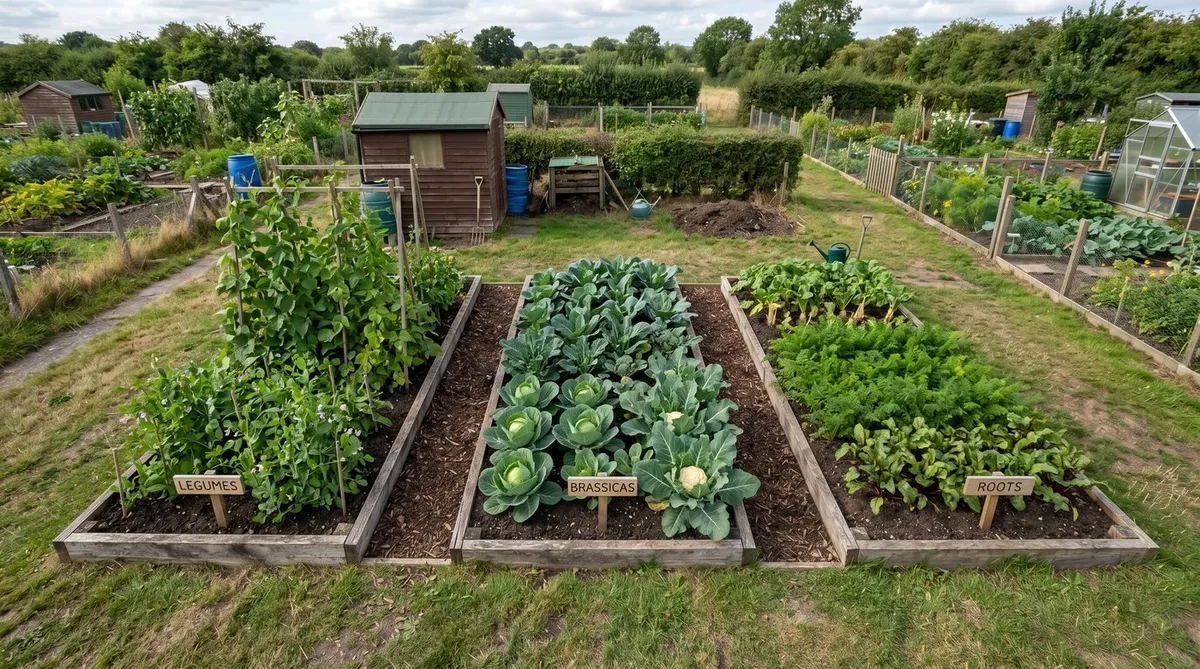
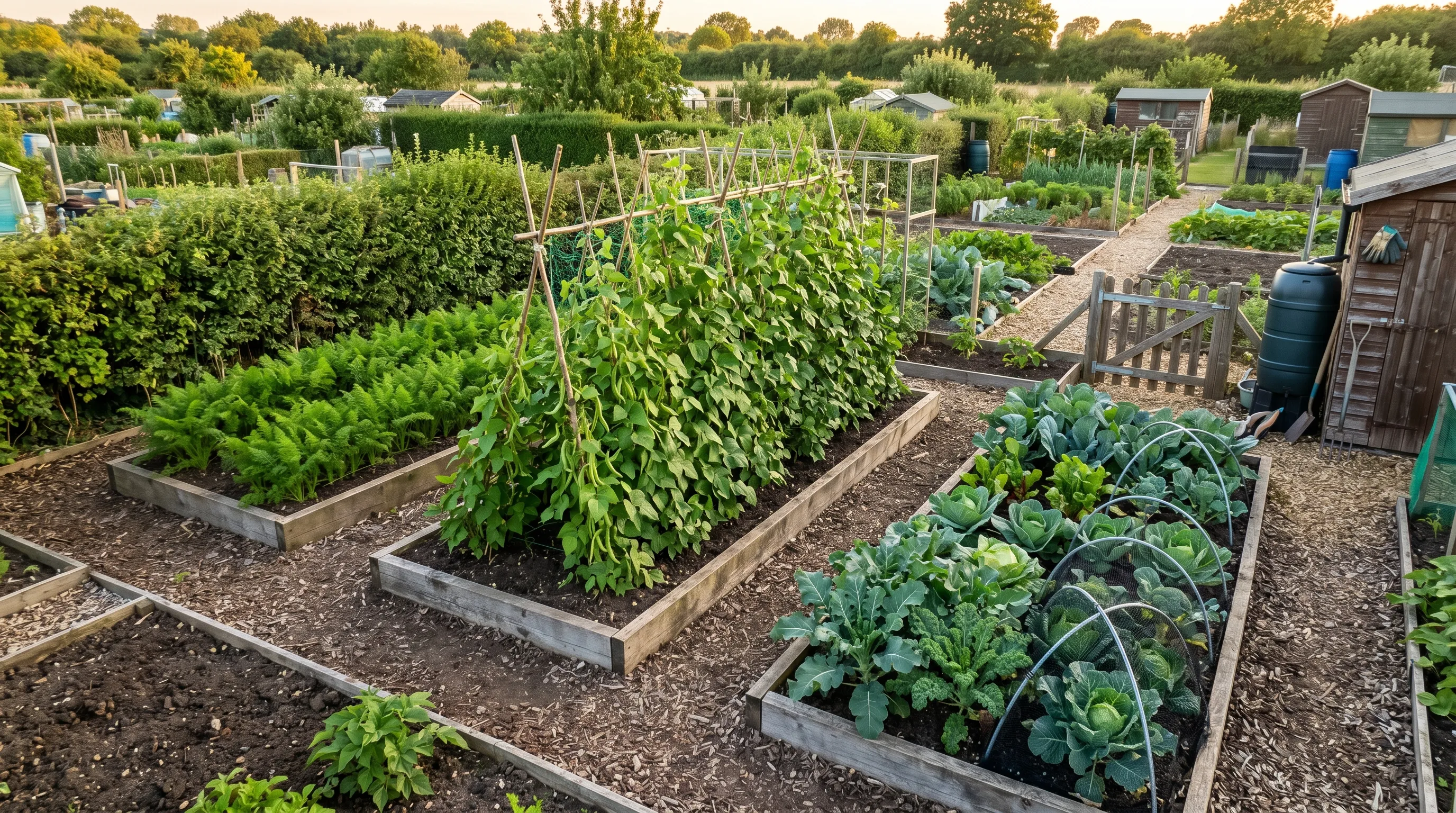 A 3-bed allotment layout for the 3-year rotation. Beds are 1.2m wide with 60cm paths between. Permanent timber or stone edges mean the beds stay in the same place. Only the crops rotate, never the boundaries.
When to Apply Lime, Manure and Compost
Lime, manure and compost each go on different beds at different times. The rules:
Lime: brassica bed only, 8-12 weeks before planting.
- Apply 200-300g per m² of ground limestone on UK clay
- 100-200g per m² on loam
- 50-100g per m² on sand
- Apply in autumn before the brassica year so winter rain incorporates it
- Never mix with manure (the ammonia reaction loses 30-50% of the nitrogen)
For the full lime application guide, our dedicated article covers ground limestone vs dolomite vs hydrated lime and the rate by UK soil type.
Manure: legume bed only, autumn before planting.
- Apply 4-6 kg per m² of well-rotted horse or cow manure
- Spread on the surface in October-November
- Let winter rain wash nutrients into the rootzone
- The nitrogen-rich legume crop builds on this and adds more nitrogen via root nodules
For the comparison of UK garden manures, our manure guide covers horse, cow, chicken, pig and sheep options.
Compost: all three beds, every year.
- Apply 25-50mm of well-rotted compost as a surface mulch in March-April
- Pull back to plant seeds and seedlings, then push the mulch back around the plants
- Compost is the routine soil-builder, separate from the lime and manure rotations
The lime, manure and compost schedule together rebuilds 0.1-0.2% organic matter per year and holds soil at pH 6.2-6.8, the optimal range for most UK vegetable crops.
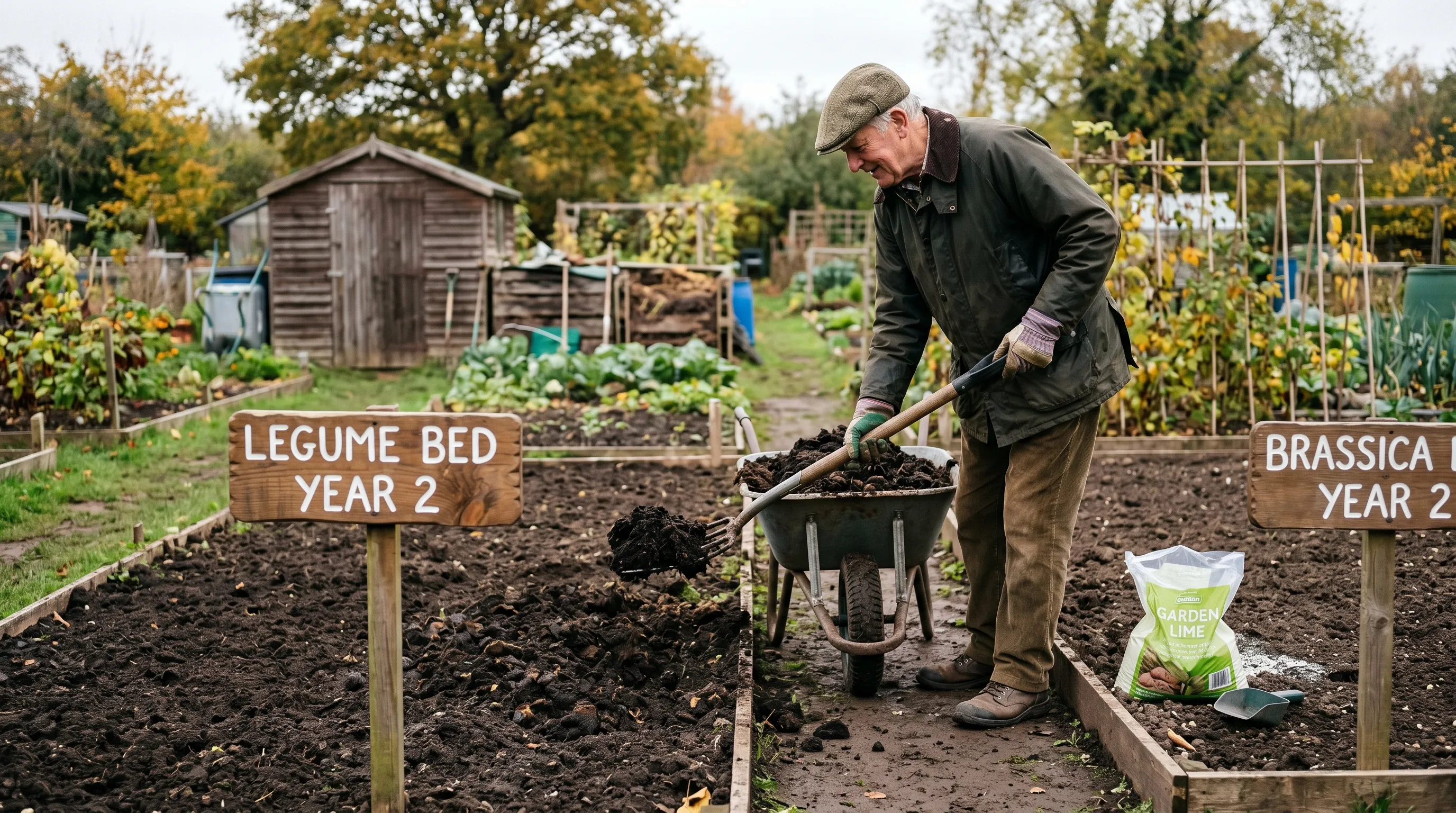 Autumn application split: manure (4-6kg per m²) goes on next year’s legume bed; lime goes on next year’s brassica bed; compost mulches all three. Never mix lime and manure on the same bed within 12 weeks.
Where Potatoes Fit (Or Do Not Fit)
Potatoes are the biggest practical problem with a 3-year rotation. Three options:
Option 1: Separate potato patch. Grow potatoes on a 4th bed outside the cycle. Practical for plots 100-200m² where 25-40m² can be dedicated to spuds. Move the potato patch 1-2 metres each year to spread the disease pressure. Simplest scheme but adds half a bed of work.
Option 2: Add potatoes to the root year. Potatoes share the root year with carrots and beetroot. Practical for small plots. Drawback: potato scab is suppressed by acid soil (pH 5.5-6.0), but the carrots in the same bed prefer slightly higher pH. Compromise pH at 5.8 and accept some scab.
Option 3: Step up to the 4-year rotation. Potatoes get their own bed in the cycle. Best for plots over 200m². Read our 4-year crop rotation plan guide for the full scheme.
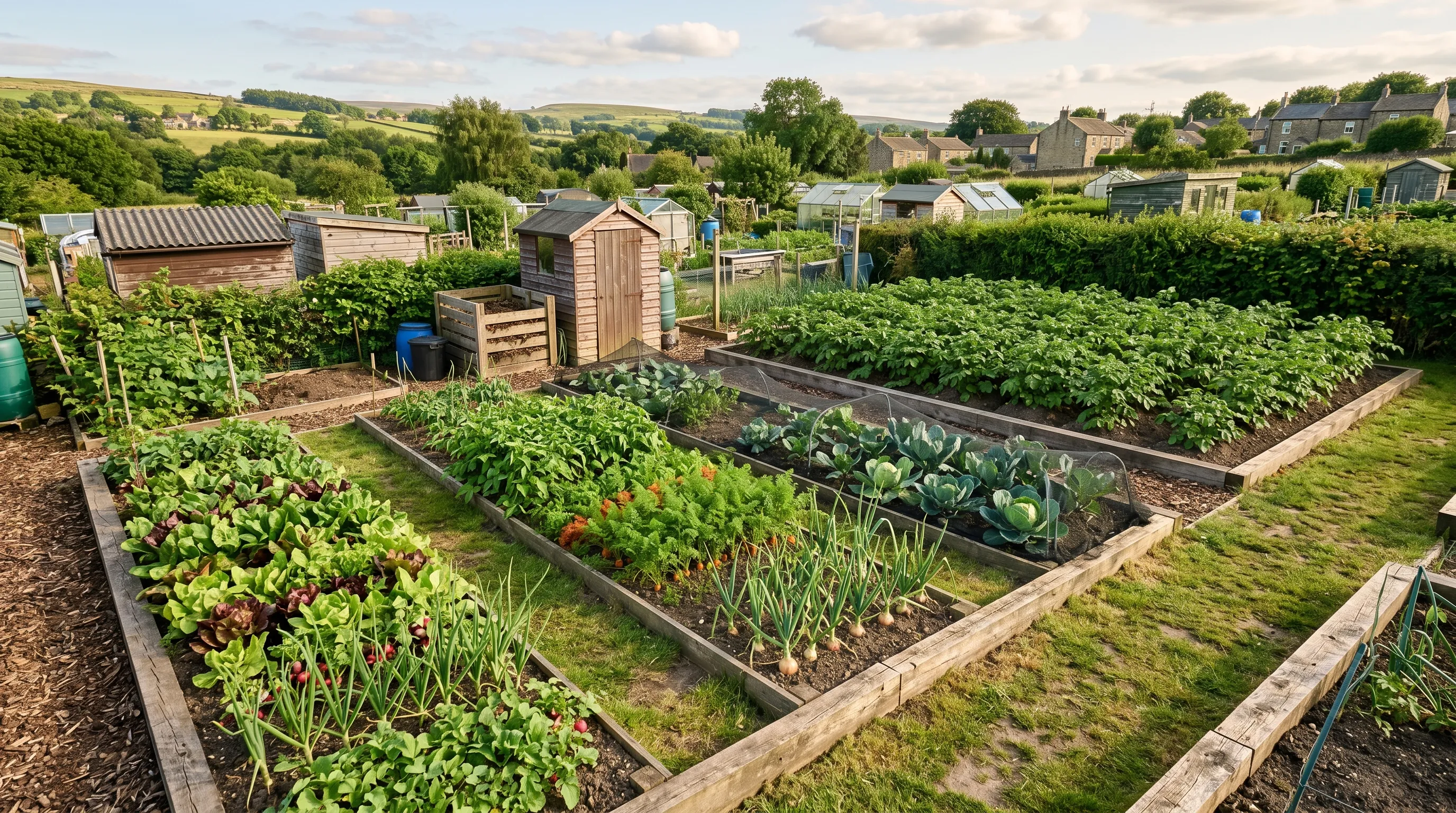
Crops by Plant Family for Rotation Planning
Each year you need to know which crop sits in which group. The full classification for UK garden crops:
Legume family (Fabaceae):
- Broad beans, French beans, runner beans, lima beans, mangetout, sugar snap peas, garden peas
- Plus less common: chickpeas, lentils, lupins (for green manure)
Brassica family (Brassicaceae):
- Cabbage, broccoli, calabrese, cauliflower, kale, Brussels sprouts
- Swede, turnip, radish, mustard
- Plus less common: kohlrabi, Chinese cabbage, mizuna, pak choi
Root and allium crops (multiple families):
- Carrots, parsnips, beetroot, salsify, scorzonera (Apiaceae and Chenopodiaceae)
- Onions, leeks, garlic, shallots, spring onions, chives (Alliaceae)
For the full plant family breakdown for rotation planning, our dedicated article shows the botanical groupings that drive the rotation logic.
Crops that fit any bed in a 3-year rotation:
- Lettuce, spinach, chard, rocket, salad leaves
- Courgettes, marrows, pumpkins, squash, cucumbers
- Sweetcorn
- Herbs (mint, parsley, basil, thyme, chives)
These crops can fill gaps in any of the three beds without disrupting the rotation logic. Use them as catch crops between main rotation crops.
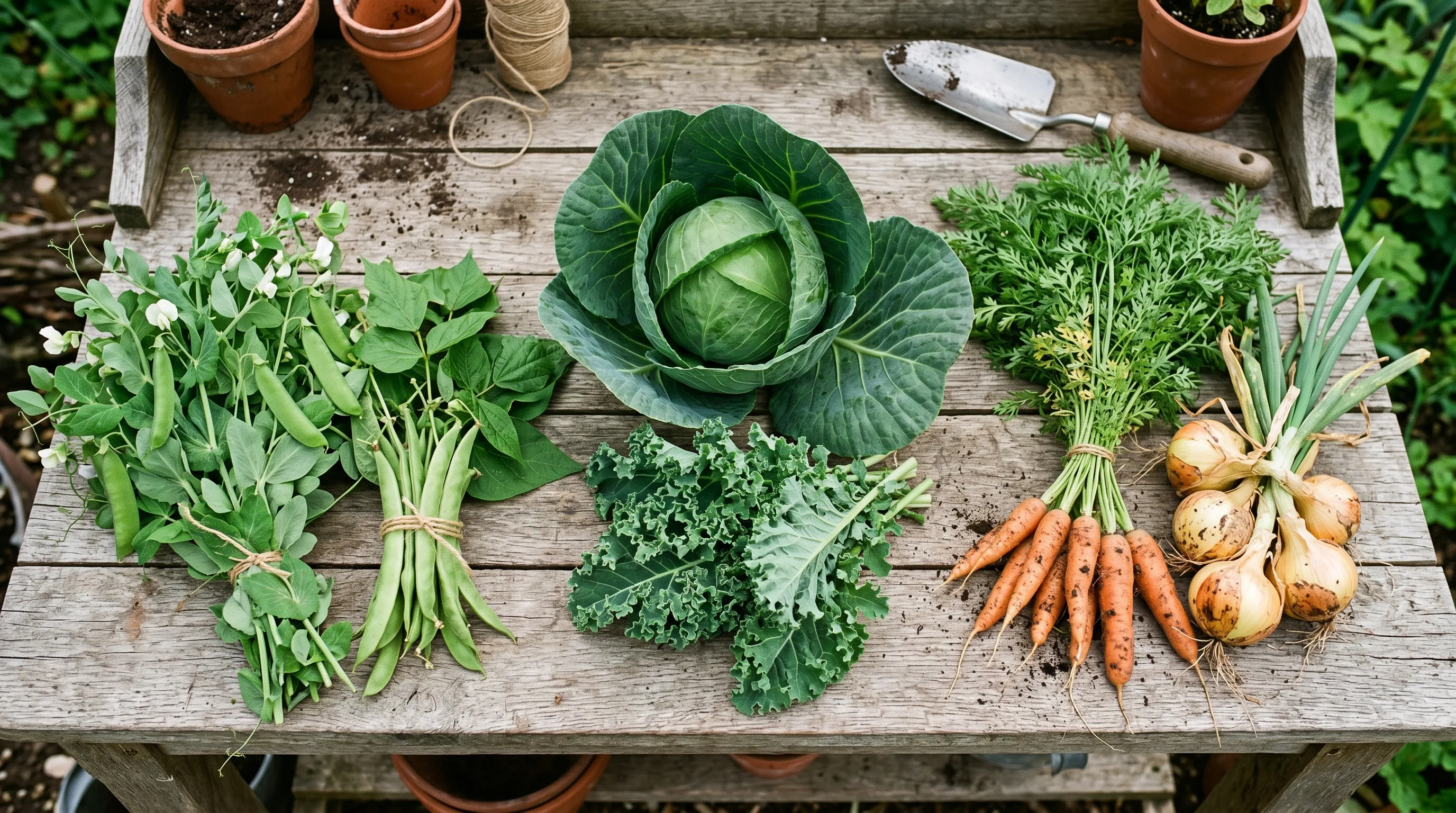 The three rotation plant families. Legumes (left) fix nitrogen. Brassicas (centre) use that nitrogen heavily. Root crops (right) follow on leaner soil and develop better storage quality.
How 3-Year Rotation Compares With 4-Year and No Rotation
The 3-year cycle delivers 90-95% of the disease suppression of the 4-year cycle on plots without heavy disease history. On plots with chronic club root or potato eelworm, step up to the 4-year cycle or longer.
For UK first-time allotment holders, a 3-year rotation plus a separate potato patch is the right starting point. After 3-5 years, expand to a 4-year cycle if the plot allows.
How to Set Up Your First 3-Year Rotation
A practical 5-step start.
Step 1: Measure and mark the beds. Divide the plot into three equal beds with permanent edges. Timber boards, brick edging, or trimmed-in turf all work. Mark each bed with a labelled stake at the corner: “A”, “B”, “C”.
Step 2: Test soil pH. Use a £6-£12 chemical test kit. Target pH 6.5 for the bed about to grow brassicas. Add lime now if needed.
Step 3: Test soil texture. Squeeze a damp ball of soil. If it crumbles, it is sandy. If it forms a ribbon, it is clay. This affects lime and manure rates.
Step 4: Plan the first year. Pick which bed starts as legumes, brassicas and roots. Many UK growers start the cleanest, best-prepared bed as brassicas and rotate clockwise.
The first cycle takes 3 years to complete. The second cycle then settles into routine maintenance.
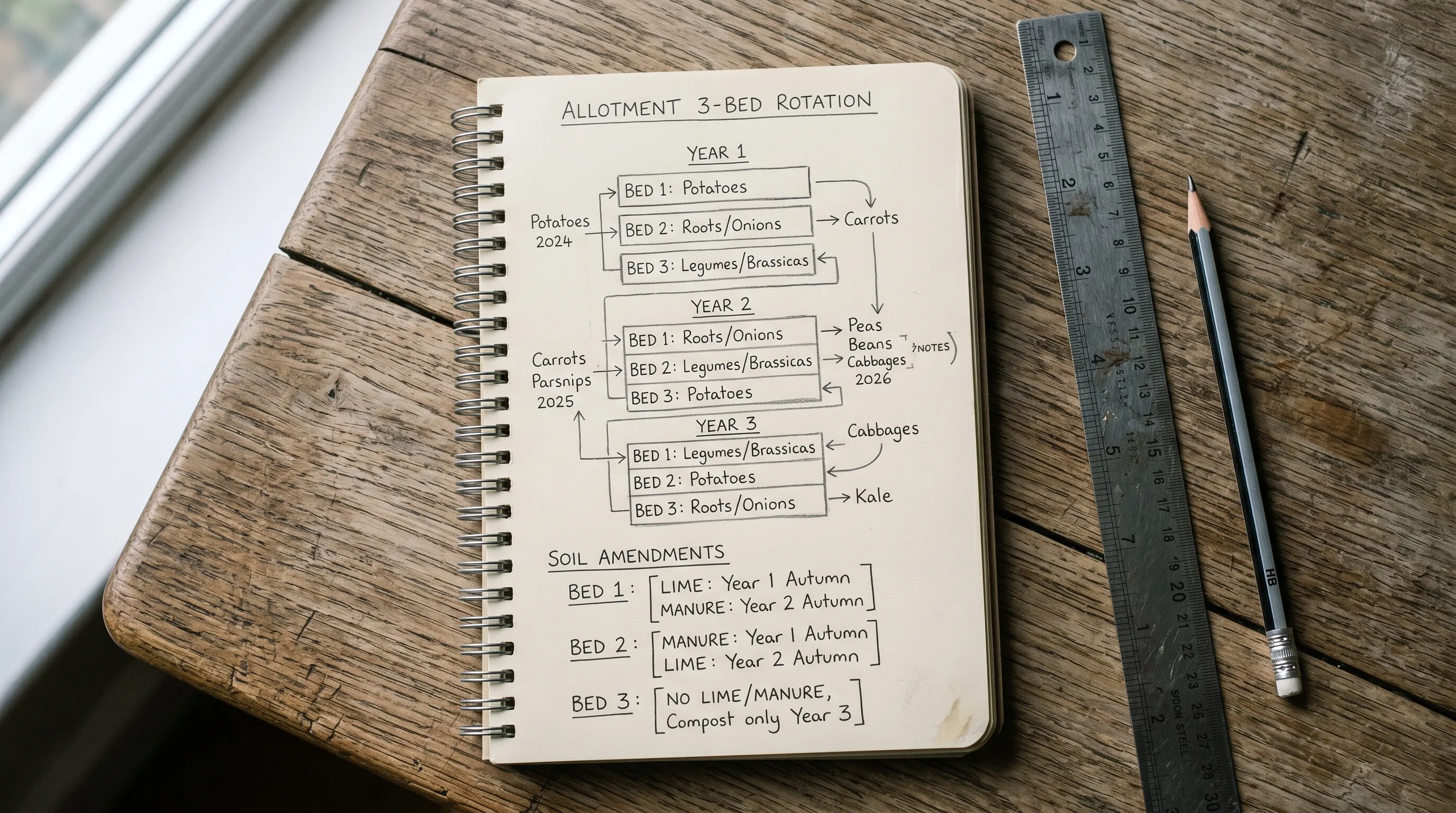 A working rotation plan in a UK allotment diary. Each bed and year listed with what grew, what was added, and what yielded. The notebook becomes more valuable than any single growing season.
Common Mistakes With 3-Year Rotation
Mistake 1: liming the legume bed. Legumes fix their own nitrogen via root nodules. Lime makes them grow lush and disease-prone with poor pod set. Save the lime for the brassica bed.
Mistake 2: applying manure to root crops. Fresh or recent manure causes carrots to fork, parsnips to split, and onions to bolt. Apply manure to the legume bed; let the residual feed the next two crops.
Mistake 3: moving the bed boundaries each year. The rotation is about crops moving between fixed beds, not beds moving across the plot. Mark permanent edges and only rotate what grows.
Mistake 4: ignoring the potato problem. Potatoes do not fit cleanly into a 3-year cycle. Plan a dedicated potato patch or step up to a 4-year rotation before disease accumulates.
Mistake 5: skipping crop diversity within each bed. A legume bed full of nothing but peas is more vulnerable to pea moth than a bed of peas plus broad beans plus runner beans. Plant 3-5 species per bed each year.
3-Year Rotation Calendar UK Month-by-Month
| Month | Rotation task |
|---|---|
| January | Order seeds based on Year-N bed assignments |
| February | Apply lime to brassica bed if pH below 6.5 |
| March | Sow broad beans and peas in legume bed. Sow brassicas indoors |
| April | Plant onions in root bed. Continue brassica sowing |
| May | Plant out brassicas and beans. Sow carrots and beetroot |
| June | Plant out runner beans and French beans. Monitor for pests |
| July | Harvest peas and broad beans. Plant late brassicas |
| August | Harvest summer beans and early roots. Plant overwintering onions |
| September | Lift onions, garlic. Plant overwintering broad beans |
| October | Apply manure to next year’s legume bed. Harvest squash, pumpkin |
| November | Apply lime to next year’s brassica bed. Last brassica harvests |
| December | Plan next year’s rotation. Order spring seeds |
The October-November application window is the cornerstone of the rotation calendar. Lime on next year’s brassica bed; manure on next year’s legume bed; rotation diary updated for the year just finished.
Frequently asked questions
How does a 3-year crop rotation work in a UK garden?
Divide the plot into 3 equal beds. Each year, one bed grows legumes (beans and peas), one grows brassicas (cabbage, kale, sprouts), and one grows root crops (carrots, beetroot, onions). Each autumn, move all crops one bed clockwise. The cycle repeats every 3 years.
Where do potatoes fit in a 3-year rotation?
Potatoes do not fit a strict 3-year rotation. Either grow them on a separate fourth bed outside the cycle, or use the 4-year rotation that gives potatoes their own slot. UK gardeners with small plots often use a 3-year rotation plus a dedicated potato patch.
When do you lime in a 3-year rotation?
Lime the brassica bed only, applied 8-12 weeks before brassica planting. Liming the legume bed loses nitrogen. Liming the root bed causes potato scab even though potatoes are not in this rotation. Lime once every 3 years on each bed during its brassica year.
Where do you put manure in a 3-year rotation?
Manure the legume bed in autumn before peas and beans go in. Never mix lime and manure on the same bed within 12 weeks. Manure builds the soil for the heavy-feeding brassicas that follow next year, and the residual feeds the root crops the year after.
Is a 3-year rotation enough to prevent club root?
It helps but is not enough on infected plots. Brassica diseases like club root need 7+ years between crops on heavily infected ground. For plots without serious disease history, the 3-year cycle plus pre-planting lime suppresses club root and clubroot below damaging levels.
Now plan the soil-building year alongside the rotation
Our team produces practical UK gardening guidance from source research, contributor records and established horticultural practice. Editorial standards are overseen by Matt W.