Key takeaways
- A TPO makes it a criminal offence to fell, top, lop, uproot or damage a protected tree without council consent
- Applying to your local planning authority for consent is free; they must decide within 8 weeks
- Destroying a protected tree can cost up to £20,000 in a magistrates' court and an unlimited fine in the Crown Court
- Dead trees are exempt but you must give the council 5 working days' notice before work starts
- In a conservation area any tree over 75mm across at 1.5m needs 6 weeks' written notice, even without a TPO
- Remove a protected tree and you have a legal duty to plant a replacement in the same place
A Tree Preservation Order is one of the few pieces of garden law that can land a homeowner with a five-figure fine. Yet most people only discover a TPO exists after they have booked a tree surgeon. This guide explains what a Tree Preservation Order protects, how to check whether one covers your tree, and how to get consent from the council without the process dragging on.
The rules apply across England and Wales, with close equivalents in Scotland and Northern Ireland. They are drier than most garden topics, but the stakes are high. Get it right and a routine crown reduction is signed off in weeks. Get it wrong and you face prosecution, an unlimited fine and an order to replant.
What a Tree Preservation Order actually protects
A Tree Preservation Order (TPO) is a legal order made by a local planning authority (LPA), usually your district or borough council, under the Town and Country Planning Act 1990. Once an order is in place, it becomes a criminal offence to cut down, top, lop, uproot, wilfully damage or wilfully destroy the tree without the council’s written consent.
A TPO can cover a single tree, several named trees, a whole group, an area, or an entire woodland. The order names each tree and shows it on a map. What it never covers is a hedge; overgrown boundary hedges fall under separate High Hedge rules instead.
The protection is about the tree’s contribution to public amenity, not its rarity. Councils protect trees you can see from a road, path or public space and that add to the character of the area. A common sycamore on a prominent corner is more likely to be protected than a rare specimen hidden in a back garden. Damage counts too: compacting the roots, poisoning the soil, or ring-barking a protected tree are all offences, not just felling it.
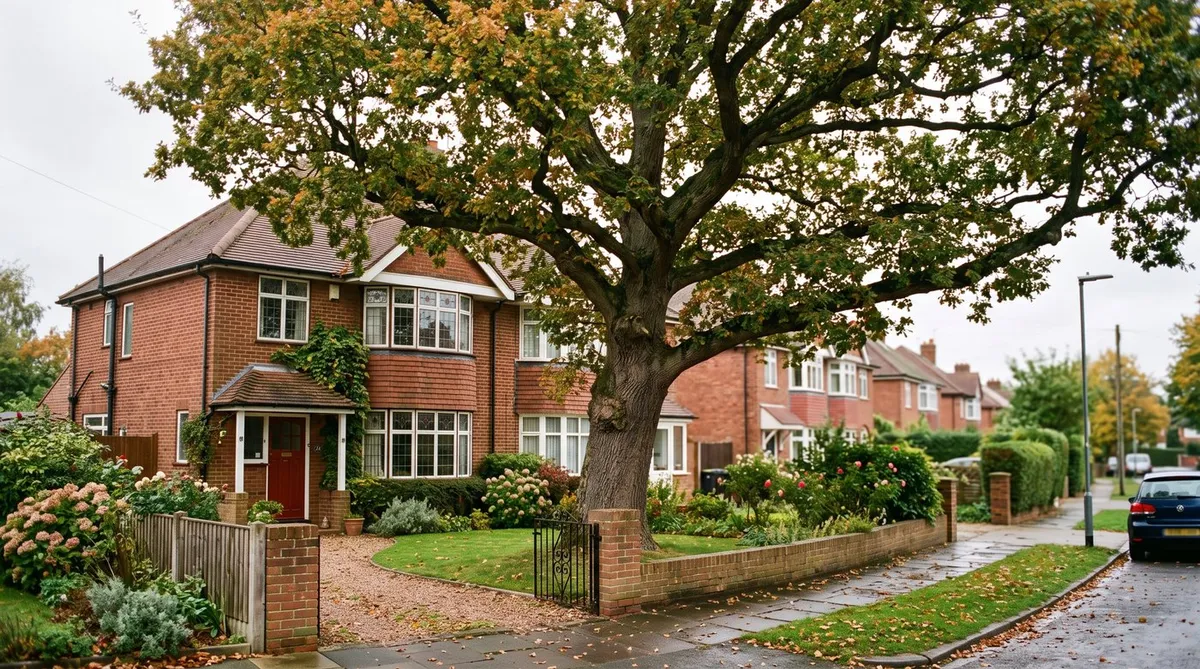
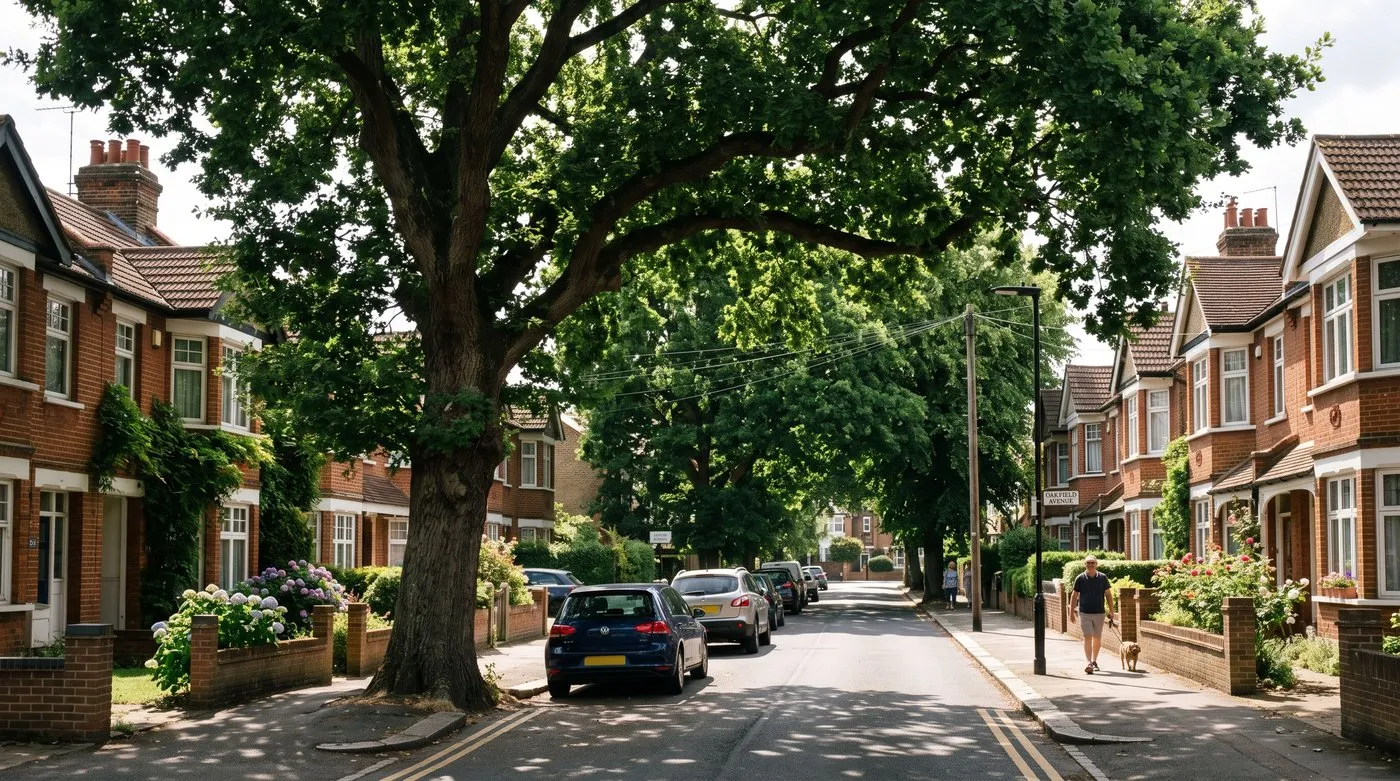 Councils protect trees that add to public amenity, like this street-facing oak. Visibility from a road or path matters more than the species.
How to check whether your tree has a TPO
Never assume a tree is unprotected because it looks ordinary or because you planted it yourself. Checking takes one email and can save you a prosecution.
Start with your local planning authority. Most councils publish a TPO map or register on their website; search the site for “tree preservation order” or “protected trees”. If you cannot find it, send the property address, a location plan and a photo to the council’s tree officer and ask directly. They answer these queries routinely and usually for free.
When you buy a house, a TPO shows up on the local land charges search (the LLC1 form) your solicitor runs. If you have moved recently, dig out the conveyancing pack before you assume anything. Two protections can also apply without a specific order: trees in a conservation area and trees covered by a planning condition on a newer estate. Both are covered below.
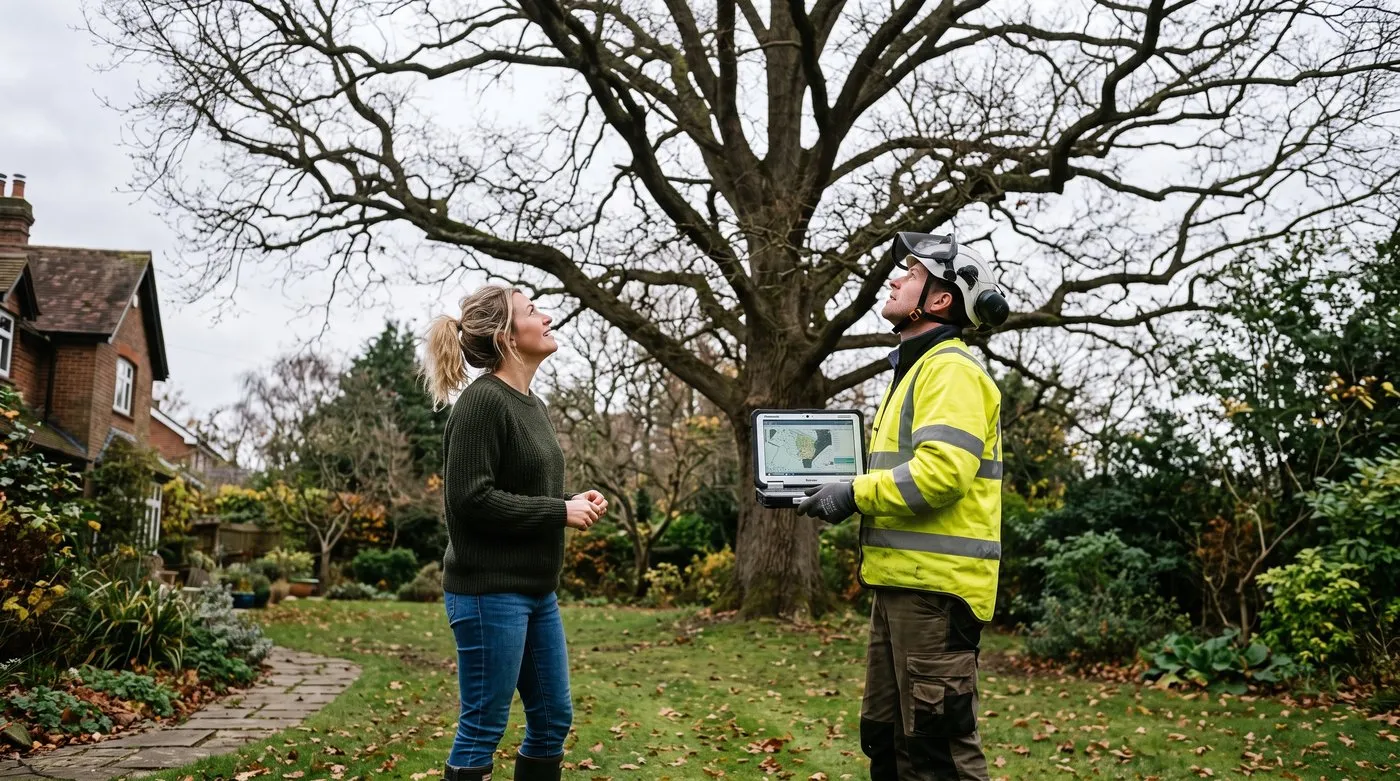 Check the tree’s status with the council before any assessment on the ground. A tree officer will confirm in writing whether a TPO applies.
What you can and cannot do to a protected tree
The table sets out the common jobs homeowners want to do and where each one stands. The rule of thumb is simple: if the work removes or damages living wood, assume you need consent.
| Job | Allowed without consent? | What you must do first |
|---|---|---|
| Fell the whole tree | No | Apply for consent (8 weeks); replant afterwards |
| Crown reduction or thinning | No | Apply for consent with a works specification |
| Crown lifting (raising low branches) | No | Apply for consent |
| Removing genuinely dead branches | Yes | Keep evidence; no notice needed for deadwood only |
| Felling a dead tree | Exempt | Give 5 working days’ written notice first |
| Cutting a branch causing imminent danger | Exempt | Act, then tell the council as soon as possible with proof |
| Pruning to clear your house or gutters | No | Apply for consent; minor clearance still needs it |
| Digging, paving or building near the roots | No | Apply; root damage counts as destroying the tree |
Anything in the “No” rows without consent is an offence, even if the cut looks trivial. Topping a protected tree by a metre because it blocks a satellite dish is exactly the kind of unauthorised work councils prosecute. When light or views are the issue, our guide to pruning trees for privacy and light in the UK explains what you can and cannot realistically achieve within the law.
Applying to the council for consent
Getting consent is free and more straightforward than most people expect. The work is in describing exactly what you want done and why. A vague “reduce the tree” invites a refusal or a request for more detail; a precise specification gets a clean yes.
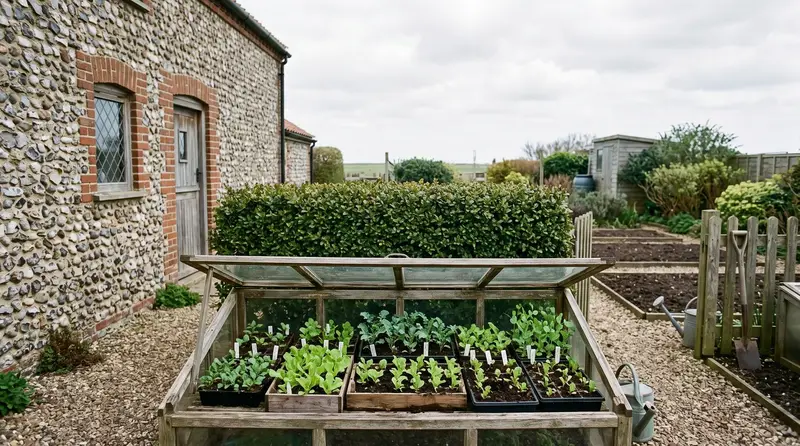
 A tree works consent application is free and filed online. A clear specification and a few photos are what get it approved.
The council has a statutory 8 weeks to decide from the date it validates your application. If it fails to respond in time, you have a right of appeal to the Planning Inspectorate, though a polite chase usually works faster. If consent is refused or granted with conditions you dislike, you can appeal within 28 days.
Warning: A quote from a tree surgeon is not permission. Some firms offer to “handle the paperwork” and then never file it. The legal duty sits with you, the tree owner, so confirm the consent reference in writing before any saw touches the tree.
The exemptions: dead, dangerous and the notice rules
The law recognises that some trees must be dealt with quickly, so a short list of works is exempt from the full consent process. These exemptions are narrower than people think, and misusing them is the most common way homeowners end up prosecuted.
A dead tree is exempt from consent, but under the 2012 regulations you must give the council 5 working days’ written notice before starting, except in an emergency. A tree that is merely dying or in poor health is no longer exempt; that category was removed. An imminently dangerous tree can be dealt with straight away, but you must be able to prove the danger was real and immediate, so take dated photographs before and after.
Cutting deadwood out of an otherwise healthy protected tree needs no notice. So do certain works by statutory bodies and some fruit-tree pruning carried out in the course of a business. Everything else needs consent. If you are unsure whether a tree is dead or simply stressed, our guide to sudden tree death in the UK helps you tell the difference before you rely on an exemption.
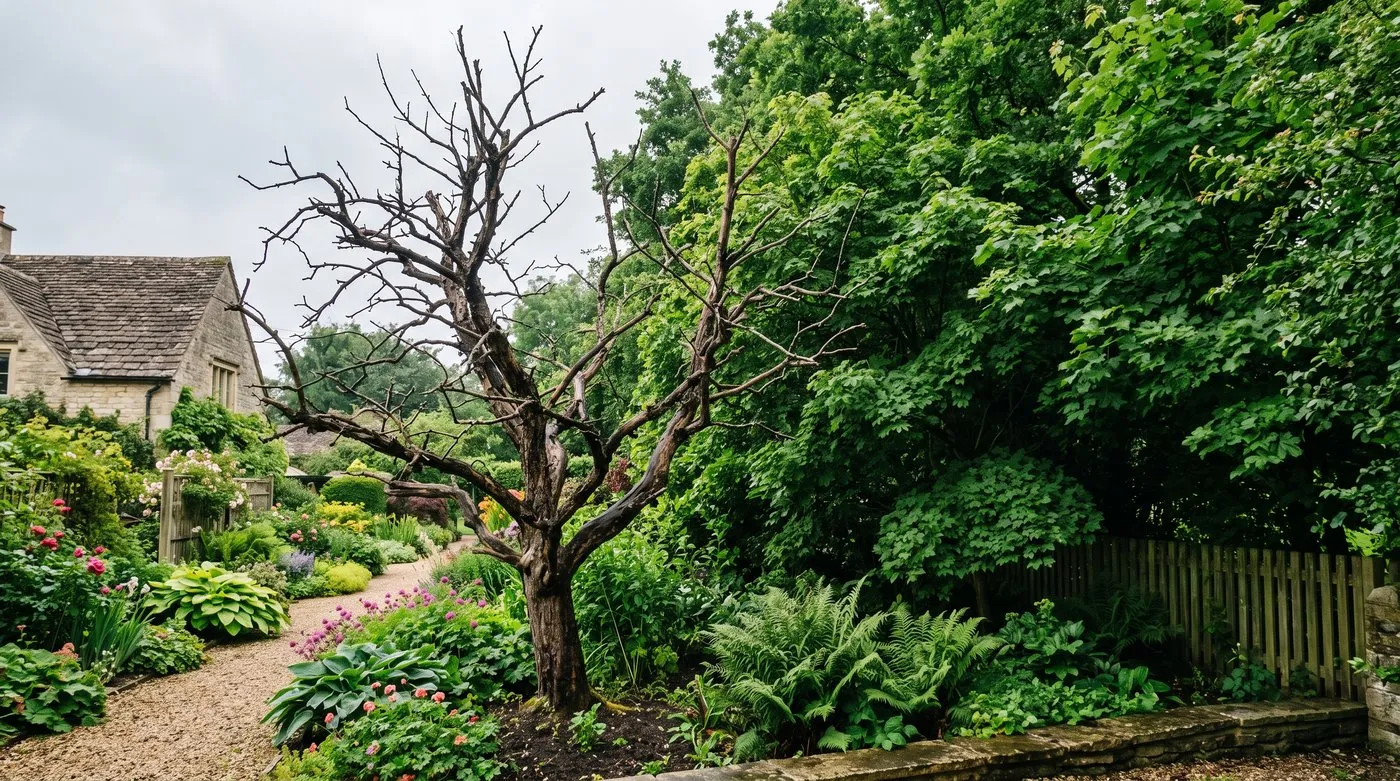 Only a genuinely dead tree qualifies for the exemption, and it still needs 5 working days’ notice. A stressed but living tree needs full consent.
Trees in a conservation area
You do not need a specific TPO for a tree to be protected. If you live in a conservation area, almost every reasonably sized tree is covered automatically. The threshold is a trunk diameter over 75mm, measured 1.5m above the ground. For stems you plan to thin, the figure rises to 100mm.
Before doing any work on such a tree you must give the council 6 weeks’ written notice. That window lets the tree officer inspect it and, if they think it worth keeping, slap a full TPO on it before you start. If they raise no objection within 6 weeks, you may carry out the notified work within the next two years.
This catches a lot of people. Someone buys a Victorian terrace in a conservation area, tidies up a “scruffy” birch, and finds they have broken the law without a TPO ever existing. If your street has period character and coordinated signage, check your conservation area status first. Many of the best native trees for UK gardens end up protected this way simply because they grow in older, designated neighbourhoods.
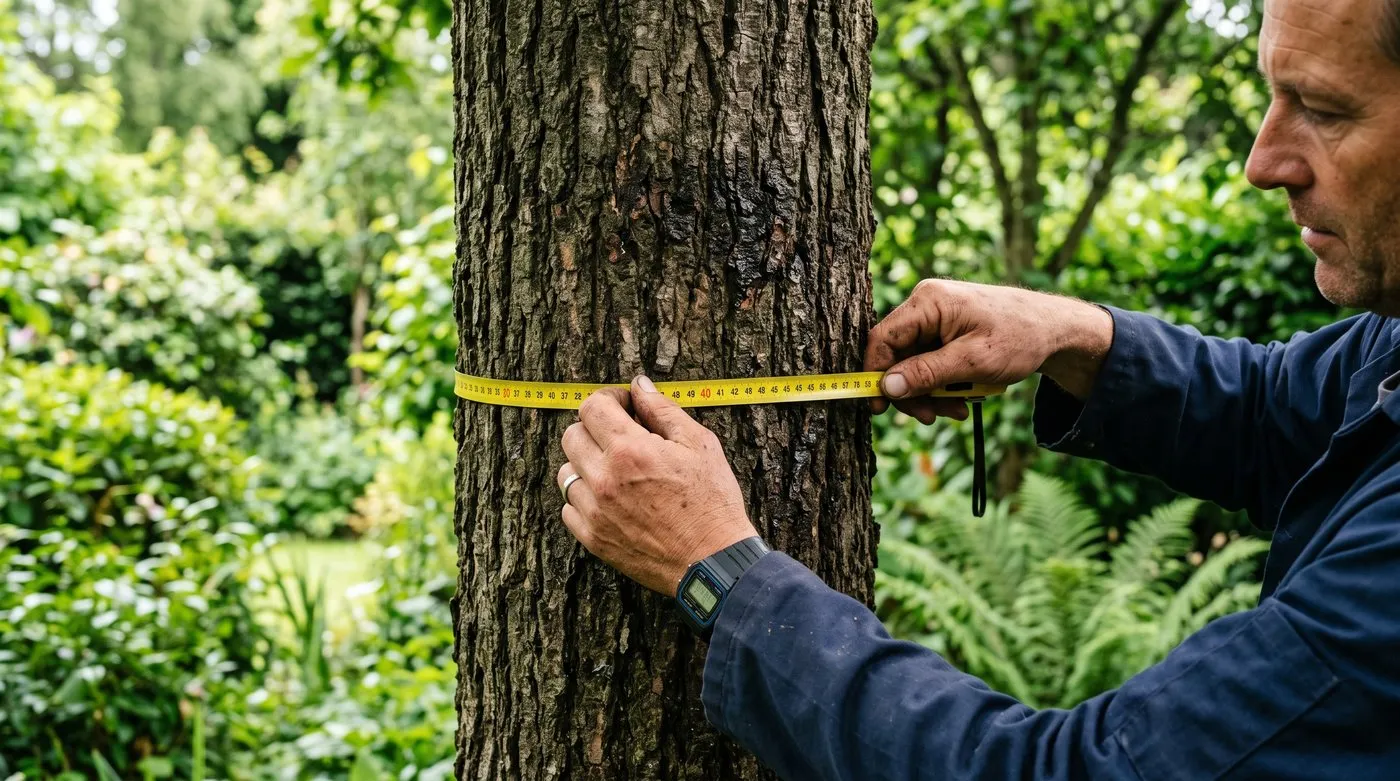 In a conservation area, protection starts at a 75mm trunk measured 1.5m up. Anything larger needs 6 weeks’ notice before work.
Penalties and fines for breaking a TPO
The penalties are what make TPOs matter. They are set deliberately high because a felled mature tree cannot be put back.
If you cut down, uproot or destroy a protected tree, or damage it so badly it is likely to die, the offence can be tried in a magistrates’ court with a fine of up to £20,000. Serious cases go to the Crown Court, where the fine is unlimited. Crucially, the court is told to have regard to any financial benefit you gained, such as the uplift in a building plot’s value, so the fine can be far larger than a simple penalty.
Lesser breaches, such as unauthorised pruning that does not kill the tree, are dealt with as a separate offence carrying a fine of up to £2,500. Councils do prosecute homeowners, not just developers, and ignorance of the order is not a defence. This is why checking first is not optional.
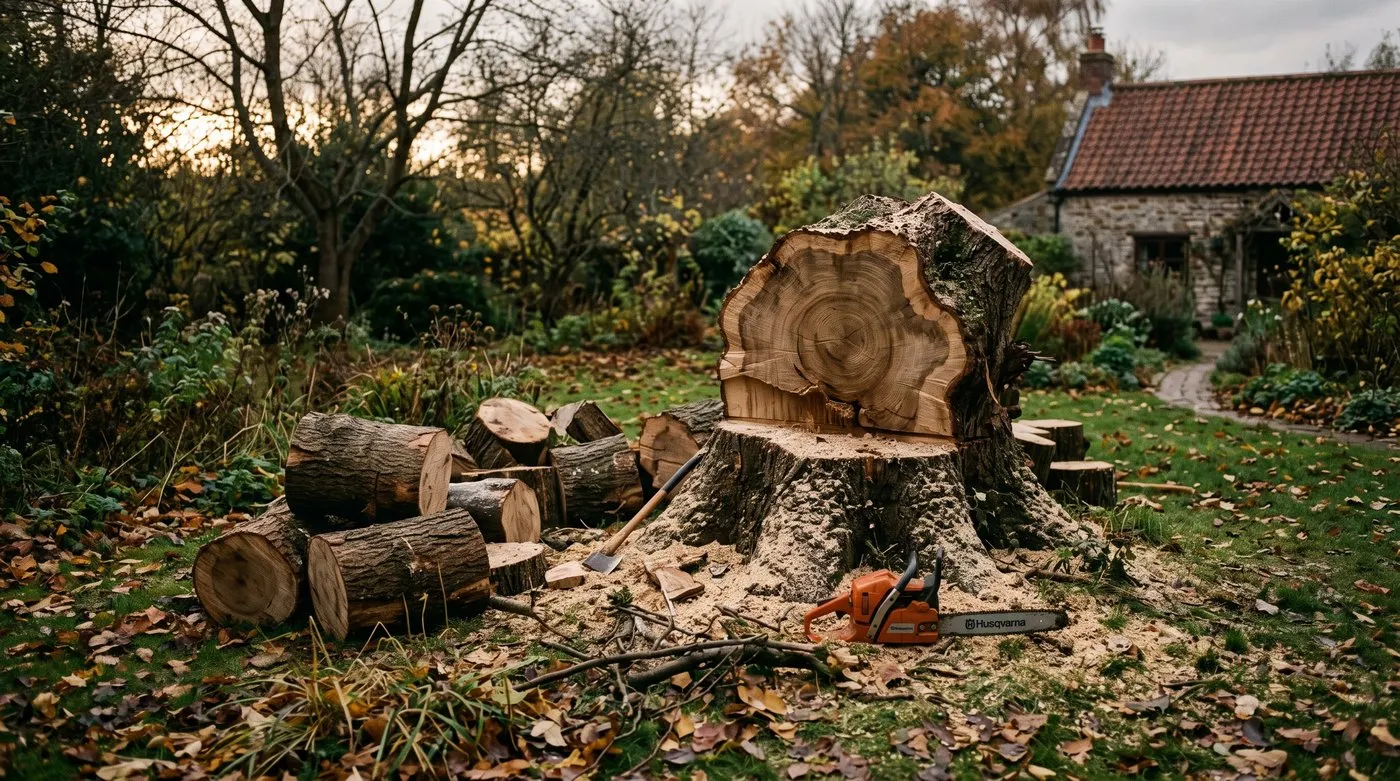 A felled mature tree cannot be replaced for decades, which is why the fines run to five figures. Councils prosecute homeowners, not just developers.
Your legal duty to replant
Removing a protected tree does not end your obligations; it starts a new one. If a TPO tree is felled or destroyed, even lawfully under an exemption, you have a duty to plant a replacement of an appropriate size in the same place, as soon as reasonably possible. The new tree automatically inherits the same TPO.
If you fail to replant, the council can serve a tree replacement notice compelling you to do it. So the dead-tree exemption is not a loophole for clearing a garden; you take one out and you put one back. Choosing the right replacement for a smaller modern plot matters here, and our roundup of the best trees for small gardens in the UK covers species that satisfy a replanting condition without outgrowing the space.
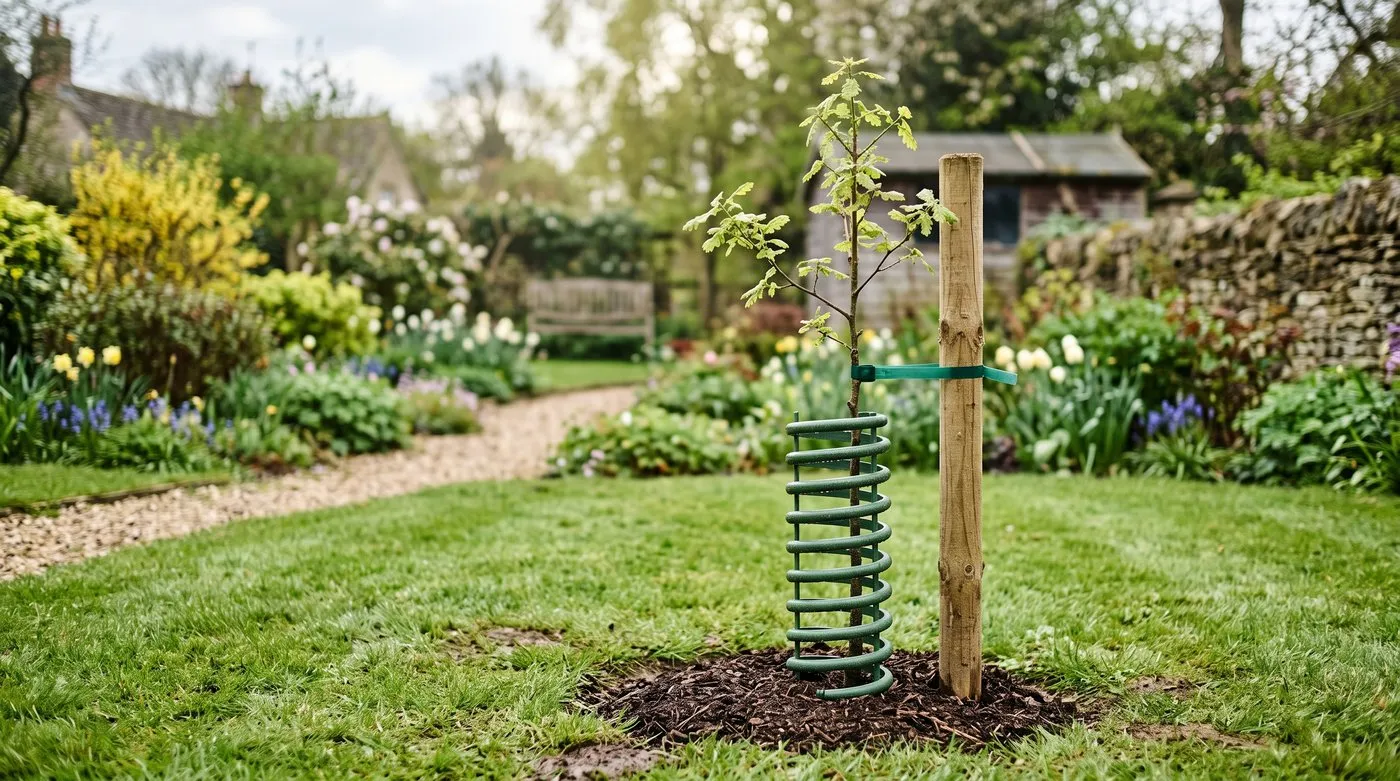 Remove a protected tree and you must plant a replacement in the same spot. The new tree automatically inherits the same TPO.
TPO, conservation area and high hedge rules compared
Three different regimes protect trees and large plants, and people mix them up constantly. This table shows which applies when.
| Protection | What it covers | Notice or consent needed | Key threshold |
|---|---|---|---|
| Tree Preservation Order | Named individual trees, groups, areas, woodland | Written consent, 8 weeks | Any protected tree, any size |
| Conservation area | All qualifying trees in the designated area | 6 weeks’ written notice | Trunk over 75mm at 1.5m |
| High Hedge (ASB Act 2003) | Evergreen hedges over 2m blocking light | Council complaint, not consent | Hedge over 2m, mostly evergreen |
| Planning condition | Trees retained as a condition of development | Discharge the condition first | Set out in the planning permission |
Boundary disputes over an overgrown conifer usually fall under the High Hedge rules, not a TPO. If that is your situation, start with our guide to what to do when a conifer has grown too big in the UK rather than an application to fell.
Common mistakes homeowners make with TPOs
- Assuming no order means no protection. A tree in a conservation area is protected without any TPO at all. Always check your conservation status as well as the TPO register before you cut.
- Trusting the tree surgeon to sort permission. The legal duty sits with the landowner. Get the written consent reference yourself and never take “we’ll deal with it” on trust.
- Treating “dead or dying” as a free pass. Only genuinely dead trees are exempt, and even they need 5 working days’ notice. A stressed but living tree still needs full consent.
- Damaging the roots by accident. Laying a patio, changing levels or compacting soil over the root zone can kill a protected tree, and that is an offence just like felling it.
- Forgetting to replant. Removing a protected tree, even lawfully, triggers a duty to plant a replacement. Skip it and the council can force the issue with a replacement notice.
When larger limbs genuinely need to come off a tree you are allowed to work on, do it correctly; our guide to removing large tree branches in the UK covers safe technique and the three-cut method.
The bigger picture on protected trees
TPOs exist because mature trees do work that no young replacement can match for decades: shade, cooling, drainage, birdsong and street character. The Woodland Trust and the Forestry Commission both stress that a canopy takes 50 years or more to rebuild once lost. That long horizon is exactly why the law leans so hard towards keeping trees standing.
For a homeowner, the practical takeaway is calm and simple. Check first, apply early, describe the work precisely, and replant if you must remove. Handled that way, a TPO is an administrative step of a few weeks, not a barrier. It is only a problem for the people who reach for the chainsaw before they reach for the phone.
Now you know where you stand on protected trees, read our guide to the legal dates for cutting hedges in the UK for the other piece of garden law that trips homeowners up every year.
Frequently asked questions
How do I know if a tree has a Tree Preservation Order?
Ask your local planning authority; most councils hold a TPO register online or by email. Search the council website for “tree preservation order” or “TPO map”, or send the address and a photo to the tree officer. A conveyancing search (the LLC1 form) also reveals any TPO when you buy a property. Never assume a tree is unprotected because it looks ordinary.
Can I be fined for cutting down a protected tree?
Yes. Felling or destroying a TPO tree can bring a fine of up to £20,000 in a magistrates’ court. Serious cases go to the Crown Court, where the fine is unlimited and can reflect the money you saved or gained. Lesser breaches, such as unauthorised pruning that does not destroy the tree, carry a fine of up to £2,500.
Do I need permission to prune a tree with a TPO?
Yes, almost always. Any cutting, topping, lopping or root work on a TPO tree needs written council consent first. Applying is free and takes up to 8 weeks. The only exceptions are dead wood, an imminent danger, or a formal exemption, and even dead trees need 5 working days’ notice before work.
Who is responsible for a tree with a TPO?
The tree owner, usually whoever owns the land it grows on. You inherit that duty when you buy the property, even if a previous owner planted the tree or the TPO predates you. You must keep it safe, apply for consent before works, and replant if it is removed.
Can I remove a TPO tree if it is damaging my house?
Not without evidence and consent, unless it poses an immediate danger. Subsidence or structural damage claims need an engineer’s or arboriculturist’s report submitted with your application. Councils will consider genuine harm, but ‘it drops leaves’ or ‘it blocks light’ is rarely enough to justify felling a protected tree.
Are trees in a conservation area automatically protected?
Yes, in effect. In a conservation area any tree with a trunk over 75mm across, measured 1.5m above the ground, is protected. You must give the council 6 weeks’ written notice before any work, which lets them decide whether to add a full TPO before you start.
Do I have to replace a protected tree that I remove?
Yes. If a TPO tree is felled or destroyed, even lawfully under an exemption, you have a legal duty to plant a replacement of an appropriate size in the same place. The new tree automatically carries the same TPO. The council can serve a tree replacement notice if you fail to replant.
Our team produces practical UK gardening guidance from source research, contributor records and established horticultural practice. Editorial standards are overseen by Matt W.