Key takeaways
- Grass needs about 3 hours of direct sun, or 15,000 lux sustained, to hold a sward
- Only creeping red fescue and Chewings fescue are genuinely shade-tolerant lawn grasses
- Under beech just 2-5% of full sunlight reaches the ground, so no grass will persist
- Perennial ryegrass needs 4+ hours of direct sun despite appearing in most shade mixes
- Raise the mowing height to 50-65mm in shade and cut the nitrogen, do not increase it
Most shade grass seed sold in Britain is sold on a promise it cannot keep. The bag says “thrives in shade”. The mix inside is usually 40 to 60% perennial ryegrass, a species that needs four hours of direct sun to hold a sward. You sow it under a sycamore, it germinates fast, and it is gone by the following August.
How much light grass actually needs
Grass needs roughly 3 hours of direct summer sun, or 4 to 5 hours of good dappled light, to hold a sward long-term. Below about 2 hours, no lawn grass sold in Britain persists for more than a season or two.
Counting hours is crude, because dappled light through a birch is worth far more than the same clock time in the full shadow of a wall. A lux meter costs about £25 and settles the argument in ten minutes. Take readings at noon in June, in the worst spot and on open lawn for comparison.
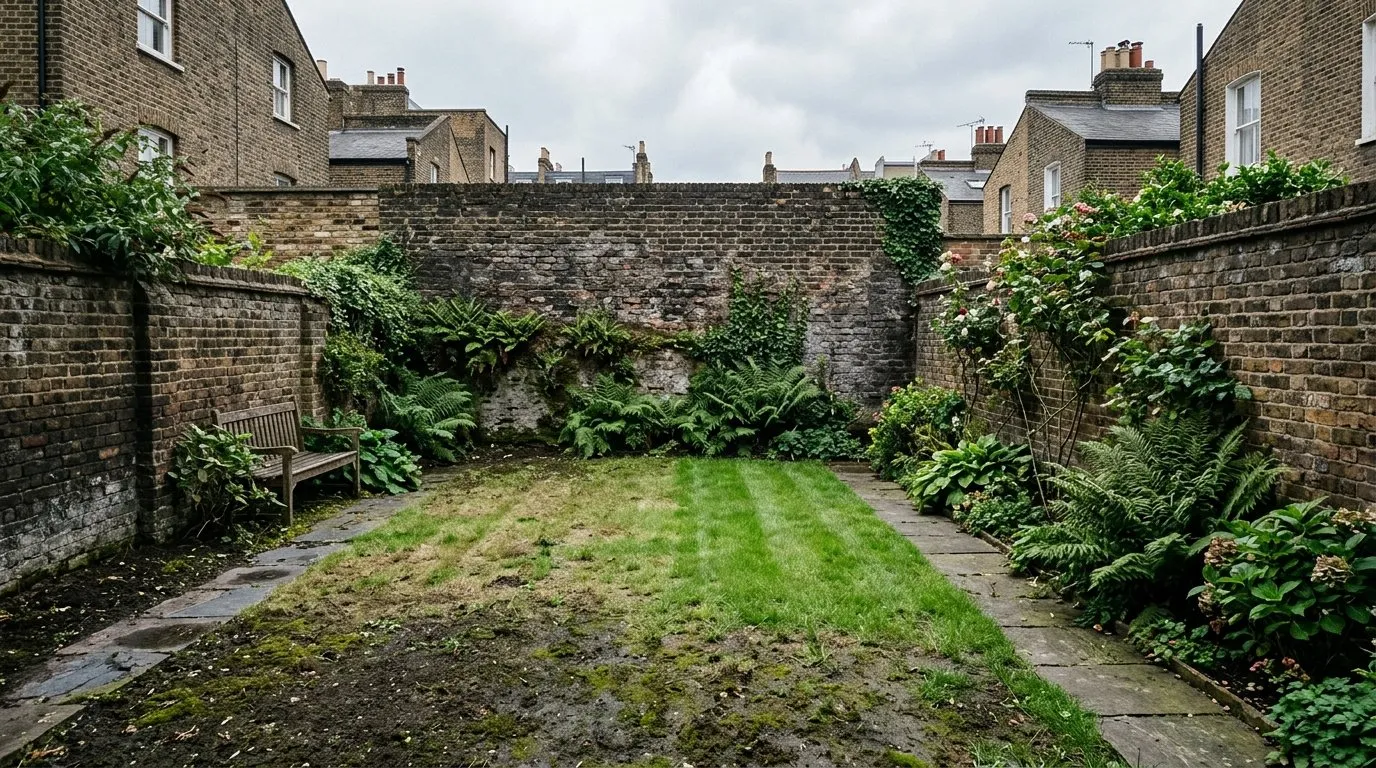 A walled city garden in south London. The strip within 2m of the wall reads under 10,000 lux at midday and has never held grass.
Which grasses genuinely tolerate shade
Four species get sold as shade grass in Britain. Only two of them earn it.
Creeping red fescue is the honest answer
The rhizomes matter more than the shade tolerance. A tufted grass that thins in shade leaves bare soil, and bare soil grows moss. A creeping grass fills sideways from whatever survives.
Chewings fescue for tighter, drier shade
Chewings fescue (Festuca rubra ssp. commutata) is tufted rather than creeping, but tolerates closer mowing and drier ground. It is the fescue of choice where shade meets dry sandy soil. It will not repair gaps the way creeping red fescue does, so sow it as part of a mix rather than alone. Hard fescue (Festuca trachyphylla) is tougher still on dry shade but slow and coarse.
Rough-stalked meadow grass, the specialist with a catch
Rough-stalked meadow grass (Poa trivialis) is the genuine damp-shade specialist, and it will let you down in a dry summer. It tolerates lower light than any fescue, roughly down to 2 hours, and loves moist shaded ground under a north wall.
The catch is honest and important. Poa trivialis is shallow-rooted and weak. It browns off and dies in the first real drought, and on fine turf it is classed as a weed grass. Use it where shade is damp and permanent, such as a north-facing terrace garden that never dries. Do not use it under trees, where the ground is dry, because it is the worst possible choice for competing with tree roots.
What ryegrass cannot do, whatever the bag says
Perennial ryegrass (Lolium perenne) needs 4 or more hours of direct sun and does not belong in a shade mix. It is in most of them anyway, because it is cheap, germinates in 5 to 7 days and makes the bag look like it works. It does work, for about ten months.
Smooth-stalked meadow grass (Poa pratensis) is the same story with slower germination. Both are sun grasses. Read the back of the bag and count the percentages before you buy.
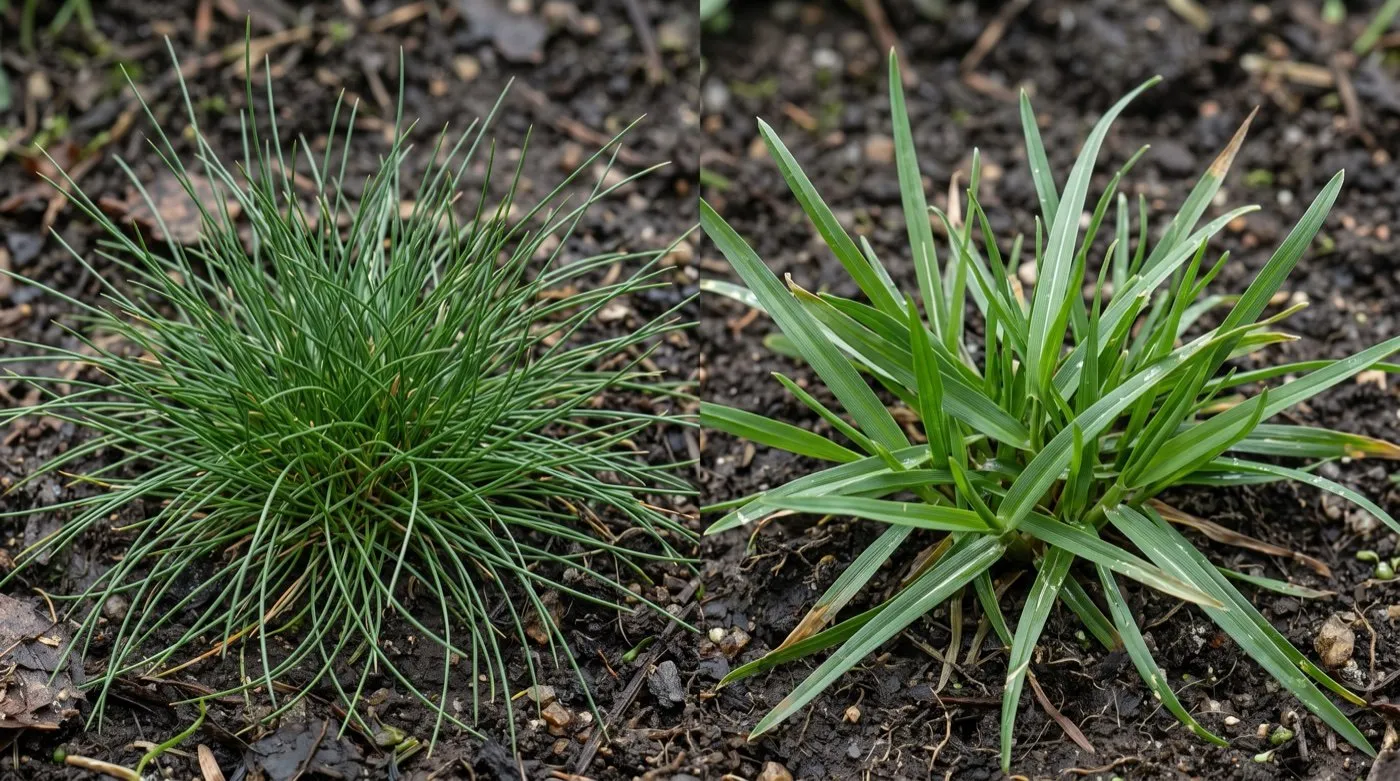 Left, the 1mm needle leaf of creeping red fescue. Right, the 4mm glossy blade of perennial ryegrass with its raised midrib. Only one of these tolerates shade.
Shade grass species compared
Ranked by how much shade each genuinely tolerates, with the honest limitation on each.
| Species | Min. light | Shade tolerance | What it CANNOT do | Role |
|---|---|---|---|---|
| Creeping red fescue | ~15,000 lux, 3h | High, ~60% cover | Cannot survive dry shade under beech or sycamore | Primary, the gold standard |
| Chewings fescue | ~18,000 lux, 3h | High on dry soil | Cannot repair gaps; no rhizomes | Primary, blend with creeping red |
| Hard fescue | ~18,000 lux, 3h | Moderate-high, dry | Cannot give a fine finish; coarse and slow | Supplementary, dry banks |
| Rough-stalked meadow grass | ~10,000 lux, 2h | Highest, damp only | Dies in the first drought; a weed on fine turf | Conditional, damp shade only |
| Supina bluegrass | ~12,000 lux, 2h | Very high | Costs £40-£70 per kg; hard to source in the UK | Niche, high-value small areas |
| Smooth-stalked meadow grass | ~40,000 lux, 4h | Low | Nothing useful in real shade | Not for shade |
| Perennial ryegrass | ~45,000 lux, 4h | Very low | Cannot persist below 4h sun, whatever the bag claims | Not for shade, despite marketing |
The gold standard for UK shade is a mix of 70% creeping red fescue and Chewings fescue, sown at 35g per square metre in early autumn. Our guide on how to sow grass seed covers the timing and ground prep that decide whether it takes.
Note that every row has a “cannot”. No seed on the market makes a lawn under a beech. The mix only decides how well you do within the light you have.
Why shade lawns really fail
Here is the part the seed bags never mention. Most shade lawns die of thirst, not darkness.
A mature sycamore moves several hundred litres of water a day in summer, and it does it through a dense mat of shallow roots in the top 300mm of soil. That is exactly where grass roots live. The tree wins every time, because it has 30 years of root mass and the grass has one season.
Low light makes the loss certain. Grass in shade puts 30 to 50% less mass into its roots than the same grass in sun, because it spends its limited energy on leaf instead. So the shaded grass arrives at the water contest already crippled, against an opponent that is bigger and deeper.
This is why “dry shade” is a category of its own, and why it is so much harder than plain shade. A north-facing wall gives you shade with normal soil moisture, and fescue copes. A sycamore gives you shade and a soil that a tree has already drained. Nothing copes.
The practical test is simple. Dig 150mm down in the problem area in July. If the soil is dust dry while the open lawn is merely dry, you have root competition, and no seed choice will fix it.
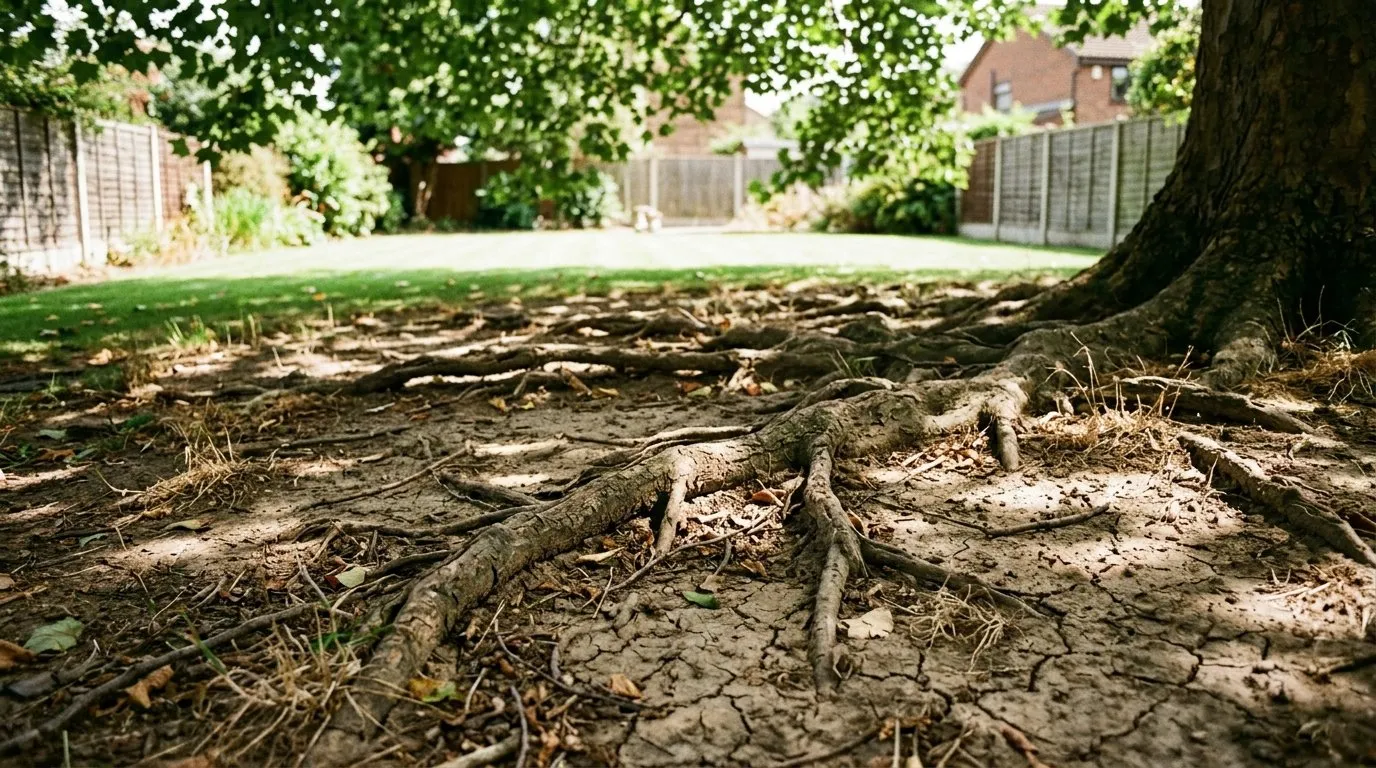 Dry shade under a mature tree. Exposed surface roots and dust-dry soil in July. This is a water contest, and grass does not win it.
Dry shade under beech is unwinnable, and that is fine
Tree species decides your chances far more than seed choice does. Canopies differ enormously in how much light they pass.
Beech combines the densest canopy in Britain with shallow, greedy roots and a slowly acidifying leaf litter. It is the single hardest place in a garden to grow anything, and a lawn is not on the list. The Woodland Trust notes that mature beech woodland floors are famously bare for exactly this reason. Your garden is not different.
Accepting this early is worth real money. Two failed overseedings under a beech cost roughly £25 in seed and two autumns. Recognising it after the first attempt saves the second.
How grass responds to low light, stage by stage
Understanding the sequence explains why shade lawns fail slowly, and why people misread the cause.
- Days 1-14. Leaves elongate and thin. The plant stretches towards light and packs more chlorophyll into less tissue. The lawn looks lush and slightly darker. This fools people into thinking it is thriving.
- Days 14-30. Tillering stops. This is the critical stage. Grass thickens a sward by producing side shoots called tillers, and in low light it stops. The lawn cannot thicken, only stretch.
- Days 30-60. Root mass falls 30 to 50%. Carbohydrate reserves in the crown drop. The plant is now living hand to mouth on each day’s photosynthesis.
- Days 60-90. With no reserves, any stress kills. Drought, wear, frost or disease that a sun lawn shrugs off removes shaded plants permanently.
- Month 4 onward. Gaps appear where plants died and no tiller filled in. Bare soil at low light is perfect moss ground.
- Month 8-14. Moss takes over. Moss has no roots to speak of, needs no water contest, and photosynthesises at light levels that starve grass.
The critical mistake follows directly from stage 6. People treat the moss and never touch the cause. Moss killer clears it, the ground is bare again, and the moss returns within one season, because nothing changed about the light. Moss is the symptom of a light problem, not a competitor that caused it. Our guide on getting rid of moss in a lawn explains the treatment side, but in shade the moss is telling you the sward has already lost.
Below 6°C soil temperature grass stops growing while moss carries on, which is why shaded lawns look worst in February. The gap between them widens all winter.
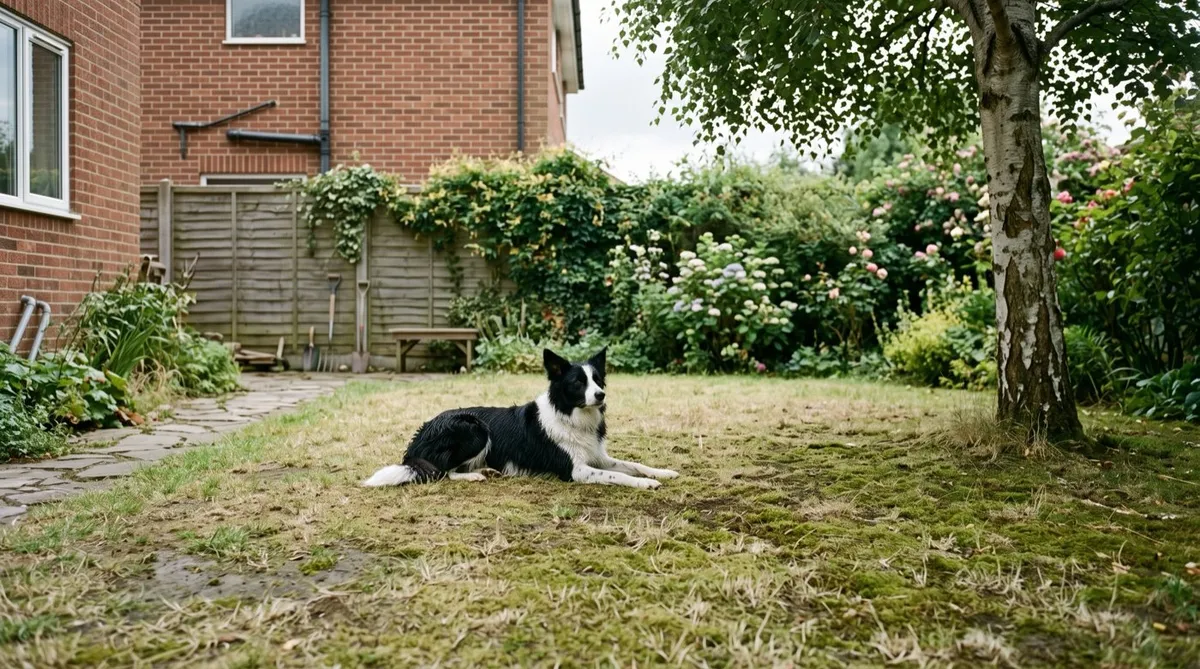
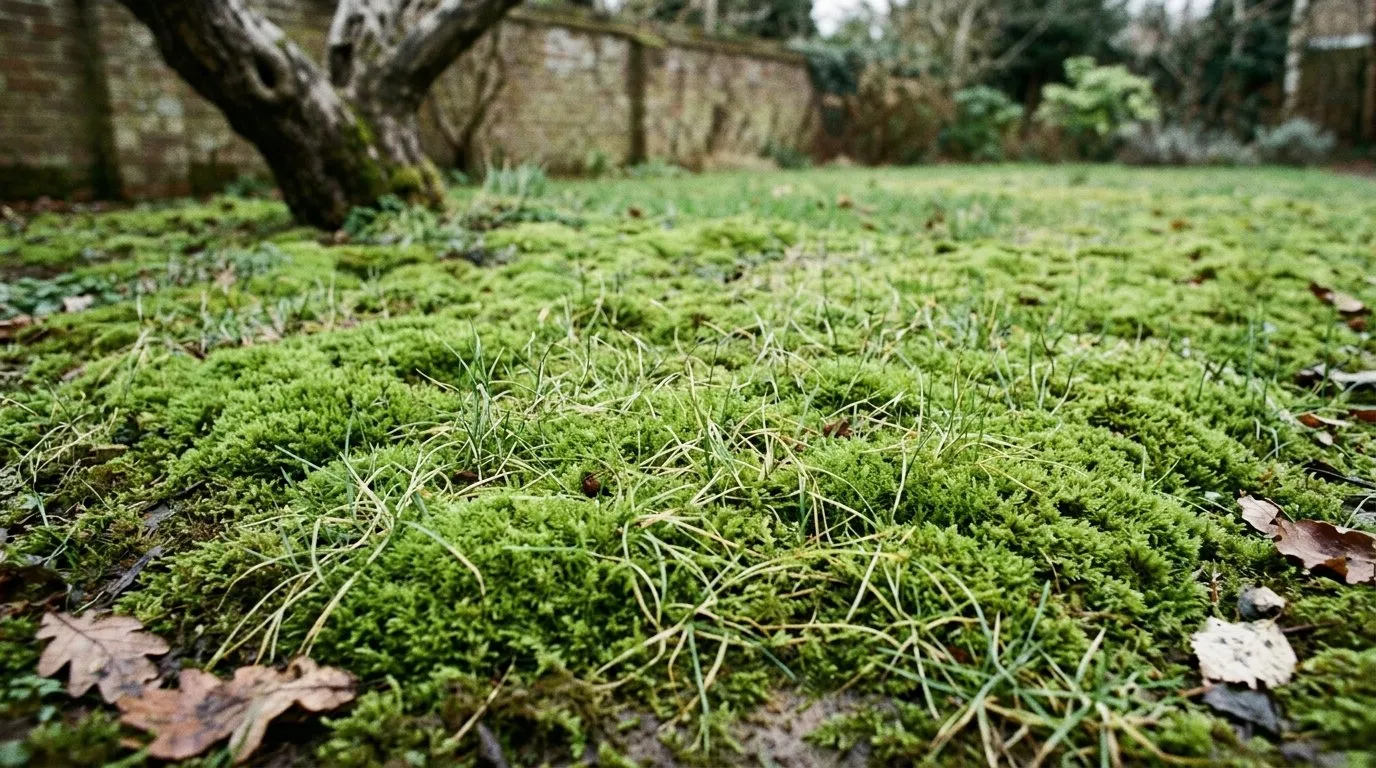 Stage six in a suburban back garden. Moss has taken the ground the fescue gave up, because moss wins at light levels that starve grass.
Mowing height and feed rates that actually help
Two settings change in shade, and both go the opposite way to most people’s instinct.
Cut the nitrogen, do not raise it. This is counter-intuitive and it matters. A thin shaded lawn looks hungry, so people feed it hard. High nitrogen forces soft, sappy leaf growth that the plant cannot support in low light, and soft growth in a damp shaded corner is an invitation to red thread and fusarium patch.
Use 15 to 20g of nitrogen per square metre per year in shade, against 25 to 35g in sun. Lift the potassium, which firms the cell walls and improves disease resistance. Feed in spring and early autumn only, never in the middle of a dark, damp winter.
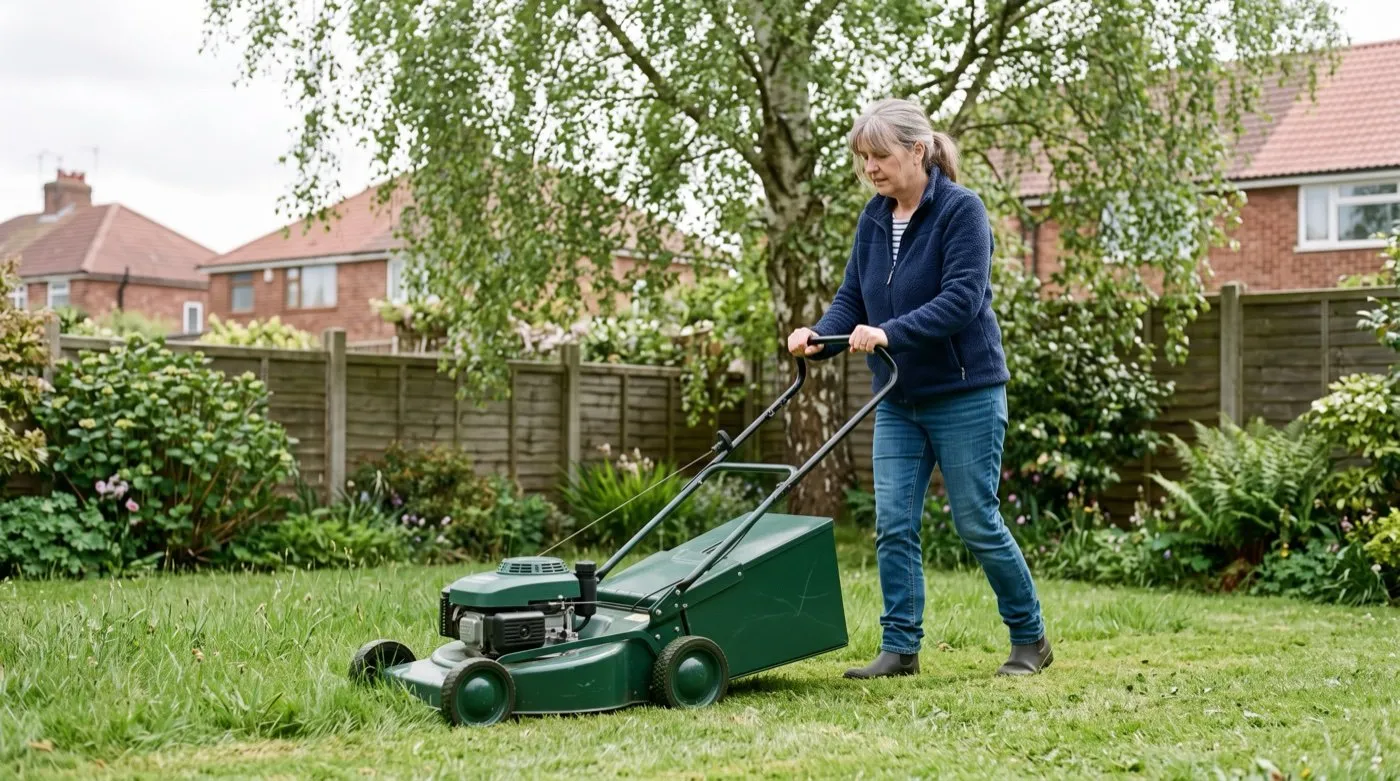 Shade lawns run at 50-65mm, not 25-40mm. Leaf area is photosynthesis, and photosynthesis is the whole constraint.
Raising the light before you buy more seed
The cheapest gain in a shade lawn is usually not seed. It is light.
Crown lifting removes the lower branches of a tree, raising the canopy and letting low morning and evening sun under it. Crown thinning removes a proportion of the interior branches, typically 15 to 25%, so more light filters through. On the Stoke terrace garden, thinning a sycamore by about 20% lifted the noon reading from 6,000 to 14,000 lux. That took the strip from hopeless to marginal.
Expect £150 to £450 for a contractor to lift or thin a domestic garden tree. Get two quotes and use a properly insured firm.
Warning: Check for a Tree Preservation Order and conservation area status before any tree work. Unauthorised work on a protected tree is a criminal offence carrying a fine of up to £20,000 in a magistrates’ court. Councils prosecute homeowners, not just developers. One free email to your council’s tree officer settles it.
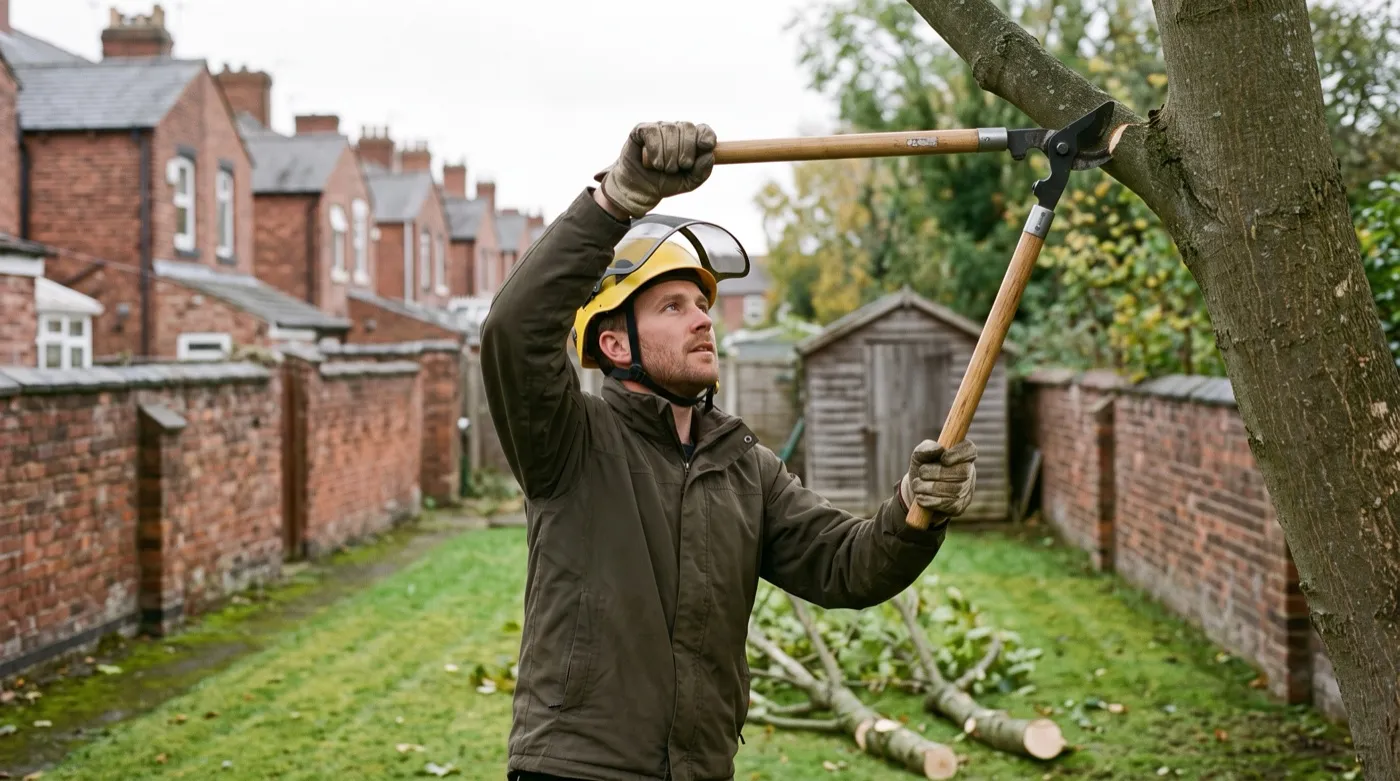 Crown lifting the boundary sycamore on the Stoke terrace garden. Thinning by 20% lifted noon light from 6,000 to 14,000 lux on the strip below.
The pattern is the same one that runs through every difficult lawn. The materials are fine. The measurement is what people skip.
When to stop fighting and plant instead
Below 2 hours of sun, or under beech, sycamore or dense conifers, stop after one failed attempt. Two failures in the same spot means light or water is the limit, and neither responds to a different seed.
The alternative is not a defeat, and it usually looks better. Shade-tolerant ground cover gives 100% cover where grass manages 0%, and it does it permanently.
Geranium macrorrhizum is the workhorse: semi-evergreen, aromatic, and it copes with dry shade under trees that beats everything else. Epimedium handles dry shade under beech, which is close to a miracle. Vinca minor covers fast. Pachysandra terminalis is dull but bulletproof under conifers. Bergenia and Luzula sylvatica, a woodrush that reads as a grass, both work in deep shade.
Our guide to lawn alternatives and ground cover covers the wider switch away from grass, and which species hold cover where a sward cannot.
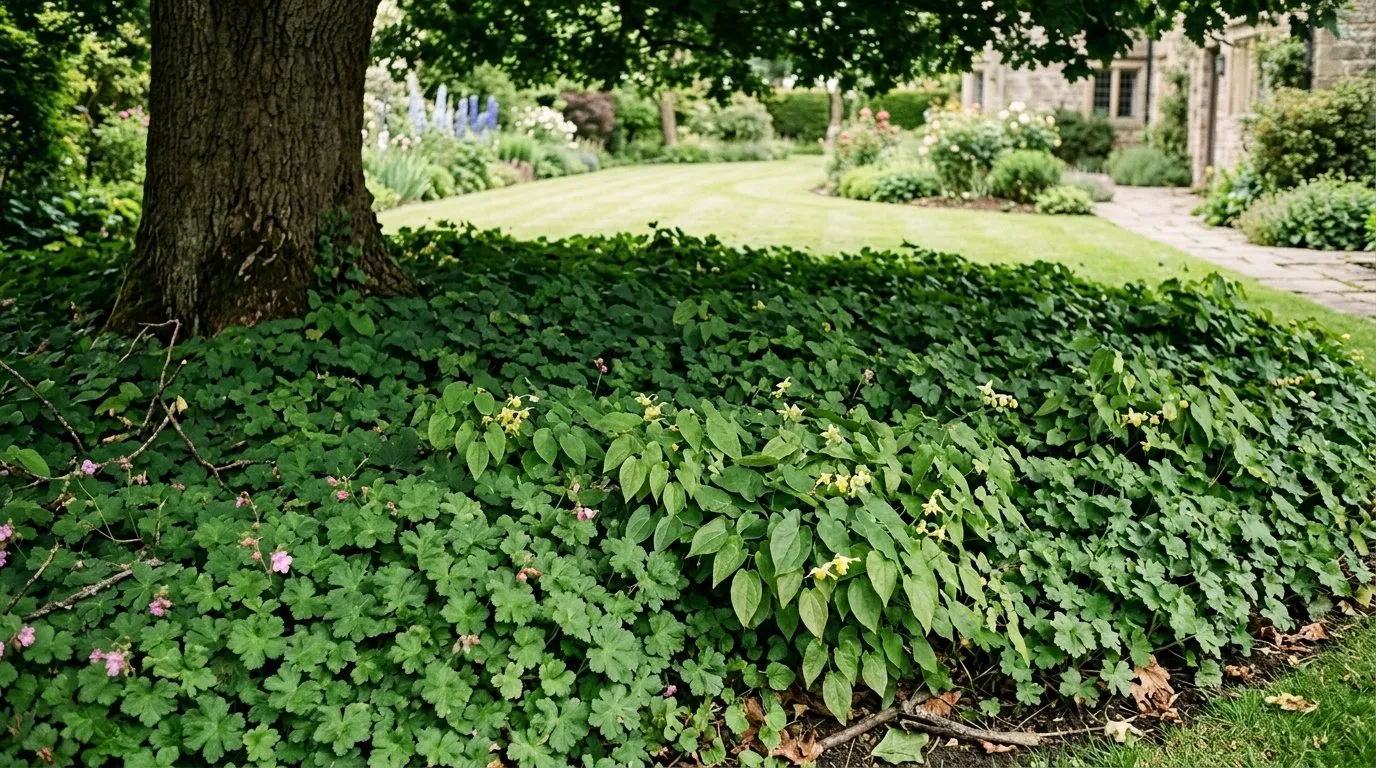 The sycamore strip in summer 2023. Geranium macrorrhizum and epimedium at 100% cover, two years after six seed attempts reached 0%.
Month-by-month shade lawn calendar
Shade changes what you do and when. This is a realistic UK year for a shaded sward.
| Month | Task |
|---|---|
| January | Stay off the frozen thin sward. Note where moss dominates for the June light audit |
| February | Worst month. Do nothing. Grass is dormant below 6°C and moss is not |
| March | Hand-rake moss gently. Never power-scarify a shade lawn |
| April | Light spring feed at 8-10g nitrogen per square metre. No more |
| May | Raise the mower to 50-65mm before growth peaks. Keep it there all year |
| June | The light audit. Meter at noon in the worst spot and on open lawn. Compare |
| July | Check soil moisture at 150mm. Dust-dry under a tree means root competition |
| August | Order fescue-dominant seed. Book any crown lifting or thinning now |
| September | Main sowing window. Overseed at 35g per square metre into raked soil |
| October | Tree work done now, once leaves drop. Keep leaves off the thin sward weekly |
| November | Plant ground cover in any strip that failed twice. Soil is warm and moist |
| December | Clear leaves. A shaded sward smothered under leaves will not be there in spring |
September is the pivot. Soil is warm, rain returns, and fescue has eight weeks to root before dormancy. Spring sowing in shade usually fails, because the seedlings meet their first drought at three months old with no root system.
Common mistakes
- Buying the bag, not the species list. If perennial ryegrass is over 20% of a “shade” mix, it is a sun mix. Check the percentages on the back every single time.
- Feeding a thin shade lawn harder. High nitrogen in low light forces soft growth and invites red thread. Use 15-20g per square metre per year, not 25-35g.
- Mowing shade grass at sun height. Leaf area is the only photosynthetic lever in shade. A single 25mm cut can finish a fescue strip that held for years.
- Treating the moss instead of the light. Moss is the symptom. Kill it and it returns within a season, because nothing about the light changed.
- Sowing the same spot a third time. Two failures means light or water is the limit. The third bag will fail exactly like the first two.
Shade and wet often arrive in the same corner, because a shaded lawn dries far more slowly than an open one. If your dark strip also holds water, our guide on diagnosing a waterlogged lawn covers the drainage side, and thin shaded patches respond to the same repair technique as any others in our guide to fixing a patchy lawn.
What the light meter really tells you
Nine years of arguing with shade has left me with one rule. Measure the light before you spend anything, because the light sets the ceiling and nothing else you do can raise it.
If the meter reads over 20,000 lux at noon in June, sow fescue and expect a decent sward. Between 15,000 and 20,000, sow fescue and expect 60% cover and a permanent maintenance job. Below 10,000, put the seed down and buy plants instead. That one reading, from a £25 meter, decides between a £0.40 per square metre answer that works and a £0.40 per square metre answer that fails every year forever.
The seed industry will keep selling shade mixes for beech trees. The beech will keep winning.
Now you know what your light will support, take the next step with our guide to the best plants for dry shade if the meter says stop fighting, and browse every garden problem guide for related issues.
Frequently asked questions
What grass grows best in shade in the UK?
Creeping red fescue and Chewings fescue, the only genuinely shade-tolerant UK lawn grasses. Both are fine-leaved fescues that hold roughly 60% cover at around 4 hours of dappled light. Rough-stalked meadow grass copes with damp shade but collapses in a dry summer. Ryegrass needs 4 or more hours of direct sun despite appearing in most shade mixes sold in Britain.
How many hours of sun does grass need?
About 3 hours of direct summer sun, or 4-5 hours of good dappled light. Below roughly 2 hours no lawn grass holds a sward for more than a season or two. A cheap lux meter is more reliable than counting hours: fine fescue needs around 15,000 lux sustained at midday, against 85,000 lux on open lawn.
Why does grass die under trees even with shade seed?
Water competition, not darkness. A mature tree extracts hundreds of litres a day through shallow roots. Grass roots in shade are already 30 to 50% smaller than in sun, so they lose that contest every dry spell. Shade seed fixes the light problem and does nothing at all about the water problem, which is why it fails under trees.
Can you grow grass under a beech tree?
No, realistically. Beech passes only 2-5% of full sunlight and roots shallowly and densely. That combination beats every lawn grass sold in Britain. Under birch or ash, which pass 30-50% and 20-30%, fine fescue has a genuine chance. Species of tree matters far more than the seed mix you buy.
Should I mow shade grass higher or lower?
Higher. Raise to 50-65mm against 25-40mm in sun. Longer leaf means more surface area to photosynthesise in low light, which is the only lever you have. Scalping a shade lawn removes the leaf it needs to survive. Cut less often too, roughly every 14 to 21 days rather than weekly.
Does feeding a shade lawn more nitrogen help?
No, it makes things worse. High nitrogen forces soft leafy growth the plant cannot support in low light. That growth invites red thread and fusarium. Use 15-20g of nitrogen per square metre per year in shade against 25-35g in sun, and lift the potassium to firm the leaf.
When should I give up on a shade lawn?
Below 2 hours of sun, or under beech, stop after one failed attempt. Two overseeding failures in the same spot means the light or water is the limit, not your technique. Ground cover such as Geranium macrorrhizum or epimedium gives 100% cover in two years for £20-£45 per square metre.
Our team produces practical UK gardening guidance from source research, contributor records and established horticultural practice. Editorial standards are overseen by Matt W.