Key takeaways
- Five distinct causes produce identical standing water, and each needs a different fix
- A steel rod that stops dead at one consistent depth of 100-250mm confirms a compaction pan
- Dig a 600mm hole in December: water rising to within 300mm of the surface means a high water table
- A soakaway in solid clay achieves nothing, it simply fills and stays full for months
- Thatch over 10mm acts as a sponge and mimics waterlogging on perfectly drained soil
A waterlogged lawn is not a diagnosis. It is a symptom, and five completely different problems produce exactly the same sheet of standing water across the grass. That is why so much drainage money gets wasted in British gardens. People hire an aerator for a problem sitting 130mm below the deepest core, or dig a soakaway into clay that will never accept a drop.
Why standing water tells you almost nothing on its own
Water sits on a lawn for one of two reasons: it cannot get into the soil, or it cannot get away once it is in. Those are opposite problems with opposite solutions, and the puddle looks identical either way.
Infiltration failure means the surface is shut. Compacted pores, a thatch mat or a capped crust stop rain entering in the first place. The soil 300mm down might be perfectly dry. Drainage failure is the reverse: water enters fine, then hits a barrier or a saturated zone and backs up. The soil is full and has nowhere to empty to.
A third case fools almost everyone. Where the water table rises into the root zone each winter, the lawn is not draining badly at all. It is sitting in groundwater, and the water is arriving from below rather than falling from above. No amount of surface work touches that.
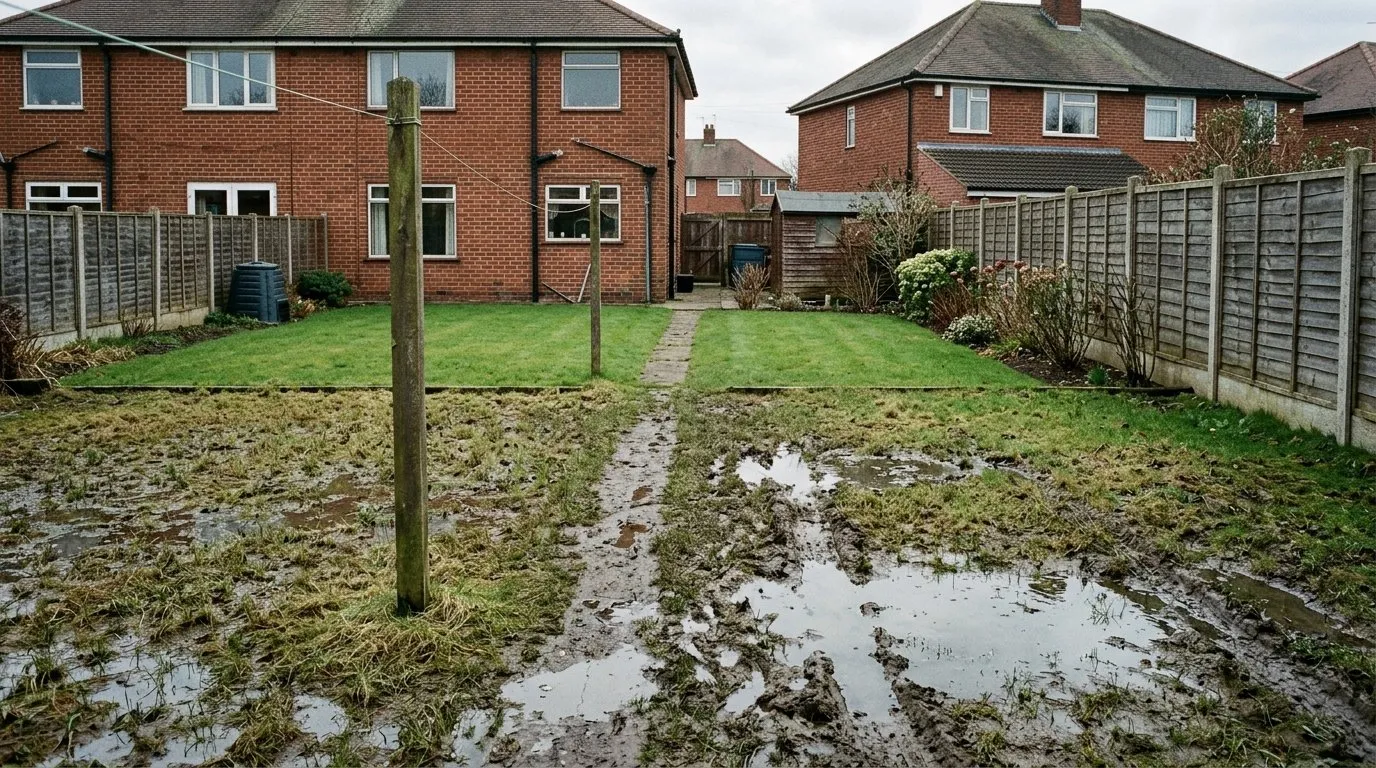 Two ends of the same lawn on identical clay. The difference is traffic history and a buried pan, not the soil.
The five reasons UK lawns waterlog
Compaction from mowing, feet and play
Compaction squeezes the soil’s air pores shut, so rain cannot infiltrate. It is the most common cause and the easiest to fix. Mowing the same lines on damp ground, a trampoline in one spot, a dog’s patrol route along a fence: all of it presses soil particles together and destroys the pore space water travels through.
Compaction is a surface problem, usually the top 50 to 100mm. That is exactly the depth hollow-tine aeration reaches, which is why coring works so well when compaction is genuinely the cause. The tell is patchiness that maps onto use. Puddles under the washing line and along the path, firm grass in the untrodden corners.
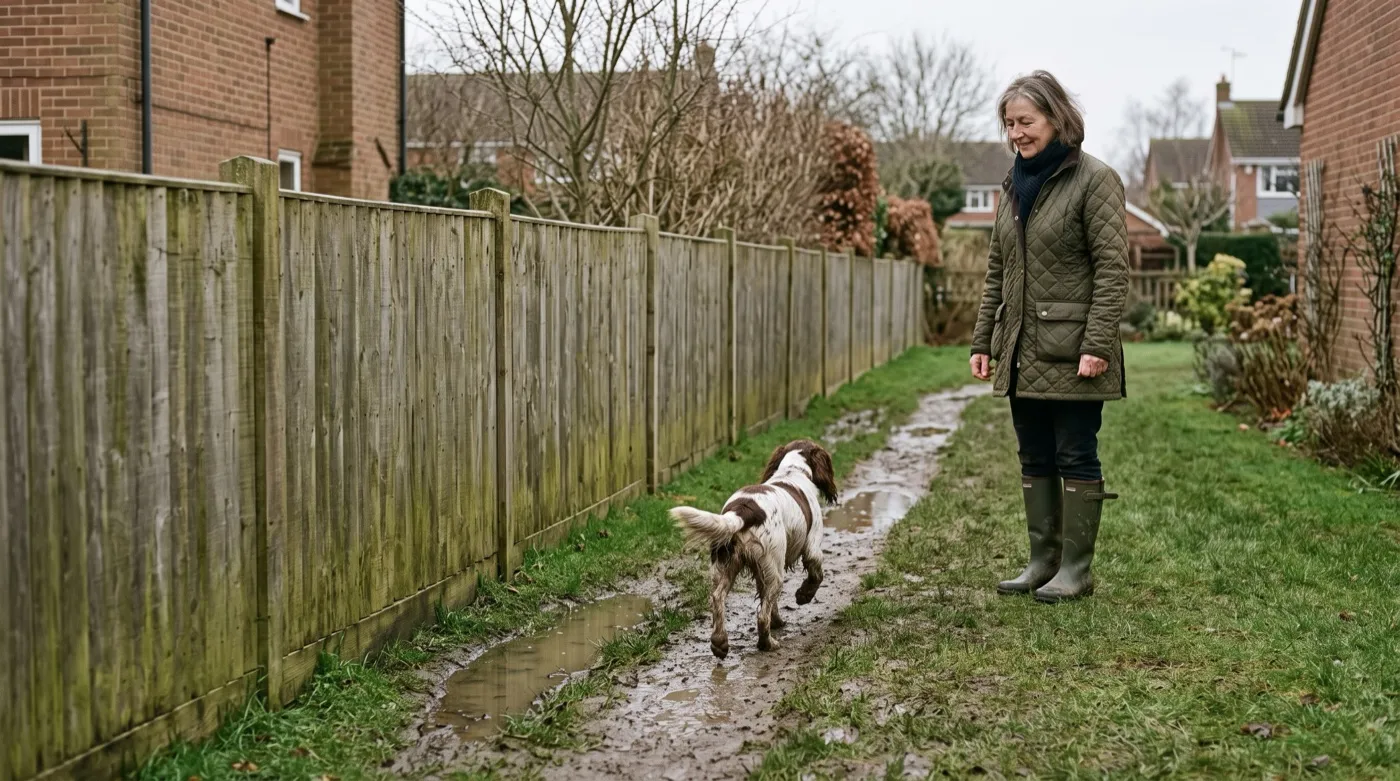 A dog’s patrol route writes itself into the lawn. The strip along the fence puddles first, because the same feet press the same 300mm of clay every day.
A clay pan smeared flat by machinery
A compaction pan is a different animal entirely. It is a hard, smeared band of clay 100 to 250mm down, created when a digger or rotavator worked wet clay and polished the layer flat. Water passes through the topsoil, hits the pan, and stops.
This is the cause that wastes the most money, because surface aeration cannot reach it. A standard hollow-tiner pulls cores 75 to 100mm deep. A pan at 220mm is 120mm below the deepest hole you can make. You can core that lawn every autumn for a decade and change nothing.
Builder’s subsoil under new-build turf
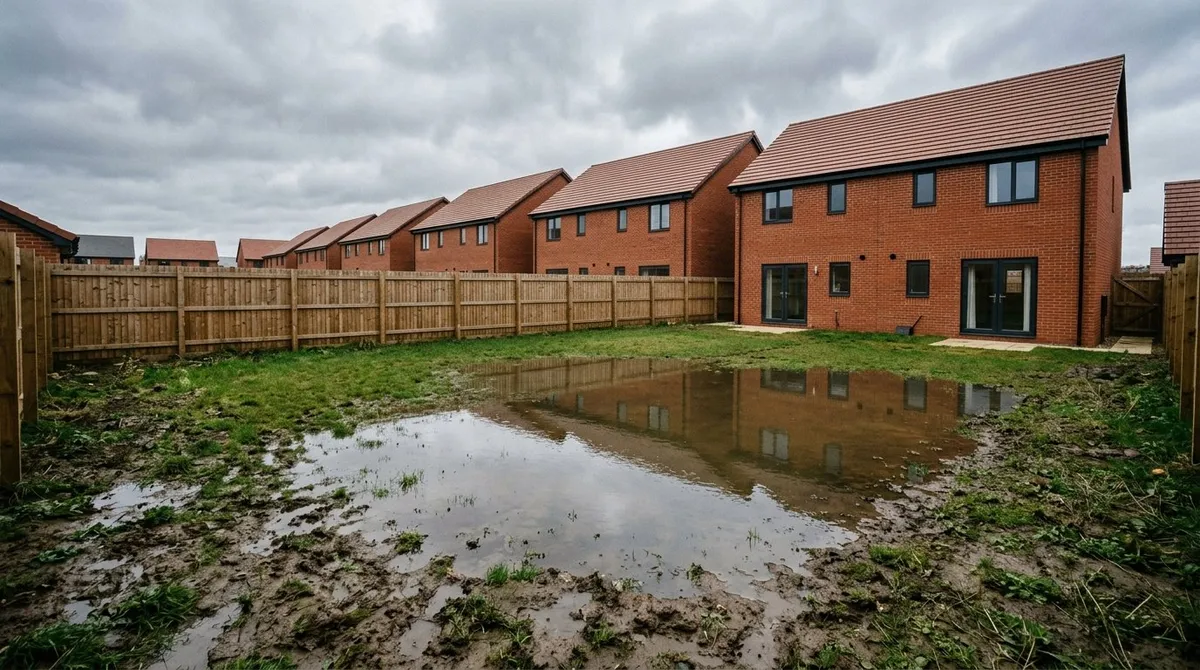
New-build estate lawns waterlog because of what is underneath, not what is on top. The standard build sequence is brutal for soil. Heavy plant tracks the plot for months, then 100 to 150mm of imported topsoil goes down over compacted subsoil, and turf is rolled straight onto it.
A high water table
Some gardens are simply low. In a valley bottom, beside a watercourse, or on a floodplain, the water table rises through winter until it reaches the root zone. The lawn is not failing to drain. It is submerged from below.
Thatch acting as a sponge
Thatch is a mat of dead stems and roots between the green growth and the soil surface. Over 10mm thick it behaves like a sponge, holding water above ground and staying saturated for days.
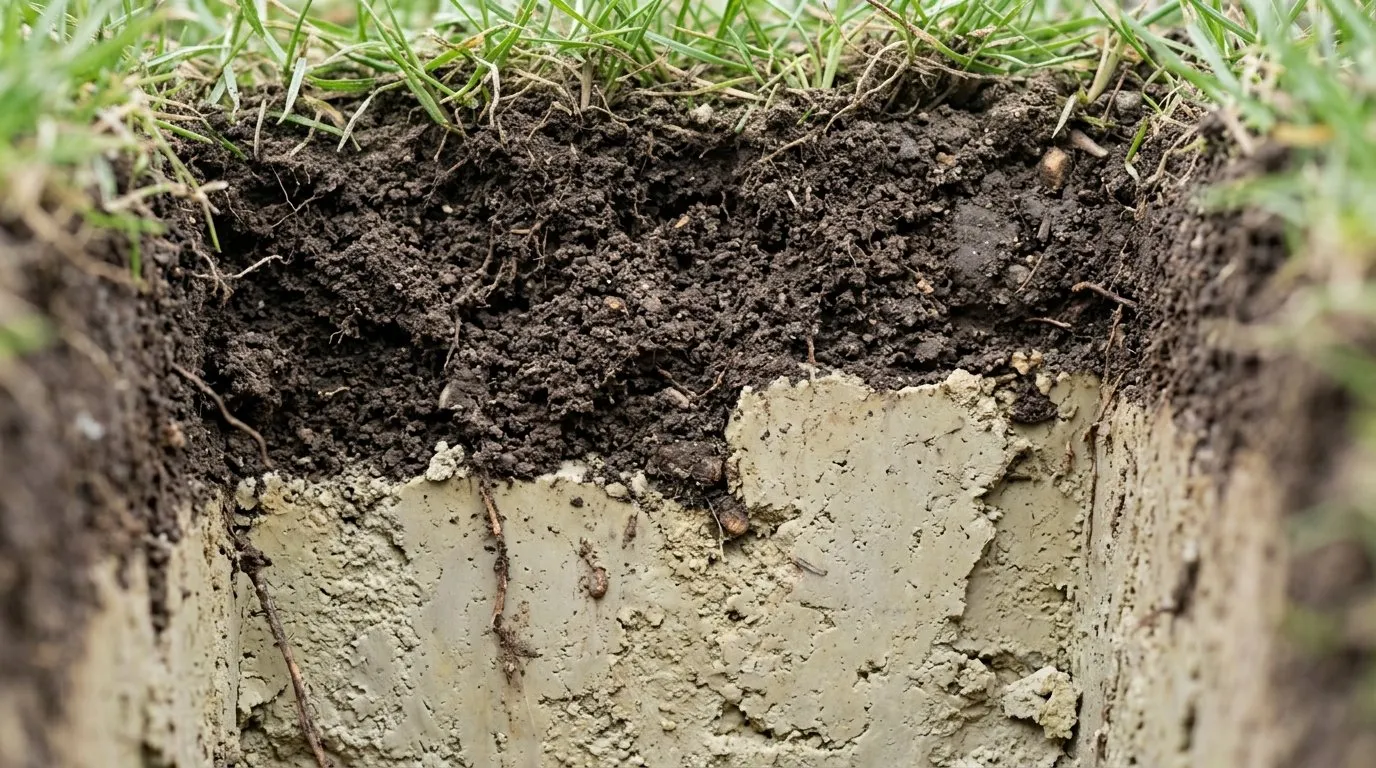 A spade slice shows the story. Dark topsoil stops abruptly at pale dense clay, the classic new-build bathtub.
Three tests that tell the causes apart
Do all three before you buy anything. Together they take an afternoon and cost nothing.
The rod probe finds a pan. Push a 10mm steel rod, or a long screwdriver, slowly into the lawn at 20 points on a rough grid. Note the depth where it becomes hard to push. Ordinary clay resists gradually and at varying depths. A pan gives a sudden hard stop at roughly the same depth every time. That consistency is the diagnosis, because machinery smeared the band flat and level.
The percolation test measures infiltration. Dig a hole 300mm deep and 300mm wide in the worst spot. Fill it once and let it drain to wet the sides. Fill again and time the second emptying. Under 4 hours is free-draining. 4 to 12 hours is moderate. 12 to 24 hours is poor. Over 24 hours means water has nowhere to go, and you should suspect a pan or the water table rather than surface compaction.
The winter hole finds the water table. Dig 600mm down in December and leave it uncovered for 24 hours. If water rises and settles within 300mm of the surface, your water table is high. Repeat in June to get the seasonal range. This is the one test almost nobody does, and it is the only one that can save you £2,000 on drains that will never work.
Add a thatch check while you are there. Slice a wedge out with a bread knife and measure the brown fibrous layer. Over 10mm is your culprit, or at least a contributor. Our guide on how to scarify and aerate a lawn covers removing it properly.
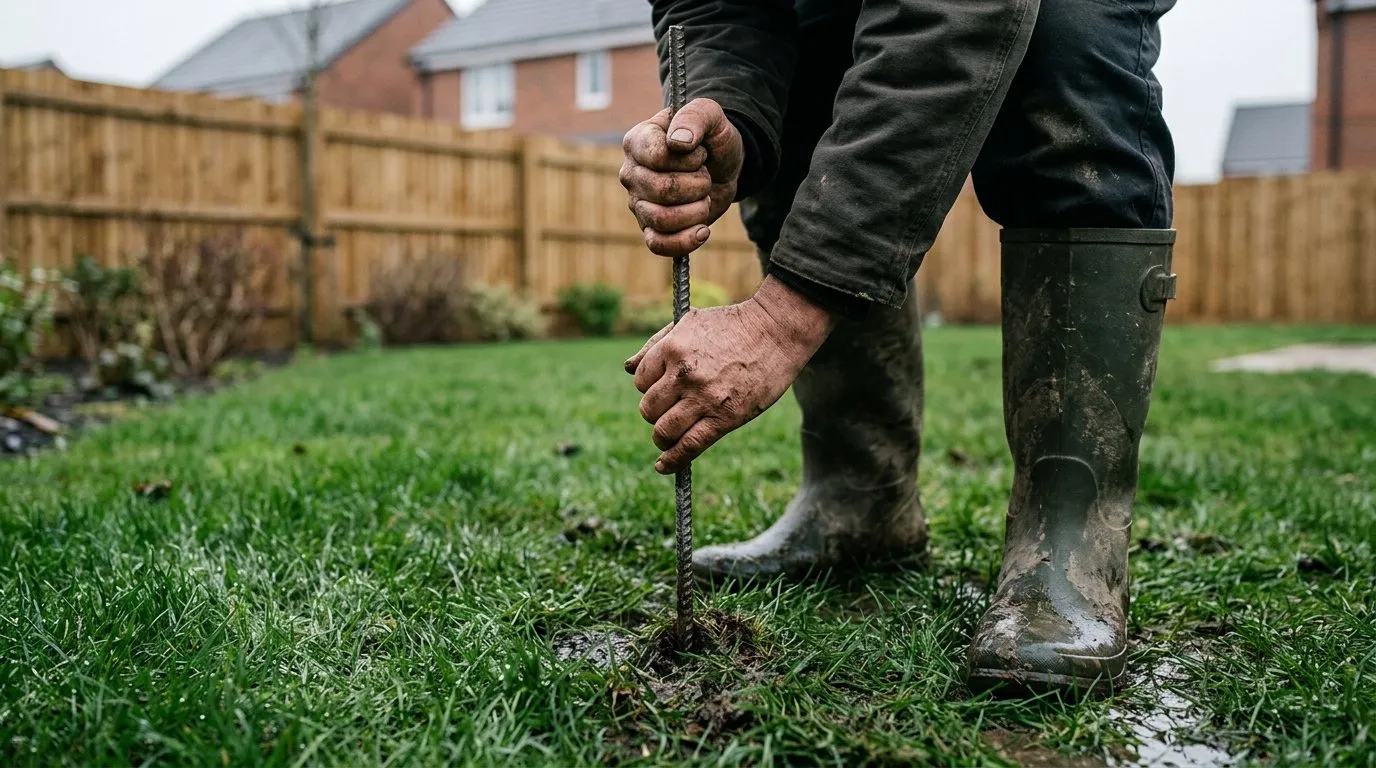 The rod probe is the cheapest diagnostic in gardening. A consistent hard stop at one depth means a pan.
What each fix can and cannot do
This is the table nobody publishes, because it says most fixes do nothing for most causes. Ranked by how much drainage they deliver when correctly matched to the cause.
| Fix | Cause it treats | Effectiveness | What it CANNOT do | Role |
|---|---|---|---|---|
| Hollow-tine aeration | Surface compaction, top 100mm | High, but lasts 3-6 months | Cannot reach a pan below 100mm; cannot lower a water table; cannot remove thatch | Primary, repeat annually |
| Sharp sand top-dressing | Small pore size in clay | High, cumulative over 3-4 years | Nothing useful in year 1; useless if a pan sits below the sand | Primary, annual, gold standard |
| Deep-tine or sub-soiling | A pan at 100-250mm | Very high where a pan exists | Zero benefit where no pan exists; £95-£400 wasted | Primary, one-off, conditional |
| Scarifying | Thatch over 10mm | High where thatch is the cause | Nothing at all if thatch is under 10mm | Conditional, one-off then annual |
| Land drains to an outfall | Trapped water, with somewhere to send it | Highest, where a legal outfall exists | Cannot work without a fall of 1 in 100 and an outfall lower than the pipe | One-off major |
| French drain | Run-off arriving from a slope | High for intercepting incoming water | Cannot drain flat ground; it intercepts, it does not extract | Supplementary, conditional |
| Soakaway | Storage, over permeable subsoil | High over sand or gravel subsoil | Zero in solid clay. It fills and stays full | Conditional, test before digging |
| Slitting | Surface crust or cap | Low to moderate, lasts weeks | Cannot move water if there is nowhere for it to go | Maintenance only |
| Re-grading | Ponding in surface hollows | Moderate | Cannot change infiltration; moves water elsewhere in your garden | Supplementary |
| Bog or rain garden | Accepts the water instead | 100%, by redefining the problem | Cannot give you a lawn to walk on | Alternative, wettest 10-20% |
The gold standard for an ordinary compacted clay lawn remains hollow-tine aeration plus sharp sand top-dressing every autumn. It is cheap, it compounds, and a household can do it alone. The full method is in our guide to fixing a waterlogged lawn on clay soil.
But note how many rows above say “cannot”. That is the point of this article. Matching the fix to the cause matters more than the fix itself.
How water actually moves through a saturated lawn
Understanding the sequence explains why timing and depth matter so much.
- Rain hits the surface. Infiltration begins at the soil’s intake rate. Free-draining loam takes 50mm per hour or more. Compacted clay manages under 5mm per hour.
- The top 50mm saturates within minutes on compacted ground. Every pore fills, and air is displaced upward.
- Water moves down by gravity through whatever continuous pores exist. It needs a connected path. Isolated pores hold water but move none.
- Flow meets the first barrier. A pan, dense subsoil or the water table. Water stops descending here.
- The zone above the barrier fills upward. This is a perched water table, and it is what actually drowns grass roots.
- Roots suffocate within 48 to 72 hours of full saturation at 10°C or above. Grass needs oxygen at the root, and saturated soil has none.
- Water leaves only by evaporation or transpiration once downward flow stops. Below 6°C soil temperature, grass transpires almost nothing, so winter waterlogging persists for weeks where summer waterlogging clears in a day.
That last point is the critical mistake people make. They judge drainage in summer. A lawn that clears a downpour in three hours in July can hold water for three weeks in January, on identical soil. The difference is not drainage. It is that a growing sward at 15°C pumps water out through its leaves, and a dormant one at 4°C does not.
Test in winter. Judge in winter. A summer percolation test on a lawn that floods in December tells you very little.
Why a soakaway in clay is money down a hole
A soakaway only works if the ground below it drains faster than the ground above. That is the whole principle, and it is why soakaways fail so often in British gardens.
A soakaway is a pit, typically 1 to 1.5 metres cube, filled with clean rubble or modular crates. It stores water and lets it seep into the surrounding subsoil. Over sand or gravel it works well. Dug into Mercia mudstone or London clay, it fills during the first storm and stays full until spring. You have built an expensive underground pond.
Warning: Never connect garden land drains to a foul sewer. It is an offence and water companies do prosecute. A legal outfall is a soakaway, a ditch or a watercourse. Discharging to a ditch or watercourse can need consent from the lead local flood authority. Site any soakaway at least 5 metres from a house or wall to protect the foundations.
Land drains have the same dependency. A perforated pipe needs a fall of at least 1 in 100, which is 10mm per metre, and an outfall physically lower than the pipe. On a flat plot with no ditch and no permeable subsoil, there is nowhere for the water to go. The pipe just fills. This is the awkward truth contractors rarely lead with.
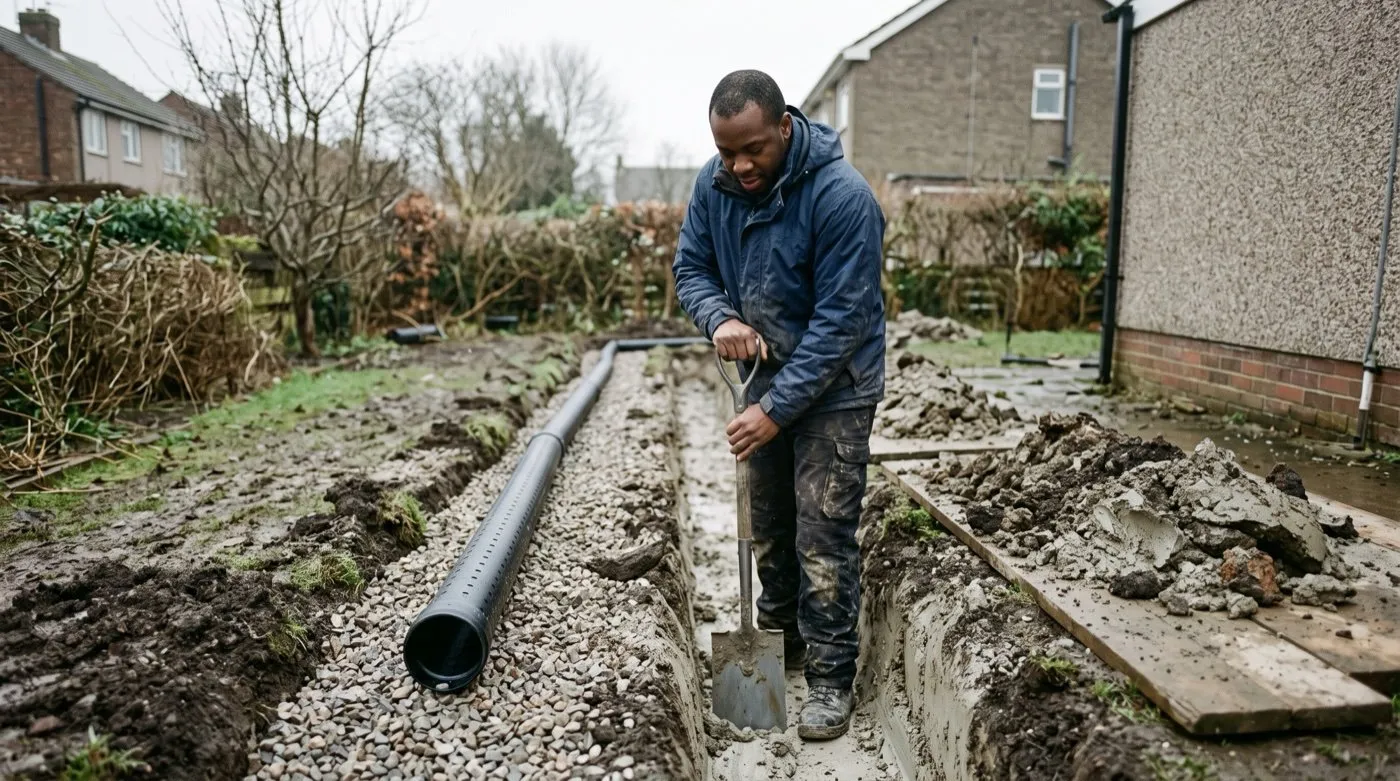 Land drains only work with a fall of 1 in 100 and an outfall lower than the pipe. Without both, the trench simply fills.
Re-grading, and the limits of moving water sideways
Where the lawn dishes into a hollow, water collects for the obvious reason. Re-grading raises the low spots so surface water runs off rather than pooling.
The technique is not complicated. Lift the turf, add topsoil or a sandy loam to build the level, firm it, and relay. Aim for a fall of about 1 in 80 away from the house, roughly 12mm per metre. That is enough to move water and gentle enough that nobody notices a slope. Small dips of under 30mm can be filled by top-dressing without lifting turf at all, over two or three seasons.
Understand what this does and does not achieve. Re-grading changes where water sits. It does not change how fast the soil accepts it. Raise one end and the puddle moves to the other end, or into a border, or towards a neighbour’s fence. On a genuinely impermeable lawn you are shuffling the problem around the garden.
Re-grading earns its place in one specific case: an otherwise sound lawn with one or two hollows left by settlement or old tree stumps. As a cure for whole-lawn waterlogging on clay, it fails. Our guide on levelling a bumpy lawn covers the technique in full.
The pattern across seven years is consistent. The diagnostic step costs almost nothing and changes the answer most of the time. The fixes are well documented and widely sold. The matching of fix to cause is where the money is won or lost.
When to stop fighting and plant the wet corner
Some ground will not be drained, and recognising it early is a skill rather than a defeat. Where the water table sits within 300mm of the surface all winter and there is no outfall lower than your garden, no drainage scheme will hold.
The alternative is to accept the water and choose plants that want it. A bog garden is simply a wet area planted with species adapted to saturated soil. No liner, no pump, no engineering. Marsh marigold (Caltha palustris) flowers golden in March. Purple loosestrife (Lythrum salicaria) draws bees from June to August. Hemp agrimony (Eupatorium cannabinum) is one of the best butterfly plants in Britain. Ligularia, astilbe, Iris sibirica and hostas all thrive.
A rain garden is the engineered cousin: a shallow planted depression, 150 to 200mm deep, that takes run-off from a roof or drive and lets it soak away slowly over 24 to 48 hours. It handles the water and looks deliberate. The Wildlife Trusts rate wet garden features among the highest-value habitats you can create in a domestic plot, because standing water in summer is now scarce across much of lowland England.
Be selective. This is the answer for the wettest 10 to 20% of a garden, not the whole lawn. Keep the dry two-thirds as grass and stop fighting the low end.
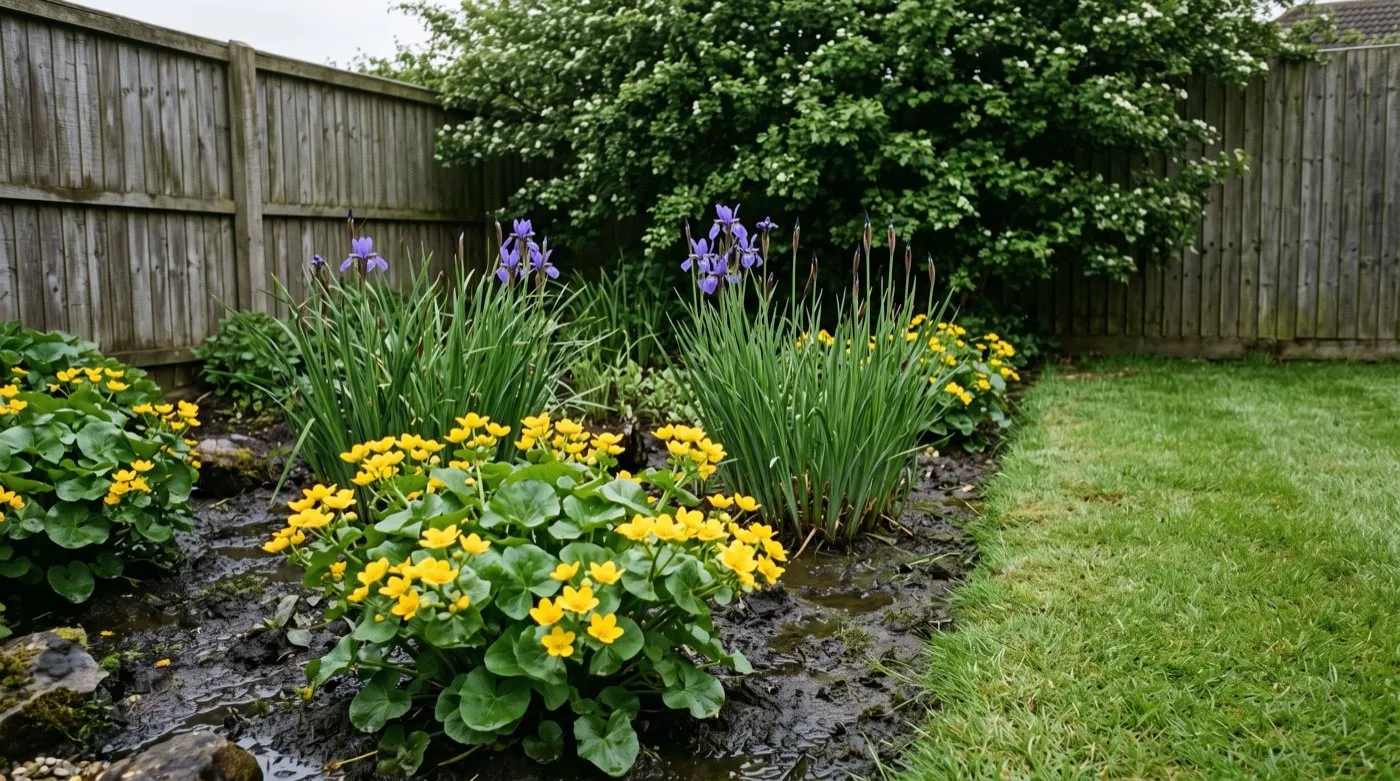 The wettest corner planted rather than drained. Marsh marigold and Iris sibirica in ground that defeated two drainage attempts.
The root cause almost everyone misses
Behind four of the five causes sits one underlying mechanism: soil structure was destroyed by working or loading clay when it was wet.
Clay has a plastic limit. Above a certain moisture content the particles slide past each other and smear rather than crumble. Once smeared, the platelets align flat and the pore space between them collapses. That is a pan under a digger, and it is also compaction under a mower. Same physics, different depth.
This is missed because the damage is invisible and delayed. The digger that smeared the subsoil left in 2016. The lawn looked fine in its first two summers, because the grass was shallow-rooted and the weather was kind. The waterlogging arrived in year three when the sward matured and a wet winter came. Nobody connects a puddle in 2019 to a machine in 2016.
Permanent prevention is a single rule: keep load off clay when it is wet. Stay off a saturated lawn entirely. Do not mow until the surface firms up. Never roll clay. Lay boards if you must cross it in winter, and route wheelbarrows on a plank. Our guide on whether you can mow a wet lawn covers the mowing side, which is where most ongoing damage happens.
For new turf, the prevention is to break the subsoil before the topsoil goes on, not after. Sub-soil to 300mm, then spread 200mm of topsoil rather than 100mm. Nobody does this on an estate build, which is precisely why estate lawns waterlog.
What it costs to diagnose and fix
Realistic UK prices for a 100 square metre lawn in 2026. The diagnosis column is the one that pays for itself.
| Step | DIY cost | Contractor cost |
|---|---|---|
| Rod probe (10mm steel rod) | £6 one-off | Not offered separately |
| Percolation and water-table tests | Free, one afternoon | £150-£300 as a drainage survey |
| Hollow-tine aeration | £35-£60 machine hire per day | £120-£250 per visit |
| Sharp sand top-dressing | £30-£50 per 100 sq m | £200-£400 supplied and spread |
| Scarifying out thatch | £40-£70 machine hire | £150-£300 |
| Deep-tine to break a pan | £80-£120 per day | £200-£400 sub-soiling |
| Re-grading a hollow | £60-£120 topsoil | £400-£900 |
| Land drains to an outfall | £400-£800 materials | £1,500-£4,000 |
| Planting a bog garden | £60-£150 plants | £300-£700 |
The hidden cost is the wrong fix. Two years of hollow-tine hire on the Stone lawn came to roughly £140 and delivered nothing measurable, because the barrier was at 220mm. The £6 rod would have redirected that spend in twenty minutes. Diagnosis is not a preliminary. It is the highest-return work in the whole job.
Month-by-month diagnosis and repair calendar
Timing matters as much on diagnosis as on repair. Winter reveals the problem and autumn fixes it.
| Month | Task |
|---|---|
| January | Map where water sits and how long it stays. Photograph it. Stay off the turf |
| February | Rod-probe on a 20-point grid while ground is soft. Log every stop depth |
| March | Dig the percolation test once soil is workable. Slice a thatch wedge and measure |
| April | Decide the fix from the evidence. Book contractors early if drains are needed |
| May | Mow high at 30-40mm. Keep the sward strong through summer |
| June | Repeat the water-table hole to establish the summer low. Compare with December |
| July | No heavy work on dry clay. Order sand and book machine hire for September |
| August | Plan drain routes and outfalls. Confirm the soakaway percolation test at full depth |
| September | Main window. Hollow-tine to 90mm, brush off cores, top-dress sharp sand |
| October | Deep-tine any confirmed pan. Overseed thin areas. Install land drains now if planned |
| November | Plant the bog corner while soil is warm and wet. Clear leaves off the sward |
| December | Dig the 600mm water-table hole and leave 24 hours. This is the key annual reading |
December and February are the diagnostic months. September and October are the repair months. Doing it the other way round, probing baked August clay and coring in April, is how people misread their lawn and waste a season.
Common mistakes that waste drainage money
- Skipping the diagnosis entirely. Buying a fix before finding the cause is how two-thirds of drainage money gets wasted. The rod costs £6 and changes the answer more often than not.
- Judging drainage in summer. A lawn clearing water in three hours in July can hold it three weeks in January. Below 6°C the grass transpires nothing. Test in winter.
- Digging a soakaway into clay. It fills and stays full. Run a percolation test at the full 1 to 1.5 metre depth first, and abandon the idea if the drop is under 10mm per hour.
- Coring a lawn with a pan. A 90mm core cannot touch a barrier at 220mm. Two years of autumn aeration on the Stone lawn changed nothing measurable.
- Mowing and walking on saturated clay. This is the mechanism that created the compaction in the first place. Every wet-season pass makes next winter worse.
Waterlogging and shade often arrive together, because a wet lawn under a north wall or trees dries far more slowly. If your problem area is also dark, our guide to grass in shade and what actually grows covers the species side of the same corner.
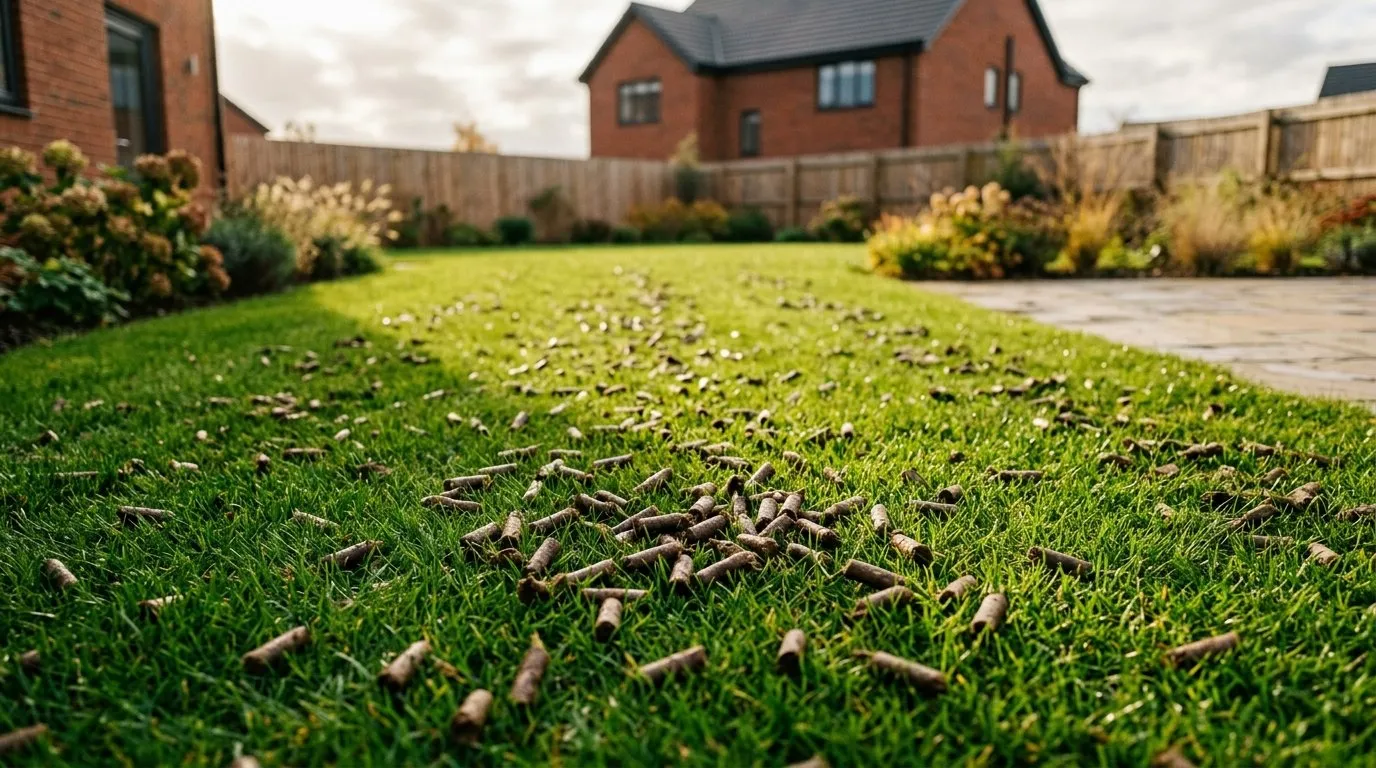 The Stone estate lawn in autumn 2023, one year after deep-tining broke the 220mm pan. Standing water now clears in under eleven hours.
What the diagnosis actually buys you
Seven winters of probing has left me with one conviction. The drainage industry sells fixes, and the fixes mostly work, but only against the cause they were designed for. Sold against the wrong cause they deliver nothing, and the customer concludes that drainage is hopeless.
Spend the afternoon. Push the rod in twenty times. Dig the December hole and look at it the next day. Measure the thatch. Those four readings will tell you whether you are buying a £45 aerator hire, a £95 deep-tine pass, a £2,000 drainage scheme or a £110 bag of marsh marigolds. Getting that choice right is the entire job.
Now you know which cause you are dealing with, take the next step with our guide to top-dressing a lawn, which covers the sand grades and spreading rates that turn a freshly cored clay lawn into a draining one. You can browse every garden problem guide for related issues.
Frequently asked questions
Why is my lawn waterlogged when my neighbour’s is fine?
Almost always compaction or a buried pan, not the soil itself. Two lawns on identical clay drain differently because one has been mown wet, parked on, or built over with machinery. Traffic history matters more than geology across a single street. Probe both lawns with a steel rod and you will usually find the difference at 100-250mm down.
How do I know if my lawn has a compaction pan?
Push a steel rod in at 20 points; a pan stops it dead. Ordinary clay resists the rod gradually and unevenly, at varying depths. A pan gives a sudden hard stop at roughly the same depth every time, usually 100 to 250mm. That consistency is the tell, because machinery smeared the layer flat during the original build.
Will a soakaway fix a waterlogged lawn on clay soil?
No. A soakaway only works if the subsoil below it drains faster than the ground above. Dug into solid clay, it fills with water and stays full for weeks, because there is nowhere for the water to go. Always run a percolation test at the full soakaway depth of 1 to 1.5 metres before you commit £400 or more to digging one.
Can thatch make a lawn look waterlogged?
Yes. A thatch layer over 10mm thick holds water like a sponge above the soil. The ground underneath can be free-draining while the surface stays saturated and spongy underfoot. Slice out a wedge with a knife and measure the brown fibrous layer between green growth and soil. Over 10mm needs scarifying, not drainage work.
How do I test for a high water table in my garden?
Dig a 600mm hole in December and leave it 24 hours. If water rises and settles within 300mm of the surface, your water table is high. Measure again in June for the seasonal range. A high water table cannot be aerated away, and land drains only help if you have a legal outfall lower than the pipe.
Does hollow-tine aeration fix every waterlogged lawn?
Is it worth giving up and making a bog garden instead?
Often yes, in the wettest 10 to 20% of a garden. Where the water table sits within 300mm of the surface all winter, no drainage scheme will hold. Planting the wet corner costs £60 to £150 and works permanently. Fighting it with land drains can cost £2,000 and still fail.
Our team produces practical UK gardening guidance from source research, contributor records and established horticultural practice. Editorial standards are overseen by Matt W.