Key takeaways
- Look for waxy grey-blue colonies up to 2.5mm on leaf undersides and growing points, not the green of most aphids
- It attacks only brassicas: cabbage, kale, broccoli, cauliflower, Brussels sprouts and swede
- Tell them apart: aphids sit in static clusters, cabbage white caterpillars chew holes, whitefly fly up when disturbed
- The aphid overwinters as eggs on old brassica stumps, so pull and shred stumps by December to break the cycle
- Squash colonies or blast them off with water, and encourage ladybirds, hoverflies and parasitic wasp mummies
- Tolerate light colonies on established plants; use organic soap only as a last resort on young or heading crops
Mealy cabbage aphid is the grey, dusty crust you find packed under a cabbage leaf in summer. It is not the caterpillar chewing holes in the outer leaves, and it is not the little white flies that lift off in a cloud. It is a sap-sucking aphid, and once you can recognise it, the fix is straightforward and mostly free.
What is mealy cabbage aphid and how to spot it
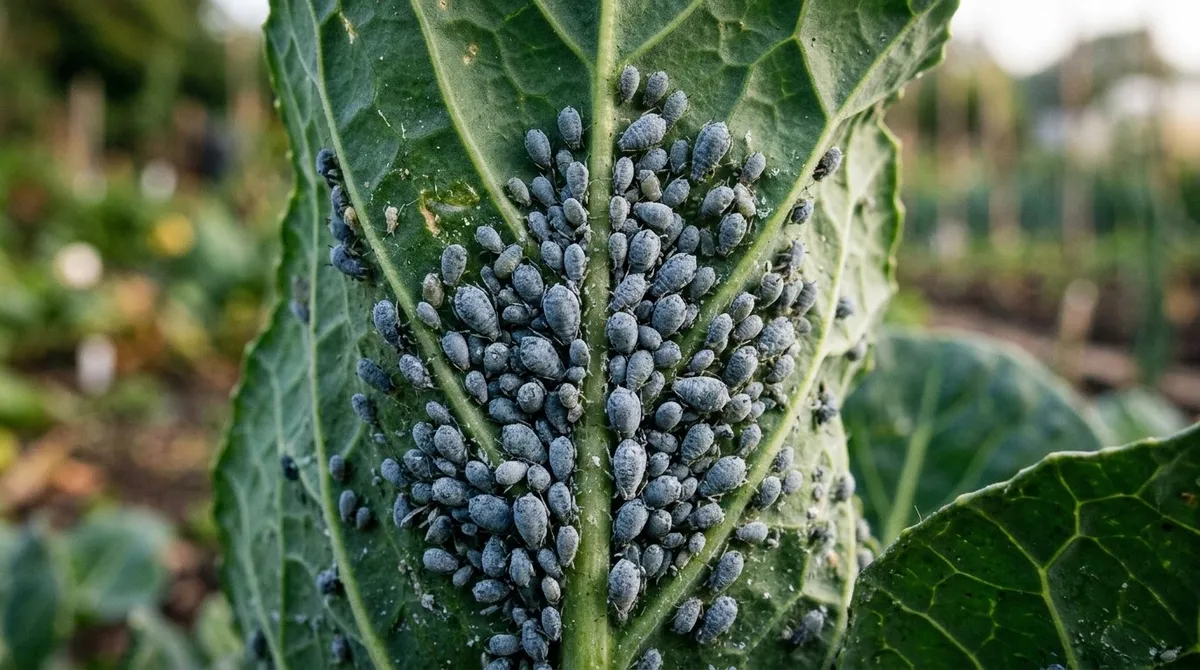
Mealy cabbage aphid is a grey-blue, wax-coated aphid, up to 2.5mm long, that feeds only on brassicas. Its scientific name is Brevicoryne brassicae. The key feature is the powdery, mealy coating that gives a colony the look of being dusted with flour. That wax is why a plain jet of water often rolls straight off them.
You will find them from April to October outdoors, with numbers peaking in the warm months of July and August. In a mild winter a few carry on feeding, but most of the population sits out the cold as eggs. Unlike the shiny green aphids on your roses or the black bean aphid on your broad beans, a mealy cabbage aphid colony is matt, crusty and grey. Once you have seen one you will never mistake it.
The colonies are dense and static. A single leaf can hold hundreds of individuals wedged together, all facing the same way, feeding on the sap. Winged forms appear when a colony gets crowded or the host plant starts to decline, and those winged aphids fly off to start colonies on fresh plants. If you want the general picture on the whole family, our guide on getting rid of aphids covers the tribe as a whole. Overwintering brassicas such as spring cabbage are a common early-season host, so check transplants from the start.
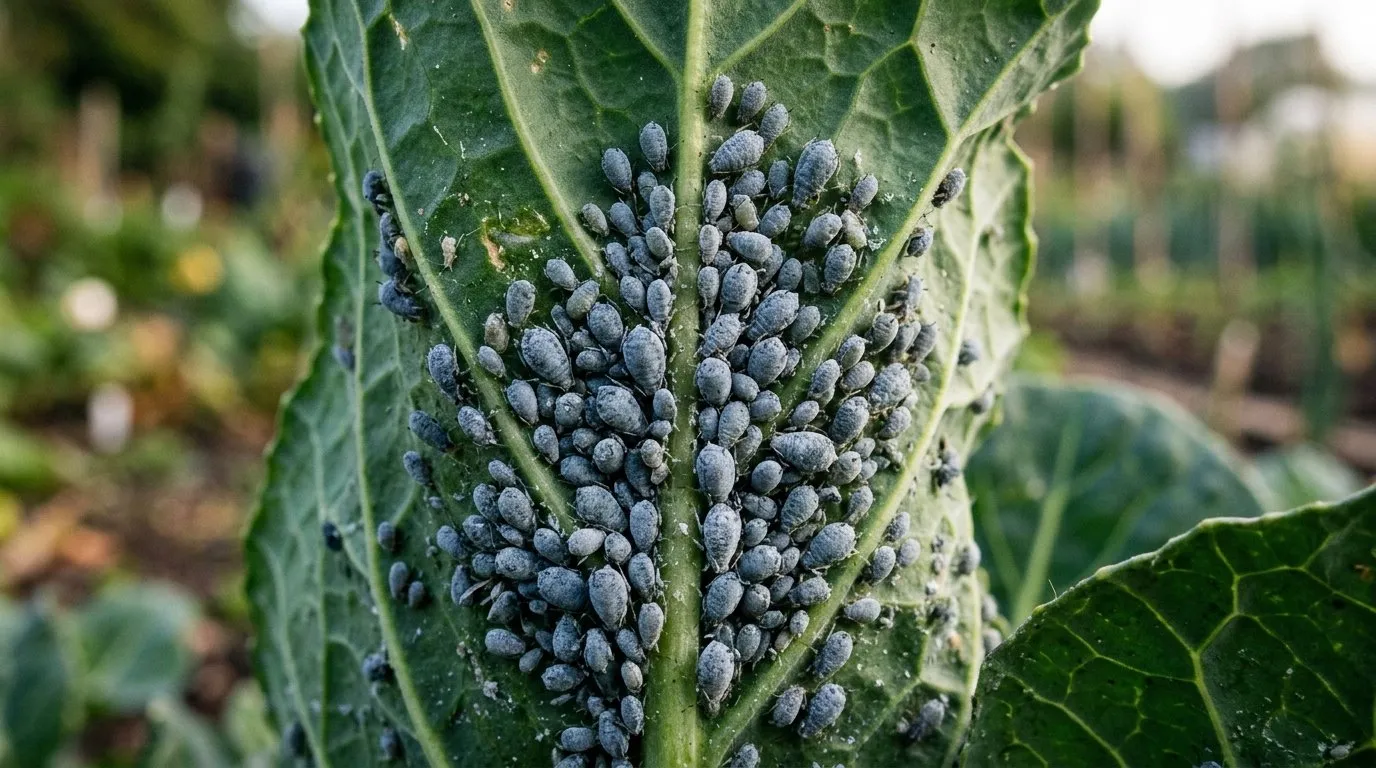 A classic colony packed under a cabbage leaf. The grey, floury coating is the giveaway.
Mealy cabbage aphid vs cabbage white caterpillar vs cabbage whitefly
These three pests get muddled constantly, yet they need completely different treatment. Aphids suck sap and cluster; caterpillars chew holes; whitefly fly. Misidentify the problem and you waste time on the wrong control. Here is how to separate them at a glance.
The most common mix-up is with the cabbage white caterpillars that shred outer leaves in late summer. Those are the fat green or yellow-and-black larvae of the large and small white butterflies. They leave big ragged holes and dark green droppings. Aphids leave no holes at all, just a grey crust and puckered, discoloured leaves.
The second mix-up is with cabbage whitefly, which are tiny white winged insects. Tap an infested plant and whitefly rise in a little cloud, then settle again. Aphids never do this outside their brief winged phase. Whitefly also coat lower leaves in sticky honeydew and sooty black mould, which aphids can do too, so use the flying test to be sure.
Three-pest identification table
| Feature | Mealy cabbage aphid | Cabbage white caterpillar | Cabbage whitefly |
|---|---|---|---|
| What it is | Sap-sucking aphid | Butterfly larva | Sap-sucking true bug |
| Size | Up to 2.5mm | 25-40mm when grown | 1-2mm |
| Colour | Grey-blue, waxy, floury | Green, or yellow and black | White wings |
| Moves when touched | No, static | Slowly | Flies up in a cloud |
| Main damage | Distorted, yellow leaves | Large ragged holes | Honeydew and sooty mould |
| Where it hides | Undersides, growing points | Leaf surfaces and hearts | Undersides of lower leaves |
| Best first action | Squash or hose off | Pick off, use netting | Yellow traps, hose off |
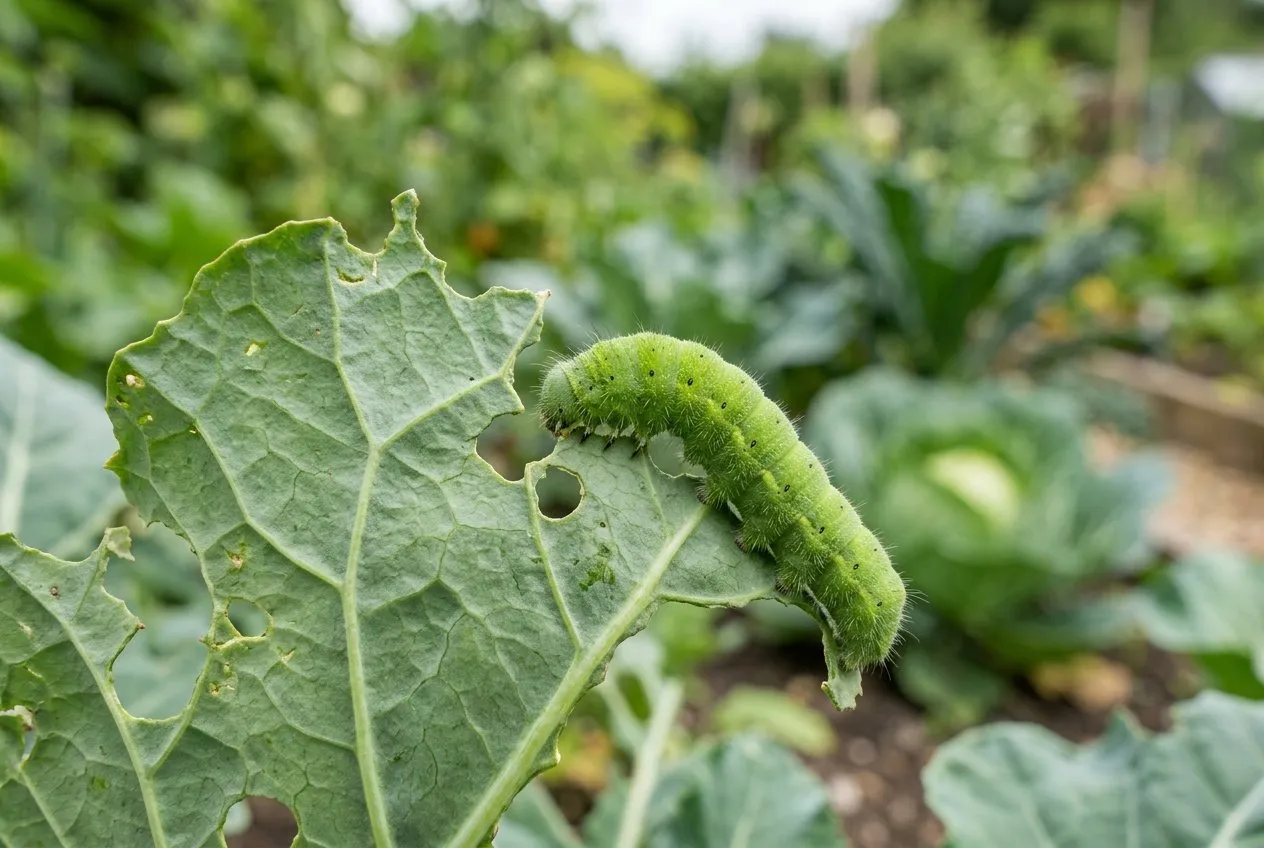 Holes and droppings mean caterpillars, not aphids. The two pests need different controls.
Where mealy cabbage aphid colonies hide on brassicas
Colonies settle in the parts of the plant you check last: leaf undersides, growing points and the tucked-in folds of sprouts and hearts. The aphids favour soft, actively growing tissue where the sap flows freely, so the newest growth carries the heaviest infestations.
On cabbages and cauliflowers, look at the growing point in the centre of the plant and the undersides of the inner leaves. On kale, run a hand under the curled leaf edges near the top of the plant. The real trouble spot is Brussels sprouts. Colonies pack right inside the developing buttons, where they are sheltered, hard to see and almost impossible to wash out later. By the time the outer leaves look grey, the buttons are often already colonised.
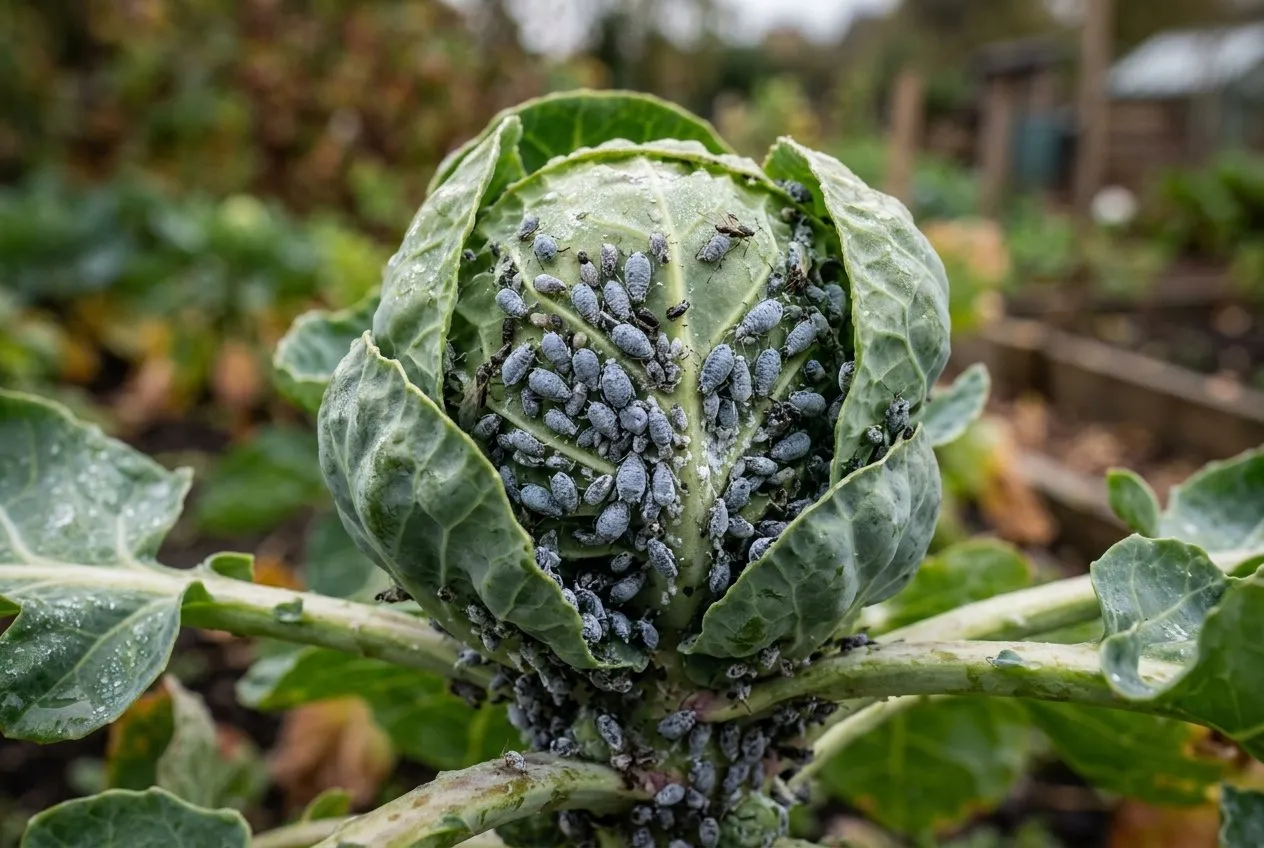 Sprout buttons are the worst hiding place. Colonies shelter deep inside, out of sight until harvest.
The damage: distorted leaves, yellowing and contaminated crops
Feeding damage shows as yellow-white patches, curled leaves and stunted growth. As the aphids drain sap, the leaf tissue around each colony turns pale and puckers. Heavy infestations distort whole leaves and can stunt or kill a young plant by destroying its single growing point.
On mature plants the harm is more about the crop than the plant’s survival. Aphids buried in sprout buttons and cauliflower curds contaminate the part you eat. Nobody wants a grey crust of insects buried inside a sprout at Christmas dinner. Broccoli spears and kale leaves pick up colonies too, and the aphids are fiddly to wash out of tight florets and curled foliage.
There is a secondary problem. Like most aphids, mealy cabbage aphid excretes sticky honeydew, which grows sooty black mould. On lower leaves this cuts the light the plant can use. The aphid can also carry brassica viruses between plants, though that matters more for seed crops than for a home veg bed. Keeping colonies down protects both the look and the yield of the crop.
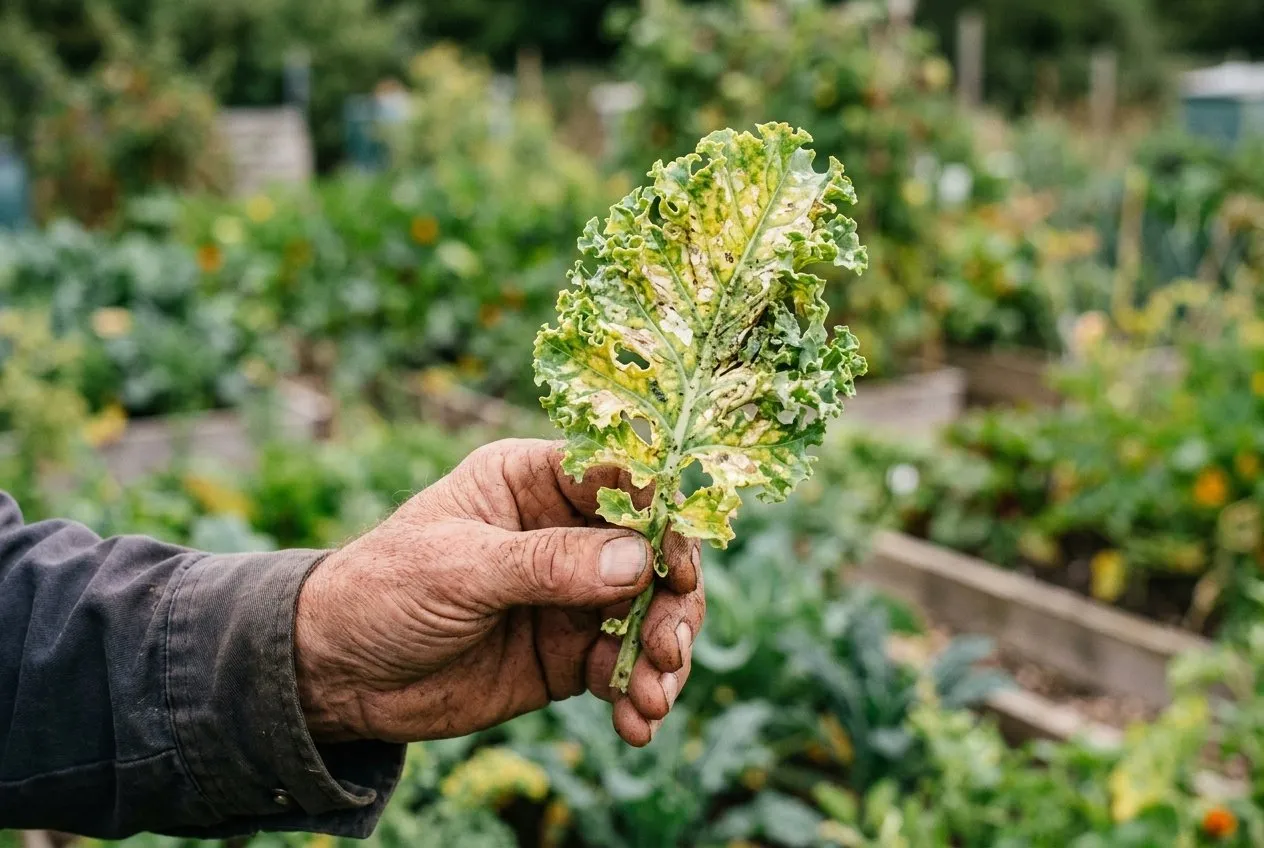 Yellow patches and puckered, distorted leaves are the tell-tale feeding damage.
Lifecycle and why clearing stumps by winter matters
The aphid overwinters as eggs laid on brassica stems in late autumn, and those eggs are why the pest returns to the same plot each year. In spring the eggs hatch onto new growth, wingless females give birth to live young through summer, and colonies build fast in warm weather. Winged aphids then spread the problem to fresh plants.
This is the weak link in the cycle. According to the Royal Horticultural Society, the eggs are laid on the stems of host plants in late autumn, so the old woody stumps of kale, cabbage and sprouts are the overwintering site sitting right in your beds. Leave last year’s stalks standing and you keep a reservoir of eggs a few feet from next year’s seedlings. Pull and shred those stumps and you strip out the eggs before they can hatch.
Timing matters. Clear finished brassica plants as soon as they stop cropping, and get every stump out by December at the latest. Cut them into pieces before composting, or bag the woody bases if your heap does not get hot. This one job does more to reduce next year’s aphids than any spray. Fitting brassicas into a proper crop rotation helps too, since moving the beds puts distance between hatching eggs and fresh plants.
Mealy cabbage aphid month-by-month calendar
| Month | What is happening | What to do |
|---|---|---|
| January | Eggs dormant on any old stumps left standing | Clear and shred any remaining brassica stumps |
| February | Eggs still dormant | Finish stump clearance before growth starts |
| March | First eggs begin to hatch | Sow under fine mesh; keep seedbeds clean |
| April | Early colonies appear on new growth | Start weekly checks of undersides |
| May | Colonies build; winged aphids spread | Squash early clusters; net young plants |
| June | Numbers rising in warm spells | Hose off colonies; watch growing points |
| July | Peak feeding on soft summer growth | Blast colonies weekly; back the predators |
| August | Colonies pack into sprout buttons and curds | Keep hosing; spot-treat heading crops if needed |
| September | Numbers ease as growth slows | Continue checks; harvest and wash carefully |
| October | Winged forms move to lay eggs | Clear finished plants promptly |
| November | Eggs laid on woody stems | Pull spent stumps as crops finish |
| December | Eggs overwintering on any stumps | Get every stump out and shredded |
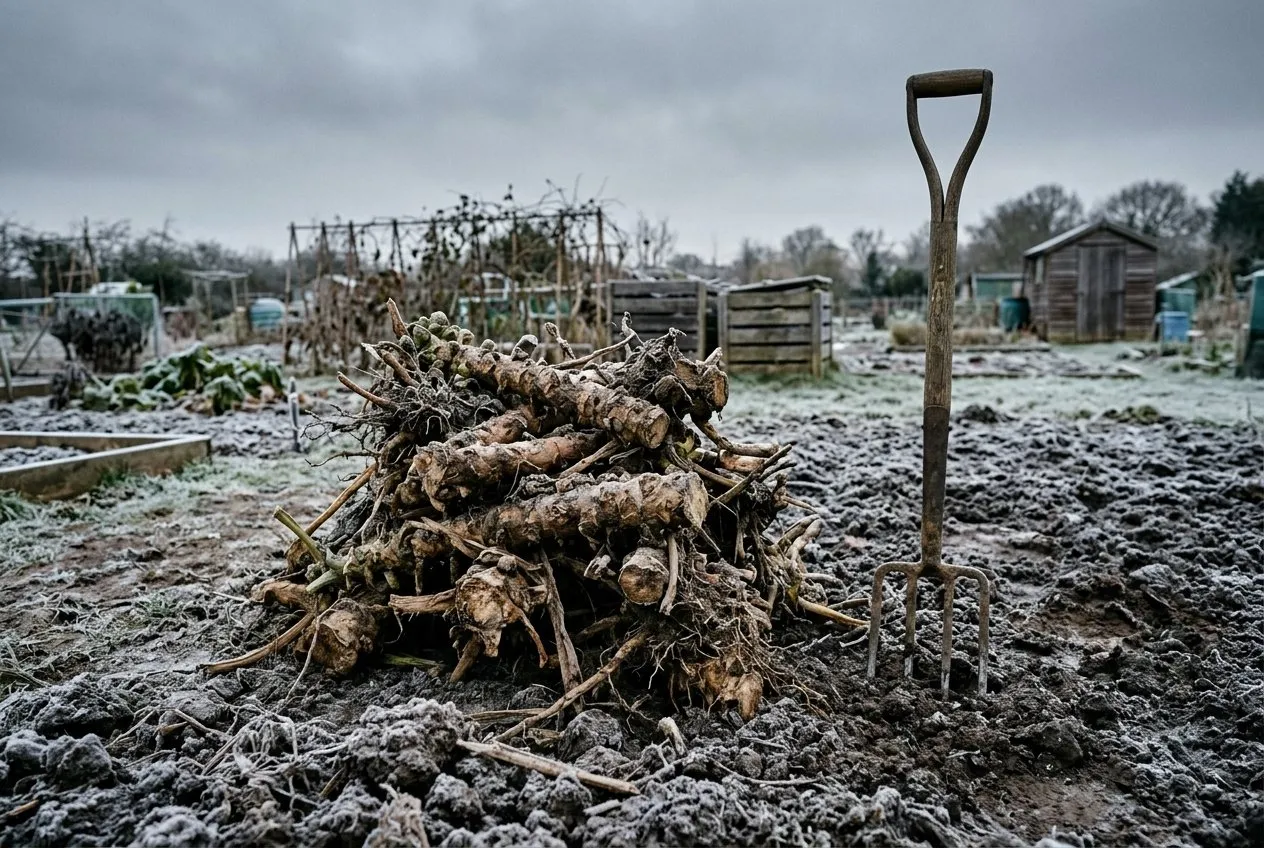 Old stumps are the overwintering site. Clearing them by December is the single best control.
How to control mealy cabbage aphid without chemicals
The two best hands-on controls are squashing and water. Both are free, both are effective on small to medium colonies, and neither harms the predators you want to keep. Start early, before a colony spreads from one leaf to the whole plant.
Squashing is simplest. Wearing a glove, pinch or rub out each colony you find on a growing point or leaf underside. Do it twice a week through summer and you keep the numbers from ever building. It is grim work but it is the most targeted control there is, and on a few plants it is all you need.
Water handles bigger colonies. A firm jet from a hose or a pressure sprayer knocks hundreds of aphids off at once, and most cannot climb back before predators find them on the ground. The mealy wax makes a gentle spray useless, so you need real force, aimed up at the undersides. Repeat every few days while colonies are active. For the full run of non-chemical methods across the veg patch, see our guide to organic pest control.
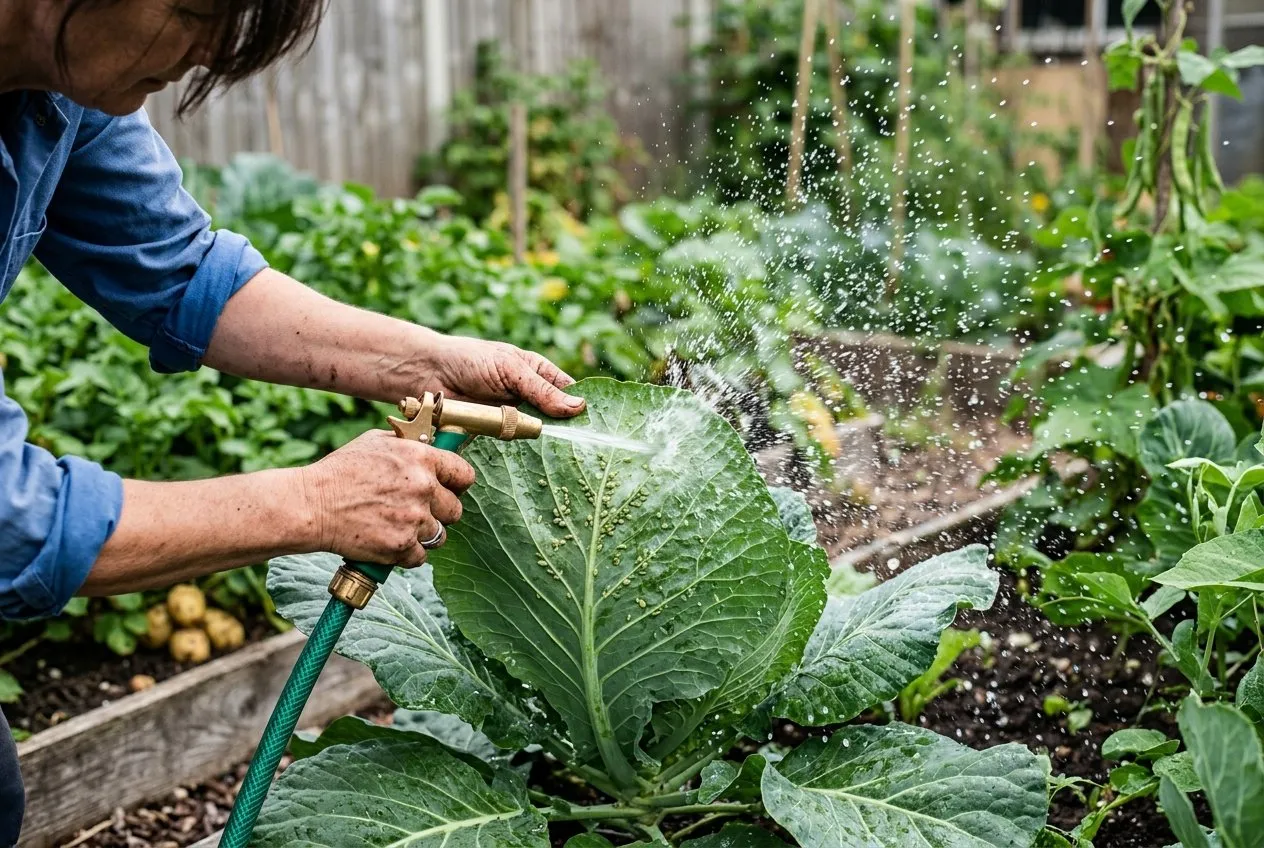 A firm jet of water dislodges hundreds of aphids at once. The wax means you need real force.
Encouraging natural enemies: ladybirds, hoverflies and aphid mummies
The most reliable long-term control is a garden full of predators. Ladybirds, hoverfly larvae, lacewings, ground beetles and tiny parasitic wasps all eat or parasitise mealy cabbage aphid, and together they keep colonies in check without any work from you. Your job is to keep them fed and unpoisoned.
The parasitic wasp is the quiet hero. Diaeretiella rapae is a black wasp only a couple of millimetres long. It lays an egg inside a living aphid, the larva eats the aphid from within, and it leaves behind a pale, swollen, papery shell called a mummy. Look closely at a colony in midsummer and you will spot these bronze mummies, some with a neat round exit hole where the adult wasp chewed its way out. Garden Organic runs a citizen-science project tracking exactly this, the exploding aphid hunt, and the mummies are the sign the wasps are winning.
To keep the predators on side, grow flowers near your brassicas. Hoverflies and wasps need nectar, so a strip of poached-egg plant, marigolds or fennel pulls them in. Never spray broad insecticides, which kill the predators faster than the pests and leave you worse off. Fitting brassicas into a companion planting scheme feeds the beneficial insects all season, and learning to recognise the larvae of lacewings stops you squashing your own allies by mistake.
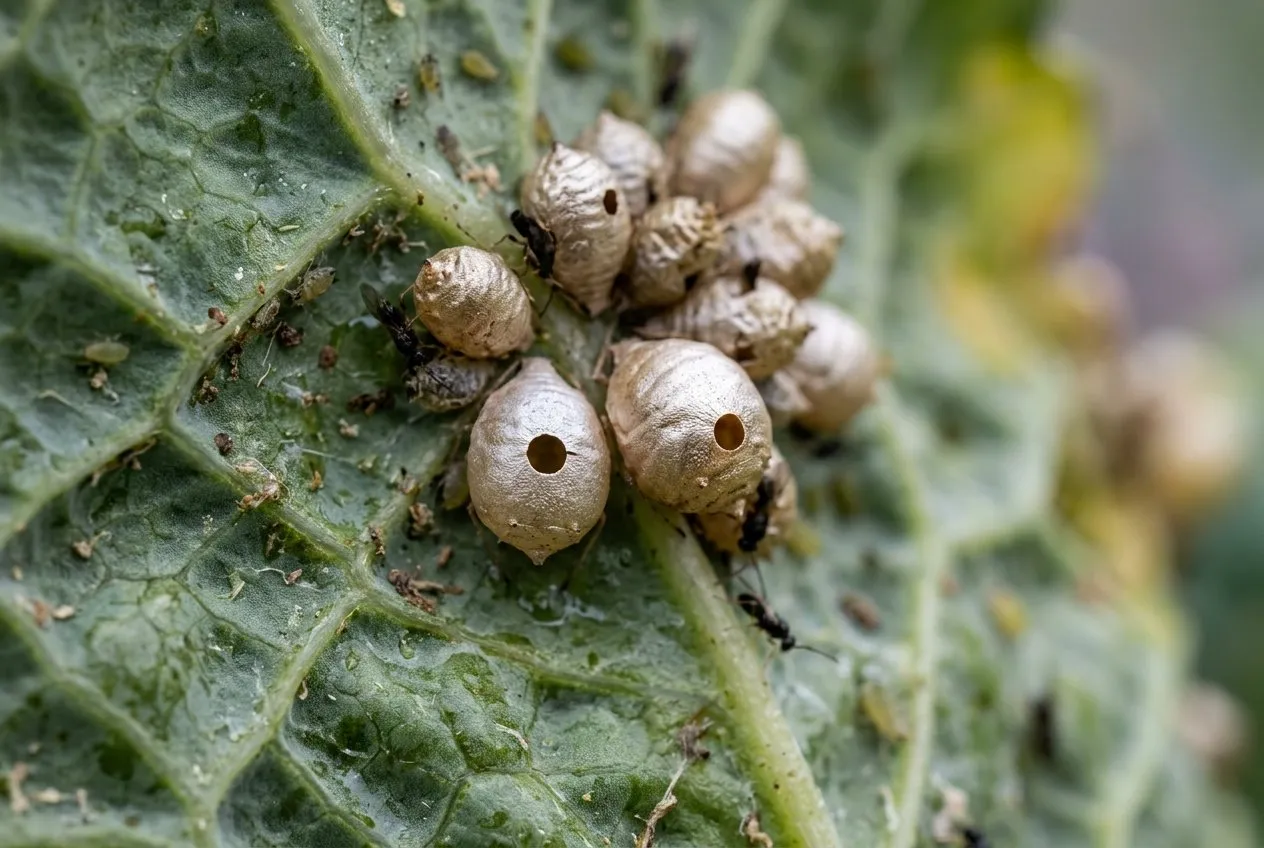 Pale, swollen mummies with exit holes mean parasitic wasps are at work. Leave them be.
Do nets and mesh stop mealy cabbage aphid?
Most butterfly netting does not stop this aphid. The standard 7mm mesh sold to keep cabbage whites off will let aphids walk straight through the holes. To exclude aphids you need fine insect mesh with a hole size of around 0.8mm, fitted tightly with the edges buried or weighted to the soil.
Fine mesh works, but it has trade-offs. It cuts airflow and can raise humidity underneath, which suits mildew, so watch for disease in a wet summer. It also keeps out the ladybirds and wasps that would otherwise control any aphids that do get in, so if a few winged aphids slip under the edge, their colony can explode with no predators to check it. Lift the mesh weekly and inspect the plants.
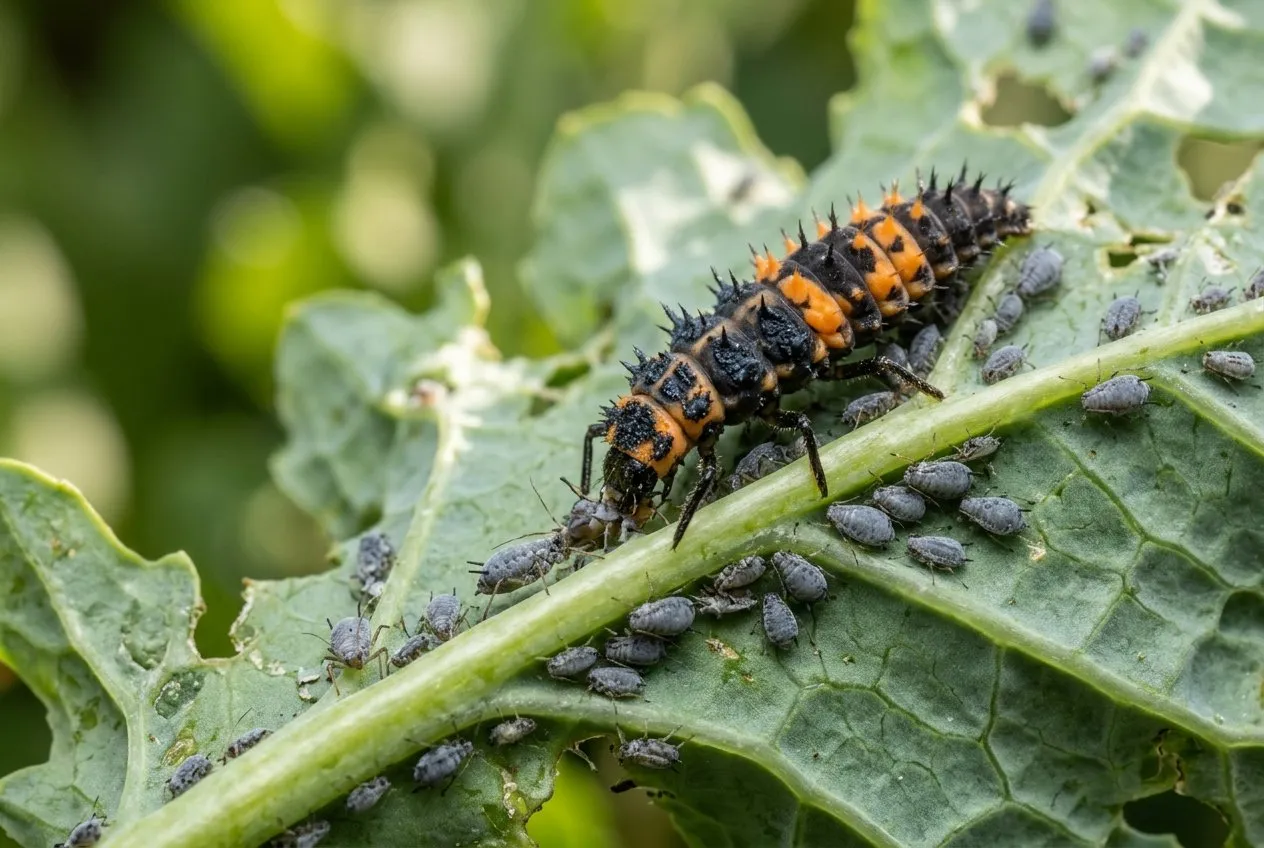 A ladybird larva clears aphids fast. Fine mesh keeps these allies out, so use it only on young plants.
Tolerance thresholds and organic sprays as a last resort
You do not need to kill every aphid. Established, well-grown brassicas shrug off light colonies, and the RHS advises tolerating aphids on mature plants rather than reaching for a spray. The threshold that matters is the crop: colonies on the part you eat, or on young plants with a single growing point, are the ones worth acting on.
Act hard on seedlings and heading crops. A colony on a seedling’s growing point can kill it, so rub those out at once. Aphids invading sprout buttons, cauliflower curds and broccoli heads spoil the harvest, so treat those. Colonies on the tough outer leaves of a big, healthy plant can usually be left to the predators.
If you must spray, use a plant-based organic option and treat it as a last resort. Insecticidal soap or a fatty-acid spray breaks down the waxy coating and works on contact, but it also hits predators it touches, so spot-treat colonies rather than drenching the plant. Spray in the evening when bees are not working. Our guide to homemade pesticides covers the legal, effective mixes for a veg patch. Never use a broad synthetic insecticide on a flowering brassica.
Washing harvested crops: the salt-water soak
A cold salt-water soak clears aphids from harvested crops. Aphids tucked into sprout buttons and broccoli florets are hard to rinse out under a tap alone, but a soak floats them free. This is the step that turns an infested-looking crop into a clean plate of veg.
Trim off any heavily colonised outer leaves first. Then soak the sprouts, broccoli, cauliflower or kale in a bowl of cold water with a good tablespoon of salt per litre for 10 to 15 minutes. The aphids float loose and the salt draws out any buried deep in the buttons. Rinse thoroughly under a running tap afterwards to wash off the salt and any last insects.
For sprouts, cutting a shallow cross in the base before soaking helps the water get right inside the button. The crop is perfectly safe to eat once washed; aphids are harmless if a few slip through, just unappetising. Growing your own means the odd insect, and a quick soak is a small price for veg with no pesticide on it at all. This same soak works for brassica crops carrying any small pest, not just aphids.
Common mistakes when tackling mealy cabbage aphid
Most cabbage aphid problems come down to a few repeated errors. Fix these and the pest becomes a minor nuisance rather than a crop-wrecker.
Leaving old brassica stumps standing over winter
This is the big one. Every old kale, cabbage and sprout stalk left in the ground is an egg bank for next year. Pull them as crops finish, shred the woody bases, and get the lot cleared by December. Skipping this hands the pest a head start every spring.
Trusting butterfly netting to keep aphids out
The 7mm mesh that stops cabbage whites lets aphids stroll through. If you net for aphids, use fine 0.8mm insect mesh, fitted tight to the ground. Otherwise you get a false sense of security while colonies build underneath, unchecked by the predators the mesh also excludes.
Spraying broad insecticides and wiping out predators
A blanket spray kills your ladybirds and parasitic wasps along with the aphids, and the aphids recover first. Reserve any spray for spot-treating colonies on the crop itself, and lean on squashing, water and predators for everything else.
Only checking the tops of leaves
Colonies hide on undersides, in growing points and inside sprout buttons. A plant that looks clean from above can be crawling underneath. Turn leaves and part the growing points every week through summer, and deal with colonies while they are small.
Reaching for the sprayer too early
Light colonies on established plants rarely need action. Give the predators a week or two to find them before you intervene, and check for wasp mummies first. Panic-spraying at the first grey speck just sets back the natural control you want to build.
Frequently asked questions
What does mealy cabbage aphid look like?
Grey-blue aphids with a powdery, waxy coating, up to 2.5mm long. They pack into dense static colonies on the undersides of brassica leaves and around the growing point. The mealy wax makes a colony look dusted with flour, which sets them apart from the shiny green or black aphids you see on beans and roses.
How do I tell mealy cabbage aphid from cabbage whitefly?
Aphids stay put; whitefly fly up in a cloud when you touch the plant. Mealy cabbage aphids are grey-blue, wingless for most of the year, and sit in crusty colonies. Cabbage whitefly are tiny white moth-like insects that scatter into the air when disturbed and leave sticky honeydew and black mould on lower leaves.
Are cabbage aphids the same as the caterpillars on my cabbages?
No, they are completely different pests. Caterpillars are the larvae of cabbage white butterflies and cabbage moths, and they chew large ragged holes in leaves. Mealy cabbage aphids are tiny grey sap-suckers that cluster without chewing. Holes mean caterpillars; a grey powdery crust means aphids. The controls for each are different.
How do I get rid of mealy cabbage aphid without spraying?
Squash the colonies by hand or blast them off with a jet of water. Wear a glove and rub out clusters on growing points twice a week. A firm spray from a hose knocks off hundreds at once. Then leave ladybirds, hoverfly larvae and parasitic wasps to mop up the survivors, which they do well outdoors.
Can you eat sprouts or broccoli with cabbage aphids on?
Yes, once you have washed them thoroughly. Soak heads and sprouts in cold salted water for 10 to 15 minutes, then rinse well under a running tap. The aphids float free and the salt draws out any tucked deep in the buttons. Trim off any heavily infested outer leaves before cooking. The crop itself is safe to eat.
Why do cabbage aphids keep coming back every year?
Because eggs survive winter on old brassica stumps and debris. The aphid lays eggs on woody stems in late autumn, and they hatch onto new spring growth nearby. If you leave last year’s kale, sprout and cabbage stalks standing, you hand next year’s crop a ready-made colony. Clearing and shredding stumps by December breaks that chain.
Does netting stop mealy cabbage aphid?
Not the butterfly netting most people use. Standard 7mm mesh stops cabbage white butterflies but aphids walk straight through it. You need fine insect mesh of around 0.8mm to exclude aphids, fitted tight to the ground with no gaps. Even then, check under the mesh regularly, as a few winged aphids usually find a way in.
If caterpillars are shredding the same plants, our guide to the cabbage moth covers the other half of the brassica pest problem.
Our team produces practical UK gardening guidance from source research, contributor records and established horticultural practice. Editorial standards are overseen by Matt W.