Key takeaways
- OPM caterpillars appear May to July and travel in nose-to-tail processions up oak trunks
- Nests are white silken domes on the trunk or branches, never woven among the leaves
- The tiny barbed hairs cause rashes, eye and throat irritation in people and dogs
- Old, brown, spent nests stay hazardous for years because the hairs remain active
- OPM is a notifiable pest: report it via TreeAlert and never touch or remove a nest yourself
- Most silken webbing gardeners panic about is harmless small ermine moth, not OPM
Oak processionary moth is not just a tree problem. It is a public-health problem that happens to live in trees. If you garden, walk a dog, or take children to a park anywhere near London, this is the one caterpillar worth learning to recognise on sight.
The moth arrived in London in 2006, carried in on imported oak saplings. Two decades on it is established across most of Greater London and is pushing into the surrounding counties. The caterpillars are covered in tiny barbed hairs that irritate skin, eyes and airways. This guide is about spotting them safely, telling them apart from the harmless webbing people panic about, and knowing exactly what the law asks you to do.
What oak processionary moth looks like
Oak processionary moth caterpillars are dark grey to black, up to 25mm long, and covered in long white hairs. The single most reliable sign is behaviour: they move in single-file, nose-to-tail processions up and down the trunk, sometimes fanning into an arrowhead. Nothing else on a British oak does this.
The caterpillars feed only on oak. They cluster together by day and travel out to the leaves to feed, always returning to a communal nest on the bark. As they grow, from the third larval stage onwards, they develop the barbed hairs that make them a hazard. A mature caterpillar carries thousands of these microscopic hairs, each holding an irritant protein called thaumetopoein.
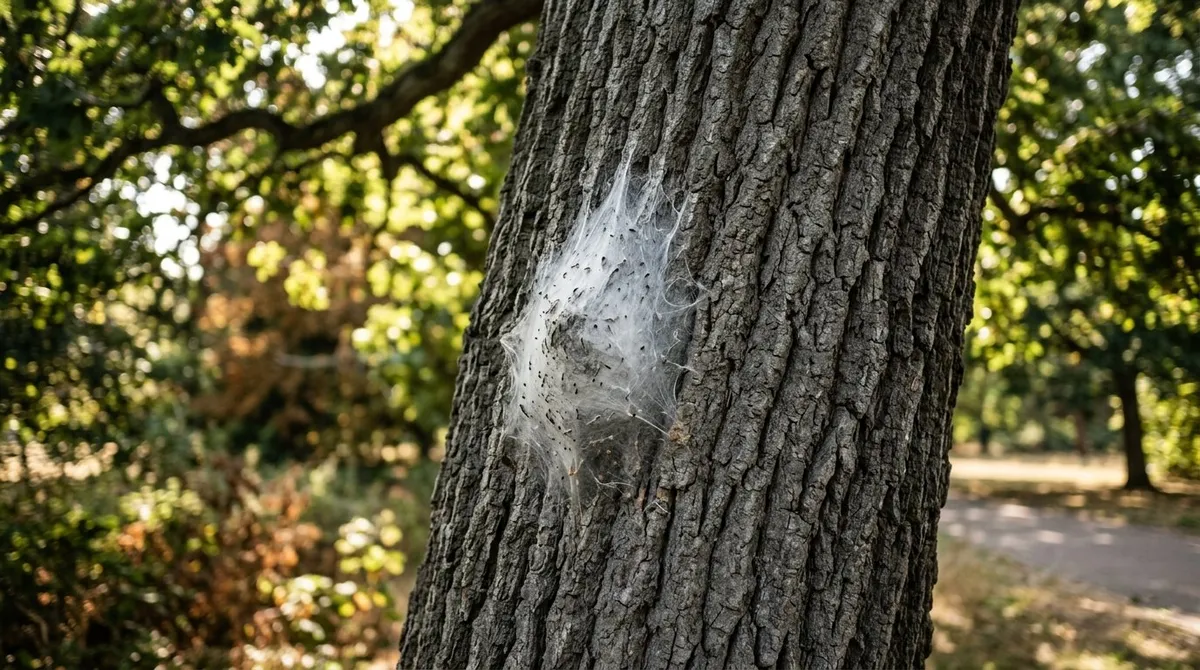
You will usually notice the nest before the caterpillars. Nests are white, silken and clamped to the trunk or a large branch. They start bright white and fade to a dirty brown over the season. Shapes vary: dome, teardrop, hammock or a flat blanket wrapped round the bark. Sizes run from a few centimetres to something the size of a rugby ball.
The animal you actually want to protect here is the tree the moth attacks. English oak and sessile oak are among our most valuable native oak trees, and a mature specimen supports hundreds of other species. OPM does not usually kill them, but it weakens them, which matters on trees already under pressure.
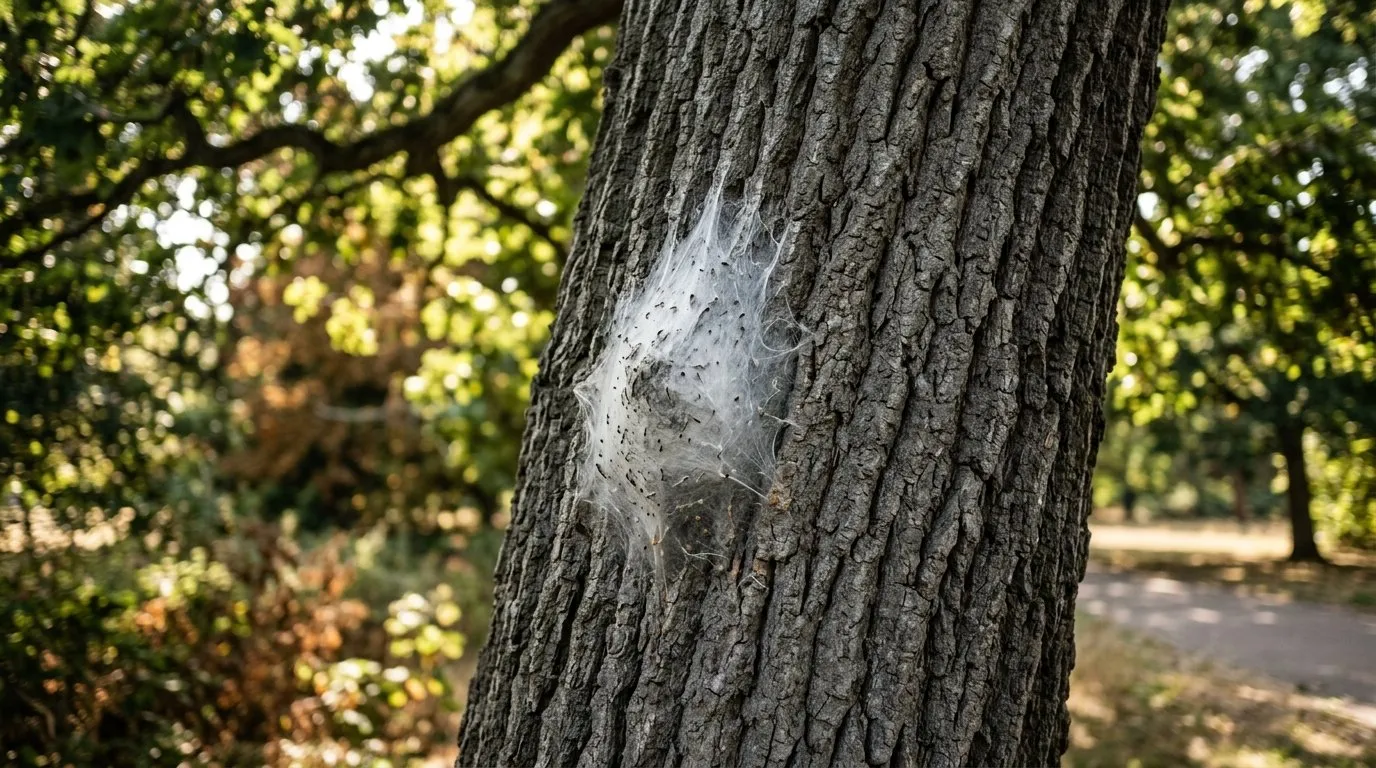 A classic OPM nest: white silken webbing pressed flat against the oak trunk, not woven among the leaves.
How to tell OPM from harmless ermine moth webbing
Most silken webbing that alarms gardeners is not oak processionary moth at all. It is small ermine moth, which is completely harmless to people and pets. Getting this distinction right saves a lot of needless worry and a lot of wasted reports.
The quickest test is the host plant. OPM lives only on oak. If the webbing is on a hedge, a spindle bush, a bird cherry, a hawthorn or a blackthorn, it is not OPM. Small ermine moth caterpillars spin large sheets of webbing that wrap whole branches, leaves and twigs, sometimes covering an entire shrub in what looks like a ghostly gauze. It looks dramatic and it does no harm. The plant usually releaves within weeks.
The second test is position. OPM nests sit flat against the bark of the trunk or a major limb. They are never woven in or around the foliage. Ermine webbing is the opposite: it is all in the leaves and outer twigs.
A third lookalike deserves respect. Brown-tail moth caterpillars also carry irritating hairs, so they are not harmless. But they live on shrubs like hawthorn, blackthorn and bramble, mostly near the coast in southern and eastern England, and their nests are tight white silk tents on branch tips. If irritating webbing is on a coastal hedge rather than an oak, brown-tail is the more likely culprit.
Comparison: OPM vs its common lookalikes
| Feature | Oak processionary moth | Small ermine moth | Brown-tail moth |
|---|---|---|---|
| Host plant | Oak only | Hedges, spindle, hawthorn, cherry | Hawthorn, blackthorn, bramble |
| Where the webbing sits | Flat on trunk and branches | Wrapped over leaves and twigs | White tents on branch tips |
| Caterpillar look | Dark, long white hairs, processions | Pale, dark spots, no processions | Dark with two orange dots, hairy |
| Health risk | High: barbed irritant hairs | None | Moderate: irritant hairs |
| Notifiable? | Yes, report it | No | No |
| Typical location | Greater London, SE England | UK-wide | Coastal south and east |
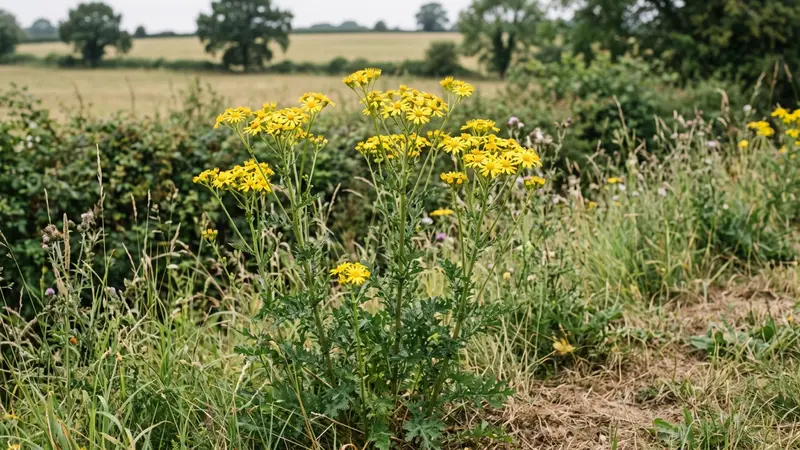
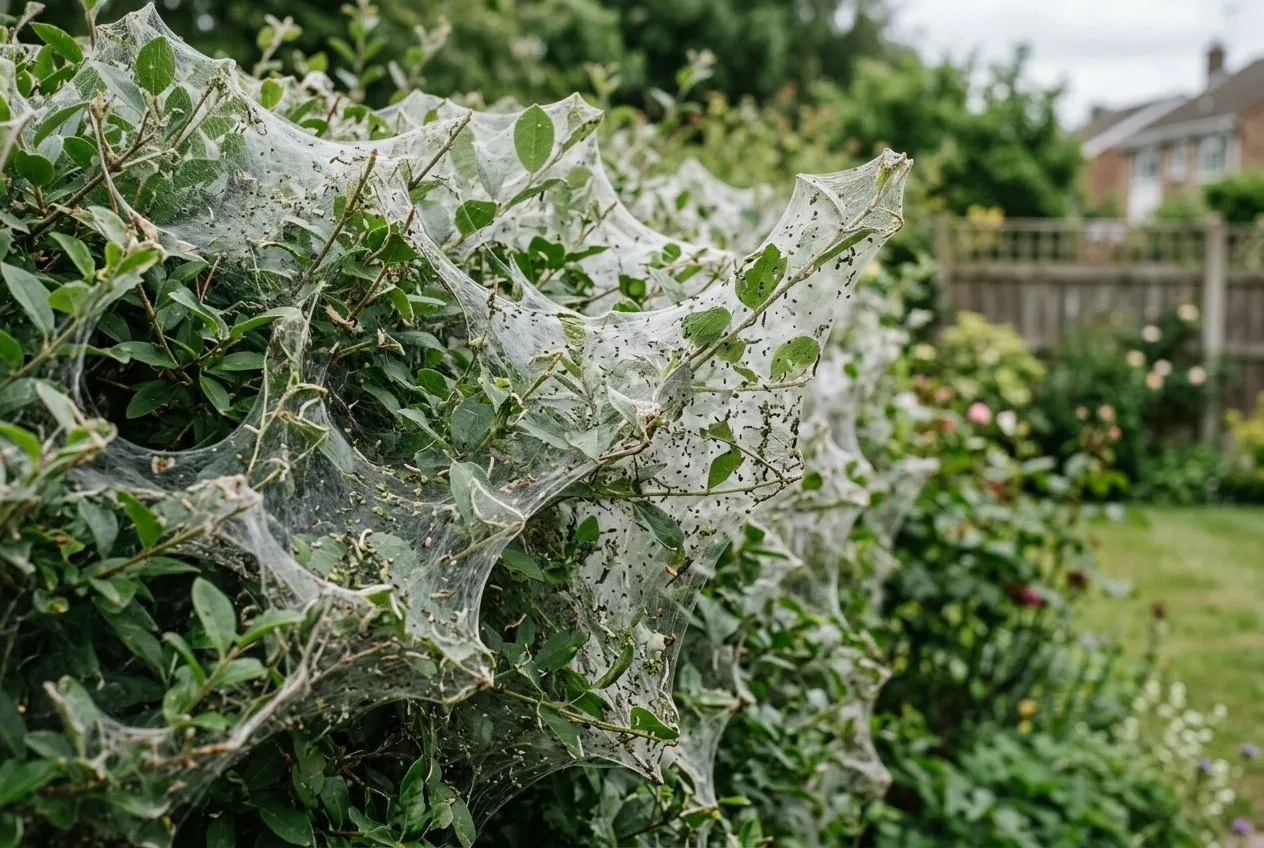 Harmless small ermine moth webbing, wrapped over a hedge. The clue is the host: leaves inside the web, and not an oak in sight.
Why the caterpillar hairs are a health risk
The danger from oak processionary moth comes from its hairs, not its bite. Each older caterpillar is covered in thousands of tiny barbed hairs loaded with an irritant protein. These hairs shed easily, blow on the wind, and collect in and around the nests, which is why you do not have to touch anything to react.
In people, contact causes itchy, sometimes painful skin rashes, usually on exposed arms, necks and hands. Hairs in the eyes cause soreness and redness. Breathed in, they irritate the throat and airways and can trigger coughing or breathing difficulty, more seriously in anyone with asthma. Reactions are usually uncomfortable rather than dangerous, but they can be severe in sensitive individuals.
The risk is highest in May and June, when caterpillars are large and hairy and the nests are active. It does not stop there. Loose hairs persist in old nests and in the leaf litter and bark crevices below an infested tree.
Warning: Old, faded brown nests are not safe. The irritating hairs stay active in spent webbing for years after the caterpillars have gone. A previous summer’s nest can still cause a rash. Treat every nest on an oak, fresh or old, as a hazard, and never handle one.
Dogs are especially exposed because they investigate with their noses. A dog sniffing a nest or a fallen caterpillar can get hairs in its mouth, gums and throat, causing drooling, swelling, pawing at the face and distress. This is worth knowing whether or not you have OPM locally, alongside the other plants toxic to dogs that catch owners out. Keep dogs on the lead near infested oaks.
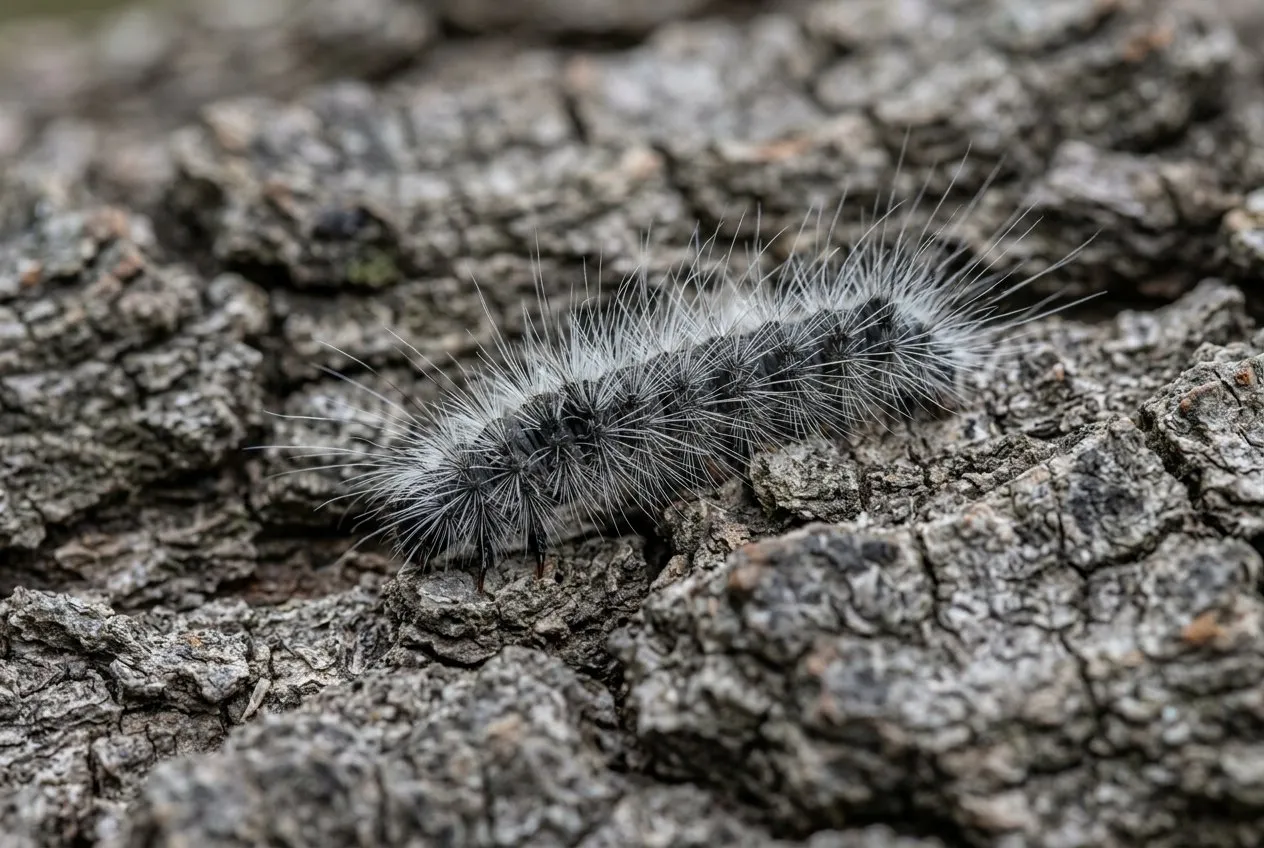 The hairs are the hazard. A mature caterpillar carries thousands of barbed hairs that shed and blow on the wind.
When to look: the OPM caterpillar and nest timeline
Oak processionary moth runs one generation a year, so the risky window is predictable. Eggs laid the previous summer hatch in April. Caterpillars are visible and feeding through May, June and July, and this is when the hairs pose the greatest risk. Nests become obvious from June onwards.
By late summer the caterpillars pupate inside the nest, and adult moths emerge a few weeks later to mate and lay eggs high in the canopy. The adults are plain grey-brown, fly at night, and are harmless. It is only the larval stage that carries the hairs.
The practical point is timing your vigilance. If you are near the zone, do your looking in late spring and early summer, when both caterpillars and fresh nests are on show. Spot a nest in winter and it is a spent one from the previous year, still hazardous, still worth reporting.
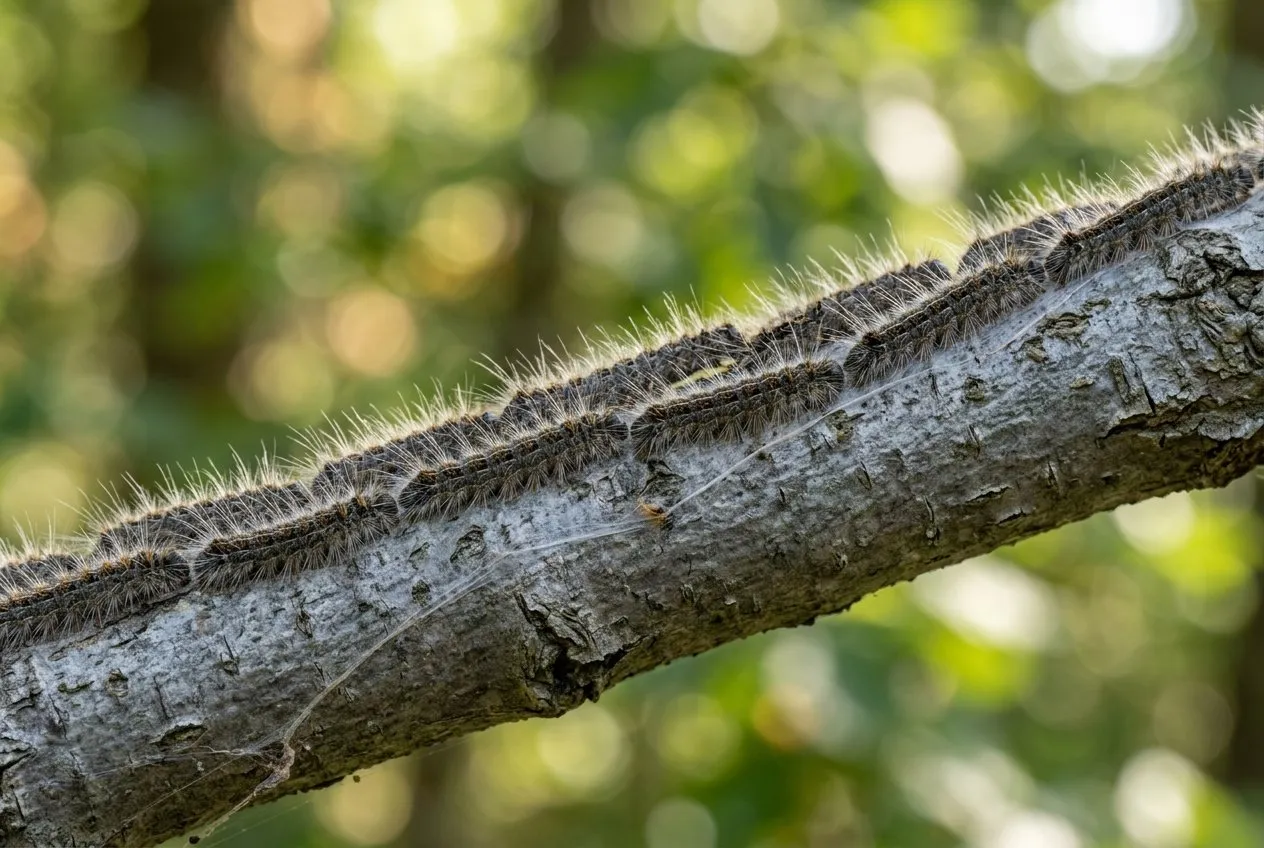 The diagnostic behaviour: caterpillars travel nose-to-tail in single file. Nothing else on a British oak does this.
Month-by-month OPM calendar
| Month | What is happening | What to do |
|---|---|---|
| January | Old nests remain on bark; eggs dormant in canopy | Note old nests, keep clear, report if new to you |
| February | Dormant; hairs in old nests still active | No contact with any nest |
| March | Eggs close to hatching | Check local council OPM updates if in the zone |
| April | Caterpillars begin to hatch | Approved spraying window on managed trees |
| May | Young caterpillars feeding; hairs developing | Start looking; keep dogs and children back |
| June | Large caterpillars, processions, fresh nests | Peak risk; report any nest via TreeAlert |
| July | Caterpillars mature; nests conspicuous | Peak risk continues; professional removal season |
| August | Pupation inside nests | Nests still hazardous; do not touch |
| September | Adult moths emerge and lay eggs | Low direct risk; nests remain hairy |
| October | Egg plaques set in canopy | Nothing to do; note nest locations |
| November | Nests fade to brown, still active | Continue to avoid contact |
| December | Dormant | Report any old nest you have not logged |
Where oak processionary moth is found in the UK
OPM is established across most of Greater London and is present in several surrounding counties, including parts of Kent, Essex, Hertfordshire, Berkshire and Hampshire. It first took hold in west and south-west London and has spread outward. Estimates put the natural spread at roughly 6km a year, which is why the boundary moves.
To manage that spread, the Forestry Commission runs a Defra-funded programme built around three zones. The Established Area covers London and its immediate surroundings, where the moth is here to stay and effort focuses on protecting people. Around it sits a Buffer Zone, then a Pest Free Area further out, where surveying and control aim to keep the moth from advancing. Zone boundaries are reviewed and updated most years as new sightings come in.
 Oak processionary moth is concentrated on London’s oaks, which is why parks in the capital carry the most warning signs.
What to do if you find oak processionary moth
The rule is short: do not touch it, and report it. OPM is a notifiable pest, which means you have a legal duty to report a suspected sighting to the plant health authorities. The reporting route is Forest Research’s TreeAlert, an online form where you upload a photo and pin the exact location.
Give as much detail as you can. A clear photo of the nest and the tree, a precise location or grid reference, and a note of whether it is on public or private land all help the response. If the tree is on council land or in a park, the local authority usually arranges control. If it is your own tree, you are responsible for engaging a professional.
Keep your distance while you do this. Stand back, keep children and dogs well clear, and do not let anyone poke or photograph the nest up close. If you have already brushed against foliage near a nest, change and wash your clothes separately.
Never attempt removal yourself. Nests are taken down by trained operators in full protective suits and respirators, often using specialist vacuum equipment, and the waste is handled as hazardous. This is not a job for a ladder and a bin bag. The Woodland Trust’s oak processionary moth guidance reinforces the same message for anyone tempted to deal with a nest at home.
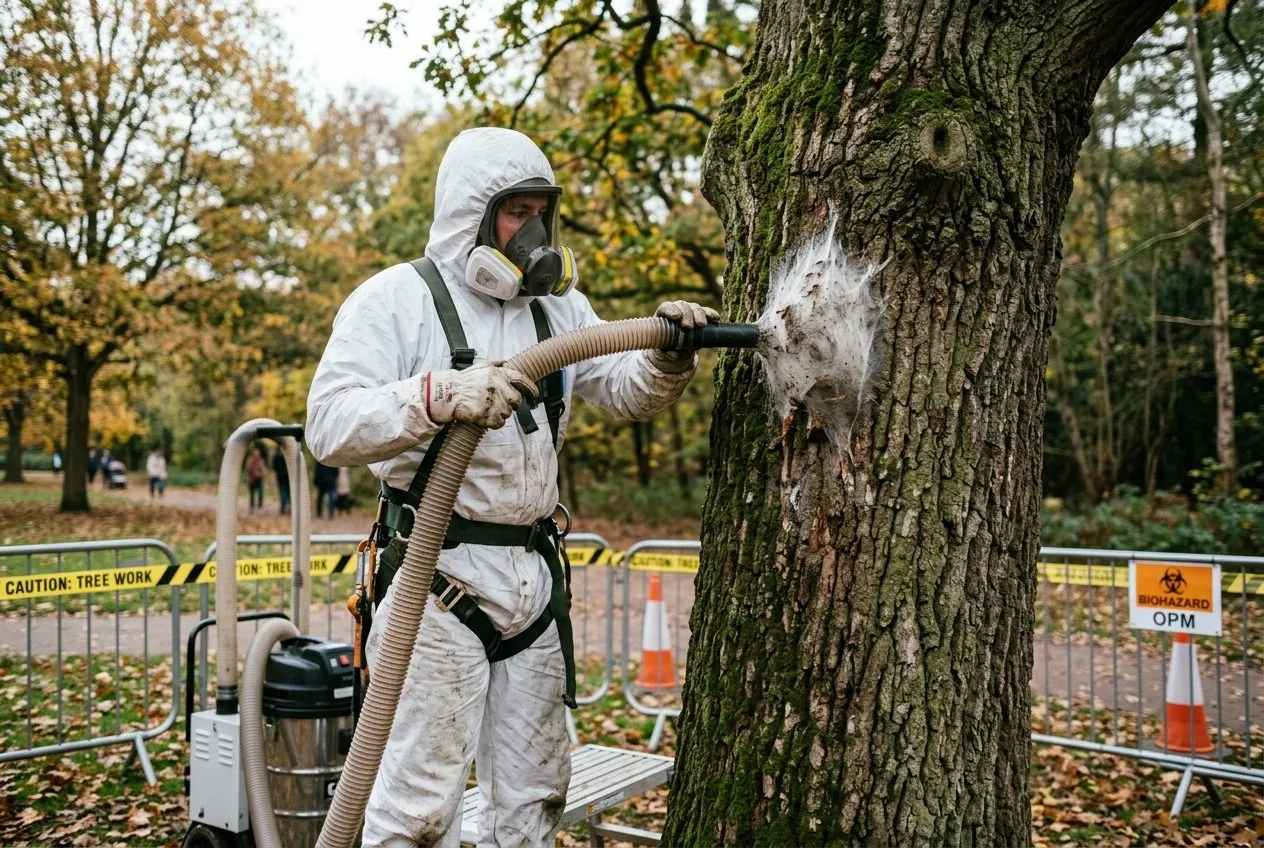 Nest removal is a job for trained operators in full protective kit, using vacuum equipment. Never a ladder and a bin bag.
 Keep dogs on the lead near marked oaks. Most dog reactions come from sniffing a nest or a fallen caterpillar.
What happens if you or your dog gets exposed
Most human reactions to OPM are mild and settle with simple care. If hairs land on your skin, do not scratch or rub, as that drives the barbs in. Wash the area with soap and water, remove and wash affected clothing separately, and use an antihistamine or a soothing cream for the itch. A cool compress helps.
Get medical advice if the reaction is more than skin deep. Hairs in the eyes need rinsing with clean water, and persistent soreness warrants a check. Any breathing difficulty, wheezing, or a severe or spreading rash means calling NHS 111 or, if breathing is badly affected, 999. People with asthma or known allergies should be especially cautious.
For dogs, act quickly. Rinse the mouth and affected area with water if you safely can, keep the dog from pawing its face, and phone your vet immediately. Swelling of the mouth or throat, heavy drooling or distress needs same-day veterinary attention. Prompt treatment usually brings a full recovery.
The best protection is avoidance, which is where a well-planned dog-friendly garden and sensible lead discipline on walks earn their keep. Once you know what a nest looks like, giving it a wide berth becomes second nature.
 If hairs touch skin, wash the area, do not scratch, and wash contaminated clothing separately.
Do infested oaks recover from defoliation
Most established oaks survive an OPM attack, even when the caterpillars strip a good share of the canopy. A healthy oak has deep reserves and usually reflushes new leaves, either later the same season or the following spring. Defoliation alone rarely kills a mature tree.
The concern is cumulative stress. An oak hit hard several years running, or one already weakened by drought, compaction or root damage, has less in the tank to recover with. Repeated defoliation leaves it more open to secondary pests and diseases. On veteran and ancient oaks, which we should protect most carefully, that added pressure matters.
This is why control focuses on human health first and tree health second. For most garden and park oaks, the tree will be fine. Your job is not to save the oak from the moth, which it can usually manage, but to keep people and pets away from the hairs while the professionals deal with the nest. If you are planting new oaks or other small native trees, buying UK-grown, traceable stock is the simplest way to avoid importing the problem in the first place.
Common mistakes people make with oak processionary moth
A handful of avoidable errors cause most of the trouble, from wasted reports to genuine exposure. Getting these right keeps you safe and keeps the response effort focused where it counts.
Panicking over webbing that is not on an oak
The most common mistake by far. Sheets of webbing on a hedge or shrub are small ermine moth, not OPM, and they are harmless. Check the host tree before you worry or report. No oak, no oak processionary moth.
Trying to remove a nest yourself
People reach for a broom or a bin bag and end up covered in hairs. Nest removal is a job for trained, protected professionals with the right equipment. Report it and let the process work. A DIY attempt risks a serious reaction and can scatter hairs further.
Treating old brown nests as safe
A faded nest from last summer looks harmless and is not. The hairs stay active for years. Do not touch, prune around, or dislodge an old nest, and warn anyone doing tree work nearby that it is there.
Letting dogs sniff around infested oaks
Off-lead dogs nosing at trunks and leaf litter are the classic OPM casualty. Near any marked or suspected oak, keep the dog on a short lead and away from the base of the tree, where fallen caterpillars and shed hairs collect.
Assuming your area is automatically clear
Living outside the London zone lowers the risk but does not remove it. Imported trees have seeded isolated outbreaks well beyond the range. If you find a genuine nest on an oak anywhere, report it; that is how new incursions are caught. Learn to recognise other moth pests too, such as box tree moth, so you can tell a real threat from a harmless one.
Frequently asked questions
How do I identify oak processionary moth?
Look for white silken nests on an oak trunk or branch. The caterpillars are grey-dark with long white hairs and move in single-file, nose-to-tail processions up and down the bark. Nests are dome, teardrop or blanket shaped. They sit on the wood, never woven among the leaves, and the tree is always an oak.
Is oak processionary moth dangerous to humans?
Yes, the caterpillars’ tiny hairs are a genuine health hazard. Each caterpillar carries thousands of microscopic barbed hairs holding an irritant protein. Contact causes itchy skin rashes, sore eyes, and throat or breathing irritation. Wind can carry loose hairs, so you do not need to touch a nest to react. The risk peaks in May and June.
Can oak processionary moth harm my dog?
Yes, dogs are at real risk, mostly from sniffing nests or fallen caterpillars. The hairs can cause mouth and throat swelling, drooling, eye irritation and skin reactions. Keep dogs on the lead near infested oaks and away from any silken webbing on trunks. If your dog reacts, rinse the area and phone your vet straight away.
What should I do if I find an oak processionary moth nest?
Do not touch it and keep children and pets back. Report it through Forest Research’s TreeAlert with a photo and location. Never try to remove a nest yourself; only trained professionals in protective equipment should do that. Note the tree so you can point out the exact spot when the local authority or landowner arranges control.
How long do old oak processionary moth nests stay dangerous?
Old nests stay hazardous for years, not weeks. The irritating hairs remain active in the spent webbing long after the caterpillars have pupated and left. A faded brown nest from a previous summer can still trigger rashes. Treat any old nest on an oak with the same caution as a fresh one, and never handle it.
What does harmless webbing on my hedge mean if it is not OPM?
It is almost certainly small ermine moth, which is harmless. Ermine moth caterpillars wrap whole shrubs and hedges in sheets of white webbing, often on hawthorn, blackthorn or spindle. The webbing envelops leaves and twigs, unlike OPM nests, which sit flat on oak bark. Ermine webbing looks alarming but causes no health risk and the plants usually recover.
Do oak trees survive oak processionary moth?
Yes, most healthy oaks survive even heavy defoliation. A vigorous oak stripped of leaves in summer normally reflushes and carries on. Repeated attacks, or an attack on a tree already stressed by drought or disease, do more harm. The bigger issue with OPM is human and animal health, not the long-term survival of an established oak.
Now you can tell a real oak processionary moth nest from the harmless webbing that alarms most people, and for another tree pest spreading across the UK, see our guide to elm zigzag sawfly.
Our team produces practical UK gardening guidance from source research, contributor records and established horticultural practice. Editorial standards are overseen by Matt W.