Key takeaways
- Larvae, not adults, do the damage: they eat fine roots in the top 2-3cm of wet compost
- A 5-10mm grit or vermiculite top-layer cut adult emergence by 82% in our trays
- Steinernema feltiae nematodes are the gold standard cure, killing larvae within 7-14 days
- Yellow sticky traps only monitor adults: they catch under 10% of the population
- Peat-free and coir composts stay wetter and breed far more gnats than old peat mixes
- Bottom-water and let the surface dry between waterings to break the breeding cycle
Sciarid flies, the tiny dark gnats that run across the surface of your seed trays, are the most common propagation pest in UK gardens. They look harmless, but the real trouble sits out of sight: the larvae graze fine seedling roots in the top 2-3cm of wet compost, checking growth and opening the door to damping-off. This guide is about fungus gnats at sowing time, in seed trays, propagators, and on the windowsill, where larvae kill or stunt young plants. For the houseplant side of the same pest, see our dedicated guides linked below. Here the focus stays on propagation: peat-free compost staying wet, root damage, and the breeding cycle you have to break.
The mistake that wrecks most seedling batches is simple. People swat the adults or spray the surface, watch the flies vanish for a day, then wonder why the seedlings still fail. The adults are a nuisance; the larvae are the killers.
What sciarid flies and fungus gnats actually are
Sciarid flies belong to the family Sciaridae, with Bradysia species being the usual culprits in UK seed trays. The adults are slender, dark, 2-4mm long, with long legs and a habit of running over compost before taking a weak, fluttering flight. They are often confused with shore flies and whitefly, but shore flies are stockier and whitefly are pure white.
The adults themselves cause almost no direct harm. They do not bite plants, and they live only about a week. The damage comes from the larvae: translucent, legless maggots up to 6mm long with a distinct shiny black head. These sit in the top 2-3cm of damp compost, where they feed on algae, fungi, decaying organic matter, and, critically, the fine root hairs and soft stem bases of seedlings.
In an established pot the larvae mostly recycle organic matter and do little visible harm. In a seed tray packed with germinating seedlings, that same grazing strips the roots a young plant cannot spare. Seedlings wilt, stall, or keel over at the base.
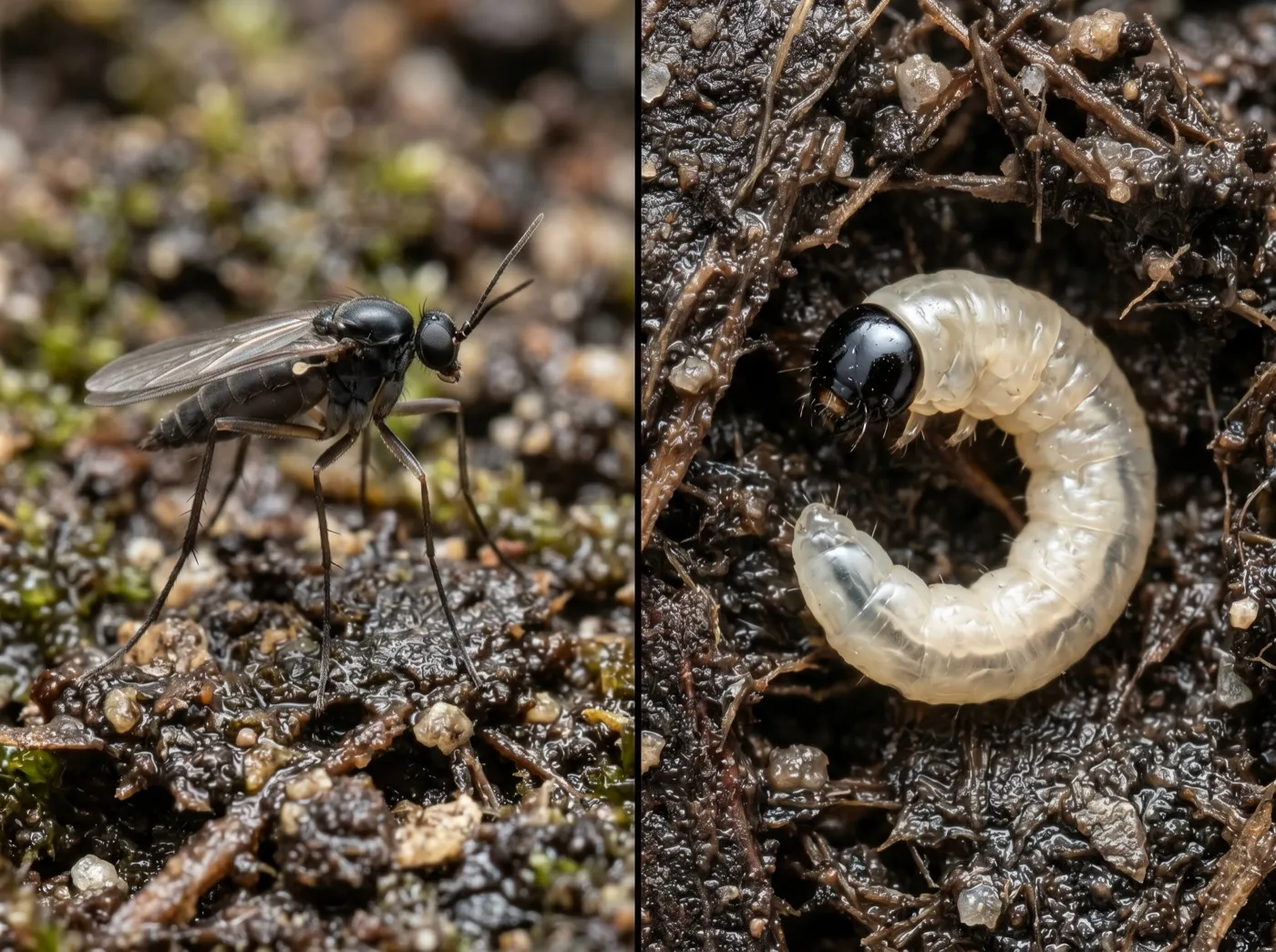 The adult sciarid fly (left) is a harmless nuisance. The translucent, black-headed larva (right) is the stage that grazes seedling roots.
The fungus gnat life cycle and why seed trays breed them
Understanding the life cycle is what separates a quick fix from a recurring problem. Fungus gnats pass through four stages, and warm propagation conditions speed every one of them up.
A female lays 100-200 eggs in the surface of damp compost, usually in cracks or against stems. At a propagation temperature of around 20C, eggs hatch in 4-6 days. The larvae then feed for 10-14 days, moult through four instars, and pupate near the surface. Pupae become adults in 3-7 days. The whole egg-to-adult cycle runs in roughly 21-28 days at 20C, faster when warmer, far slower below 15C.
| Stage | Duration at ~20C | Where it sits |
|---|---|---|
| Egg | 4-6 days | Surface cracks of damp compost |
| Larva | 10-14 days | Top 2-3cm, feeding on roots and fungi |
| Pupa | 3-7 days | Just below the compost surface |
| Adult | 7-10 days lifespan | On and above the compost, laying eggs |
The critical mistake is treating only the adults. Spraying or trapping flies removes the visible 10% while eggs and larvae carry on unseen. Within days a fresh wave of adults appears and the cycle never breaks. Seed trays are the worst offenders because constant moisture, bottom heat, and rich compost give every stage ideal conditions. Our guide to sowing seeds indoors covers the warm, damp setups gnats love.
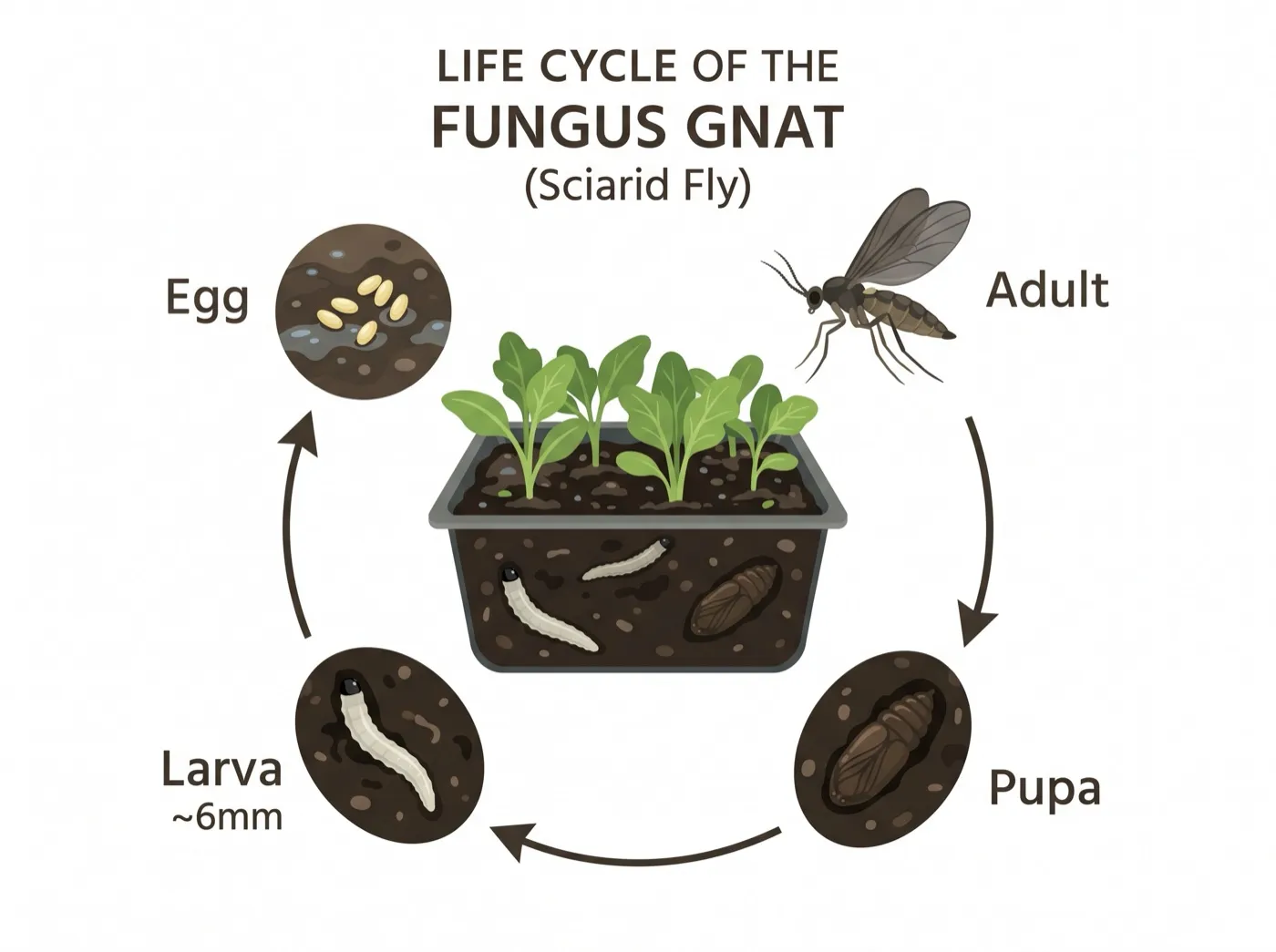 The four-stage life cycle completes in 21-28 days at 20C. Breaking it means killing larvae, not just adults.
How larvae damage seedlings and spread damping-off
The harm runs deeper than nibbled roots. Larvae feed on the fine root hairs and soft stem bases that a seedling depends on for its first few weeks. A pricked-out brassica or a tray of lettuce seedlings has barely any root reserve, so even light grazing checks growth or topples the plant.
The second, worse problem is disease. Larval feeding creates open wounds at the root and stem base, and the larvae themselves carry fungal spores through the compost. This is the link to damping-off, the collapse caused by soil fungi such as Pythium and Fusarium. Gnat larvae both wound the seedling and ferry the pathogen to the wound.
Warning: If seedlings are collapsing at the base in damp, gnat-ridden trays, treat both at once. Cutting the gnat population without improving drainage and airflow leaves the damping-off fungi free to spread.
Sciarid fly and fungus gnat control methods ranked
Not all controls are equal, and most people reach for the weakest one first. Here is how the options rank for actually protecting seedlings, ordered by effectiveness.
| Method | Target stage | Effectiveness | Role | What it cannot do |
|---|---|---|---|---|
| Steinernema feltiae nematodes | Larvae | Excellent (90%+ larval kill) | Primary cure for active infestation | Slow to act; needs moist compost above 10C |
| Grit/vermiculite top-layer | Egg-laying adults | Excellent (80-85% fewer adults) | Primary prevention | Will not kill larvae already present |
| Bottom-watering, surface drying | Eggs and young larvae | Good (breaks breeding cycle) | Cultural foundation | Slower; needs discipline every watering |
| BTI compost drench (e.g. mosquito bits) | Larvae | Good (70-80%) | Supplementary cure | Short-lived; needs repeat applications |
| Yellow sticky traps | Adults | Poor (under 10% of population) | Monitoring only | Never touches larvae doing the damage |
| Surface sprays on adults | Adults | Very poor | Not recommended | Ignores eggs, larvae, and pupae entirely |
The gold standard is a two-part approach: prevent with a grit top-layer and careful watering, then cure any active infestation with Steinernema feltiae nematodes. Nematodes are microscopic worms drenched into the compost; they hunt down larvae and kill them within 7-14 days, then keep working while the compost stays moist and above 10C.
What no method on this list can do is fix the problem by killing adults alone. Yellow sticky traps are useful, but only to monitor when adults emerge and to trim numbers. They are a thermometer, not a cure. Treat the compost or you treat nothing.
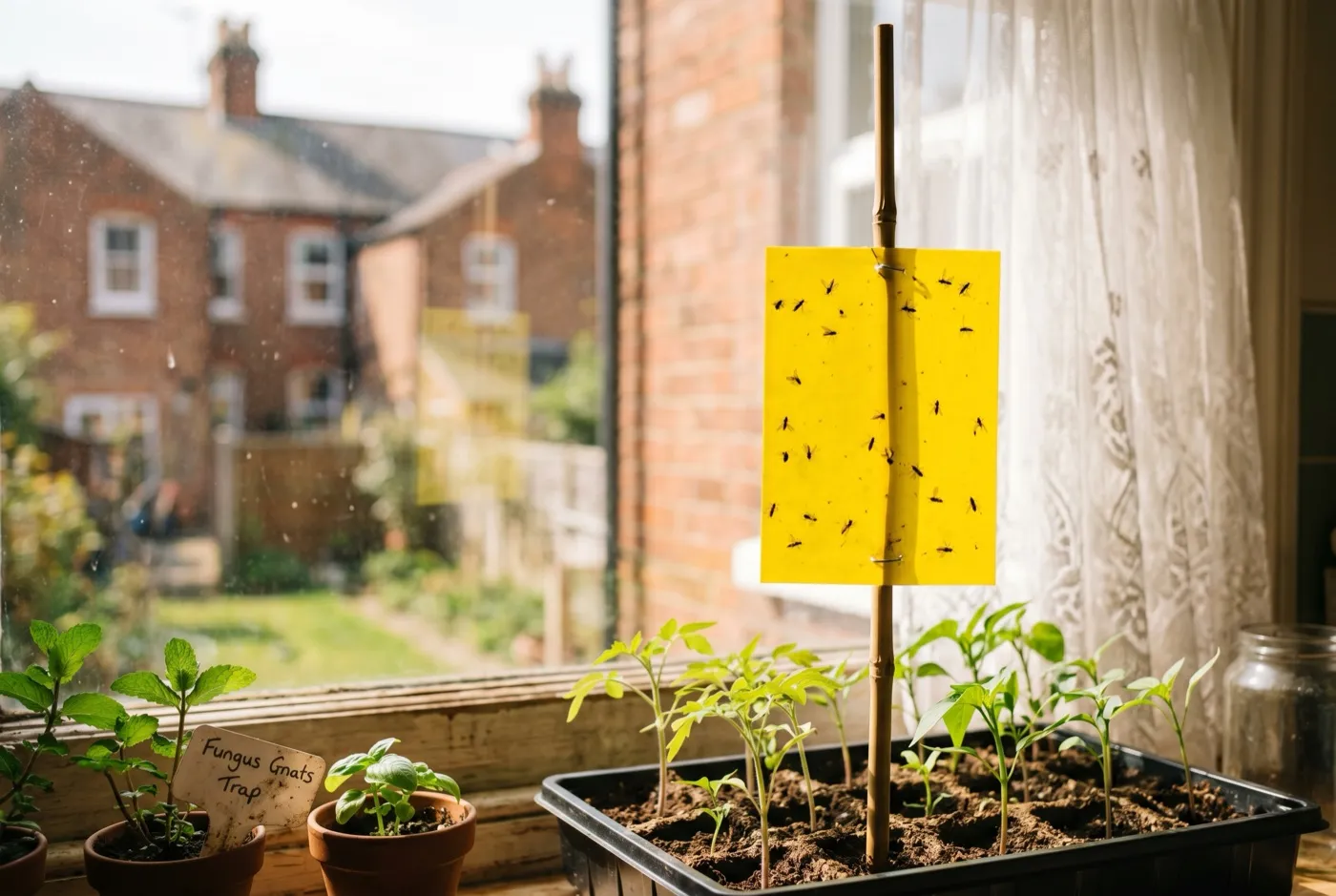 Sticky traps catch adults and show when emergence peaks, but they reach under 10% of the population. Use them to monitor, not to cure.
Why grit top-dressing stops sciarid flies laying eggs
The cheapest, most reliable prevention is a dry mineral surface. Female gnats need damp, organic compost to lay into. Cap that surface with a 5-10mm layer of horticultural grit, vermiculite, or sharp sand and you deny them the moist, fungus-rich skin they target.
Grit suits pricked-out seedlings and pots well. For trays of fine seed you have not yet pricked out, a thin layer of vermiculite does the same job without burying the seed. Both are cheap, reusable, and add no chemicals near edible seedlings. The technique pairs naturally with the staged potting-on in our guide to hardening off bedding and half-hardy plants.
Gardener’s tip: Apply the grit dry, straight after sowing or pricking out, before the first gnats arrive. Top-dressing a tray that already has eggs in it traps the larvae underneath, where they keep feeding.
The root cause: wet, rich compost that never dries out
Sciarid flies are a moisture problem, not a fly problem. The underlying cause is compost that stays wet and organic at the surface for days on end. That single condition drives every part of the infestation, and treating flies without fixing it guarantees they return.
The shift to peat-free and coir composts has made this worse. These mixes hold more water and contain more raw organic matter than the old peat blends, so the surface stays damp and fungus-rich far longer. Add bottom heat from a propagator and you have a perfect nursery. This is why the same gardener who never saw gnats a decade ago now battles them every spring.
The permanent fix is water management, not chemicals. Let the top of the compost dry between waterings. Bottom-water wherever you can, standing trays in shallow water so the surface stays dry while the roots drink from below. Use only as much compost moisture as the seedlings need, and improve airflow over the bench. Get the surface drying and the breeding habitat disappears. Our guide to protecting container plants from pests covers the same drainage-first thinking for pots.
For a deeper look at the same pest indoors, where the conditions differ, read our guides on fungus gnats on houseplants and getting rid of houseplant flies. The propagation bench needs the seed-tray approach above; houseplants need a slightly different watering and treatment routine.
A practical note on timing: apply nematodes in the evening into already-moist compost, and water them in gently. They need that moisture and a temperature above 10C to move through the compost and find the larvae, which is why a heated propagator or a mild spring spell gives the best results.
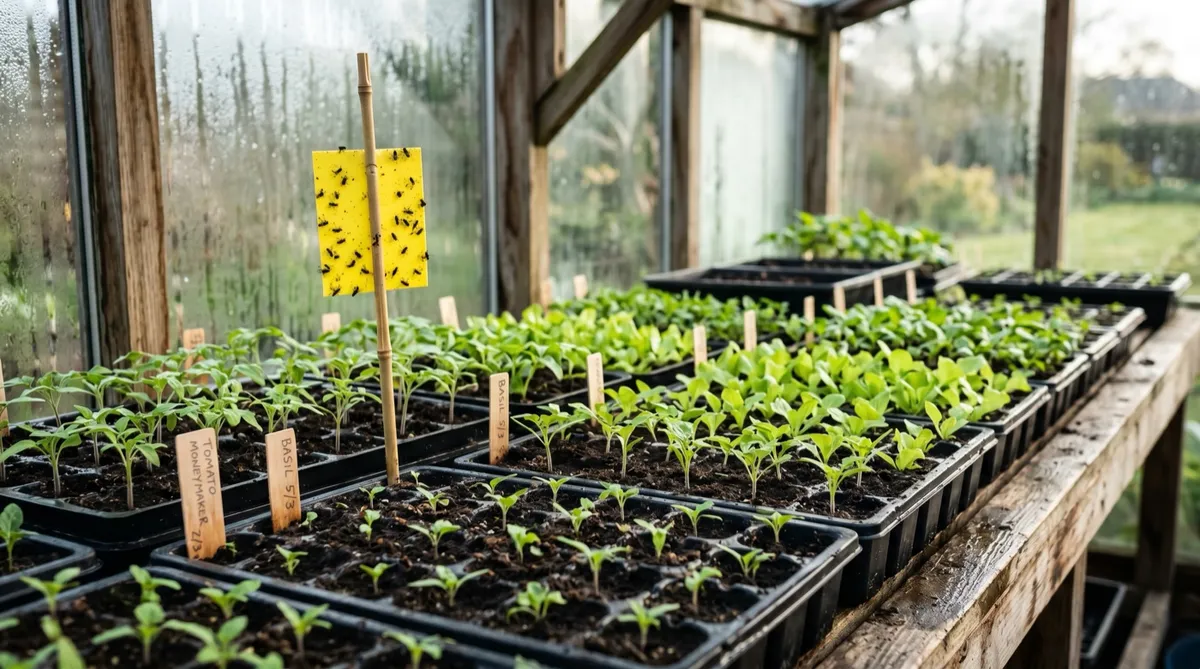
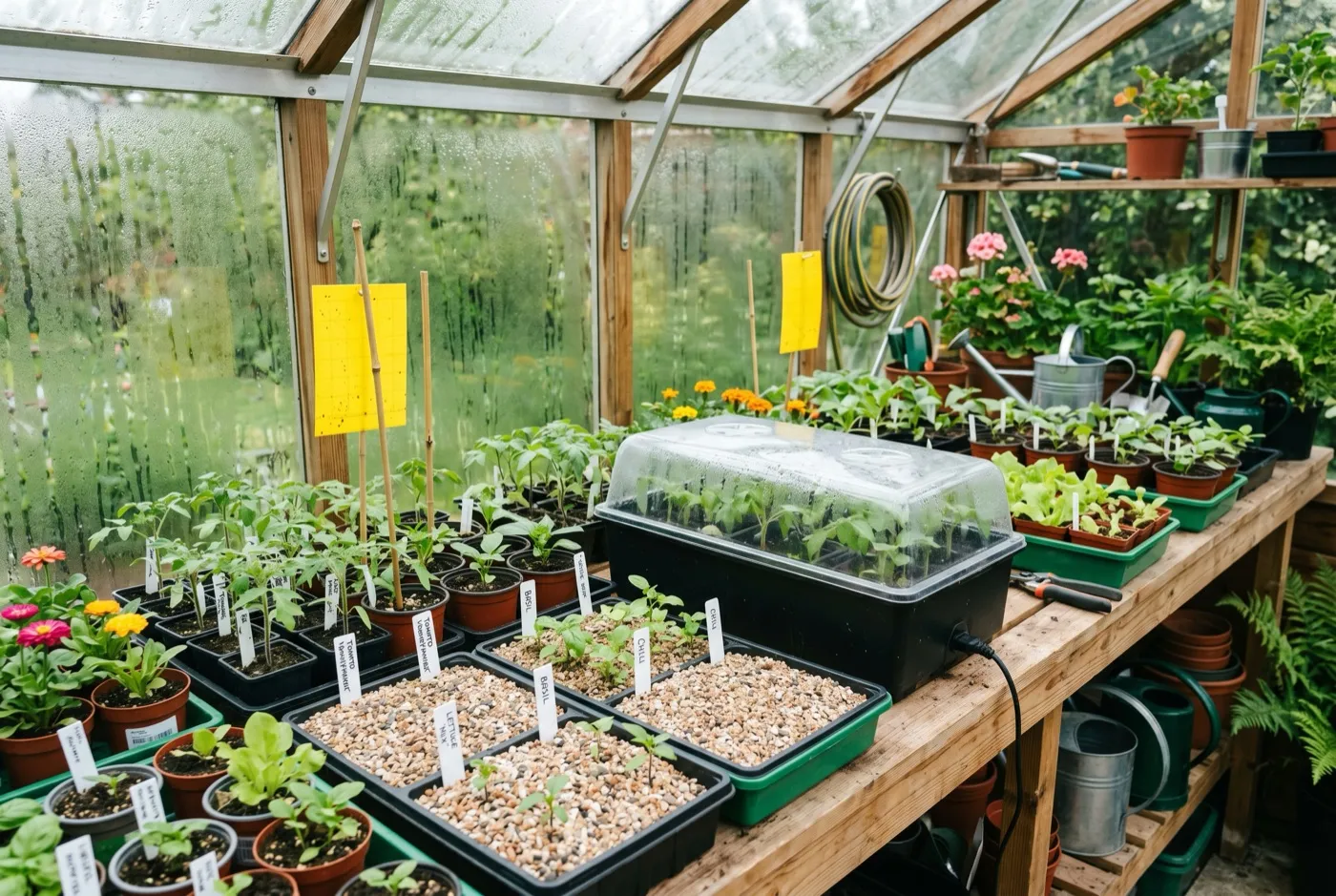 A healthy spring propagation bench: grit-capped trays, bottom-watering, and sticky traps watching for the first adults.
A month-by-month sciarid fly plan for UK propagation
Sciarid pressure tracks the sowing calendar. The worst months are the warm, busy propagation weeks of spring, when benches are full and compost stays damp. Here is how to stay ahead of them through a UK season.
| Month | Action |
|---|---|
| January | Clean trays and propagators in hot soapy water before the first sowings |
| February | Start sowing with fresh compost; bottom-water from day one |
| March | Apply grit or vermiculite caps as seedlings emerge; hang sticky traps to monitor |
| April | Peak risk: check sticky traps weekly, drench with nematodes at first sign of larvae |
| May | Keep surfaces dry as benches fill; refresh grit caps disturbed by pricking out |
| June | Reduce risk as plants harden off outside; clear and dry empty trays |
| July-August | Low risk; keep stored compost dry and bagged to stop it breeding gnats |
| September-December | Clean and store kit dry; bin tired, soggy compost rather than reusing it |
Common sciarid fly mistakes that keep the infestation going
Most failures repeat the same handful of errors. Each one leaves the larvae untouched, so the gnats always come back.
- Treating the adults, ignoring the larvae. Sprays and swatting remove the visible 10% while eggs and larvae carry on below. Always treat the compost, not the air.
- Relying on sticky traps alone. Traps monitor and trim adults but catch under 10% of the population. They tell you the gnats are there; they do not clear them.
- Overwatering peat-free compost. A constantly wet, rich surface is the breeding habitat. Bottom-water and let the top dry, or the cycle never breaks.
- Topping with grit too late. Capping a tray that already holds eggs traps the larvae underneath, where they keep feeding. Apply grit dry, at sowing, before gnats arrive.
- Reusing old, soggy compost. Tired compost left wet in a bag or open tray breeds gnats between sowings. Bin it, or store compost dry and sealed.
Related reading: Damp indoor bulb pots draw the same flies, so see our guide to growing paperwhite narcissi indoors.
Frequently asked questions
What are the tiny black flies in my seed trays?
They are sciarid flies, also called fungus gnats. The 2-4mm adults run over damp compost and fly up when disturbed. Their larvae live in the wet surface compost and feed on fine seedling roots, checking or killing young plants in propagation.
Do fungus gnat larvae actually kill seedlings?
Yes, the larvae damage and kill weak seedlings. They graze fine roots and stem bases in the top 2-3cm of compost, then open wounds that let damping-off fungi like Pythium in. Strong, established plants usually shrug them off, but seedlings rarely do.
How do I get rid of sciarid flies in compost?
Drench the compost with Steinernema feltiae nematodes to kill larvae. Add a 5-10mm grit or vermiculite top-layer, bottom-water, and let the surface dry between waterings. Yellow sticky traps catch adults but never fix the larvae doing the harm.
Why does peat-free compost get more fungus gnats?
Peat-free and coir composts hold more moisture and organic matter. That damp, fungus-rich surface is exactly where female gnats lay eggs and larvae feed. Old peat mixes dried faster, so the switch to peat-free has made seed-tray gnats far more common.
Will yellow sticky traps stop a fungus gnat infestation?
No, sticky traps only monitor and trim adult numbers. They catch under 10% of the population and never touch the larvae in the compost. Use them to track when adults emerge, then treat the compost with grit, careful watering, or nematodes.
How long do fungus gnats take to go away?
Expect control within 2-3 weeks of treating properly. A nematode drench kills larvae in 7-14 days, and adults die off as no new larvae mature. Keeping the surface dry and gritted stops a fresh generation taking hold after that.
Our team produces practical UK gardening guidance from source research, contributor records and established horticultural practice. Editorial standards are overseen by Matt W.