Key takeaways
- A witches' broom is a dense mass of shoots from one point, often 30 to 90cm across
- Taphrina fungi cause most UK brooms, mainly on silver birch and cherry
- Brooms are cosmetic and rarely harm the tree, so most can be left alone
- A single birch can carry 10 or more brooms and still live for decades
- Prune unwanted brooms 20 to 30cm below the swelling, into healthy wood
- Many dwarf conifers began as brooms; witches'-broom hunting is a real hobby
Witches’ broom is one of the strangest sights in a British tree. It looks as if a bird has built an oversized nest of bare twigs high in the crown. In truth it is the tree’s own growth gone haywire from a single point. Most witches’ broom in UK gardens comes from a fungus called Taphrina, and it turns up most often on silver birch and cherry.
The good news is simple. It almost never harms the tree. A birch can carry a dozen brooms and live out its full life. This guide explains what causes it, how a broom forms, how to tell it apart from mistletoe, which trees get it, and when it is actually worth pruning one out.
What a witches’ broom actually looks like
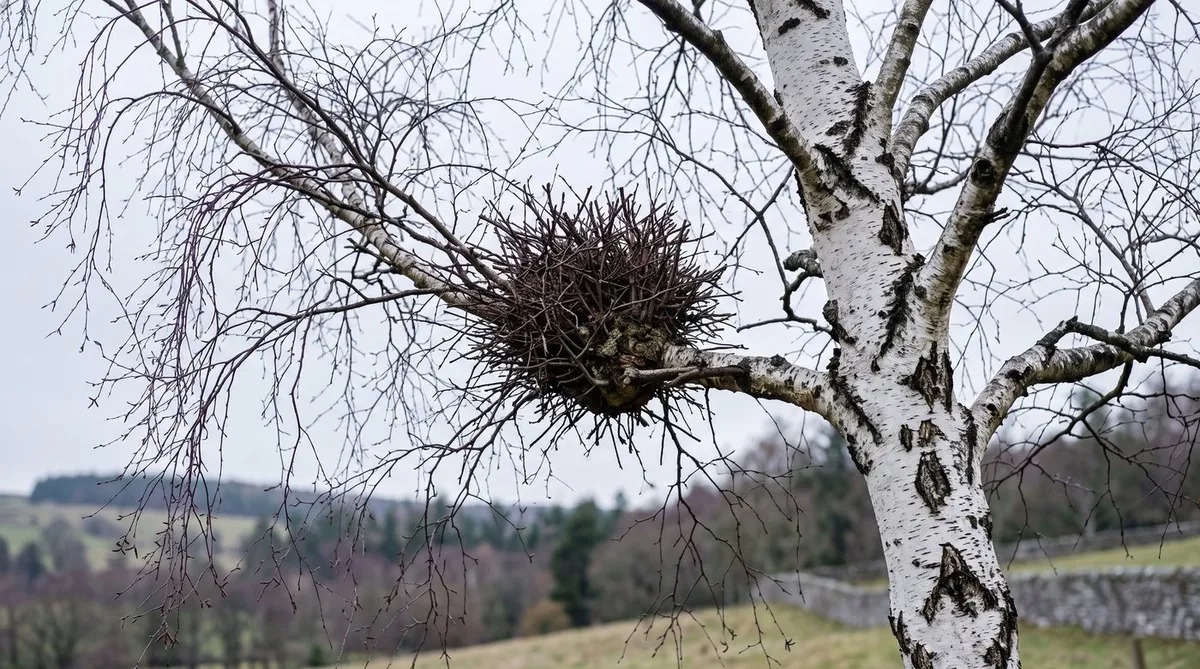
A witches’ broom is a dense, congested mass of shoots that all grow from one small area of a branch. The twigs are shorter and thinner than normal, and they crowd together into a tangle. From the ground it reads as a dark clump against the sky, most obvious in winter once the leaves fall.
The mass usually sits between 30 and 90cm across, though old brooms on birch can top 1m. It is anchored on a swollen, knobbly base where the fungus lives in the wood. That base is the giveaway. Under the tangle you find a distorted lump of bark, not a clean fork.
In spring the broom flushes its own leaves, often a week or two ahead of the rest of the tree. On birch those leaves are frequently smaller, paler and slightly puckered. Some carry a faint whitish bloom, which is the fungus fruiting on the leaf surface. By midsummer the broom blends into the canopy and is easy to miss until the leaves drop again.
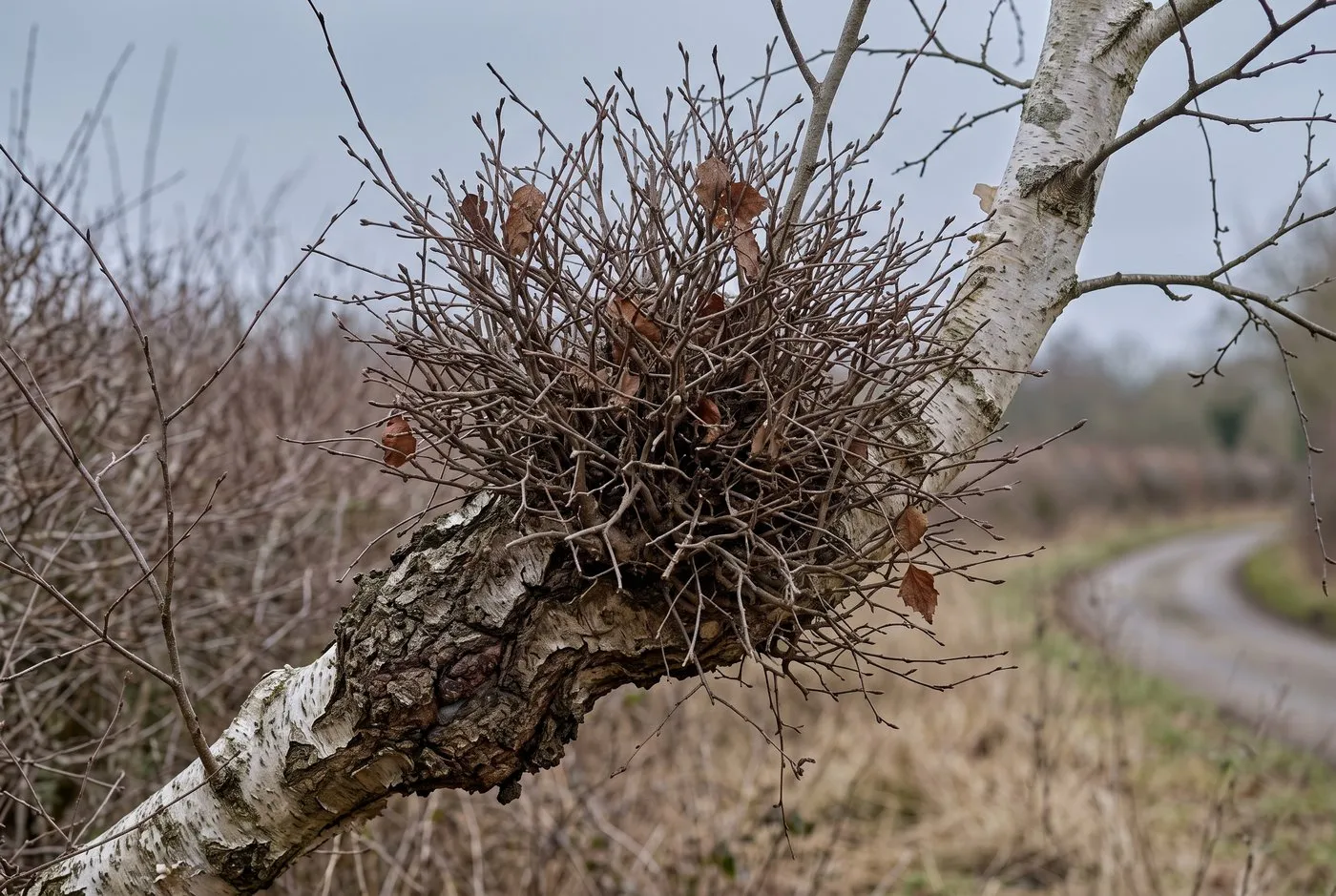 A birch witches’ broom in close-up along a rural Midlands lane. The twigs are shorter and thinner than normal growth and all radiate from one swollen point.
How a witches’ broom forms on a tree
A broom forms when something overrides the tree’s normal control of its buds. In a healthy branch the leading tip suppresses the buds below it, so growth stays orderly. A broom breaks that rule. Every dormant bud around one point wakes at once and keeps branching. The process runs in four clear stages.
- Infection. Fungal spores land on a young shoot or bud in spring. Taphrina ascospores germinate in cool, damp weather, roughly 10 to 18C, which suits a normal British April.
- Hijack. The fungus grows into the bud and releases plant hormones, mainly cytokinins. These chemicals cancel the tree’s apical dominance at that spot.
- Proliferation. Freed from control, the buds all break together. Internodes shorten, so the shoots stay stubby and pack tightly. A recognisable broom builds over one to two seasons.
- Perennation. The fungus now lives permanently in the swollen woody base. It re-flushes with the broom every spring and the mass enlarges year on year, often for 20 years or more.
The critical mistake is treating a broom as a one-off. It is not a scar that heals. The living fungus in the base means the broom regrows if you cut it too shallow. Understand that the swollen base is the engine, and both diagnosis and pruning become obvious.
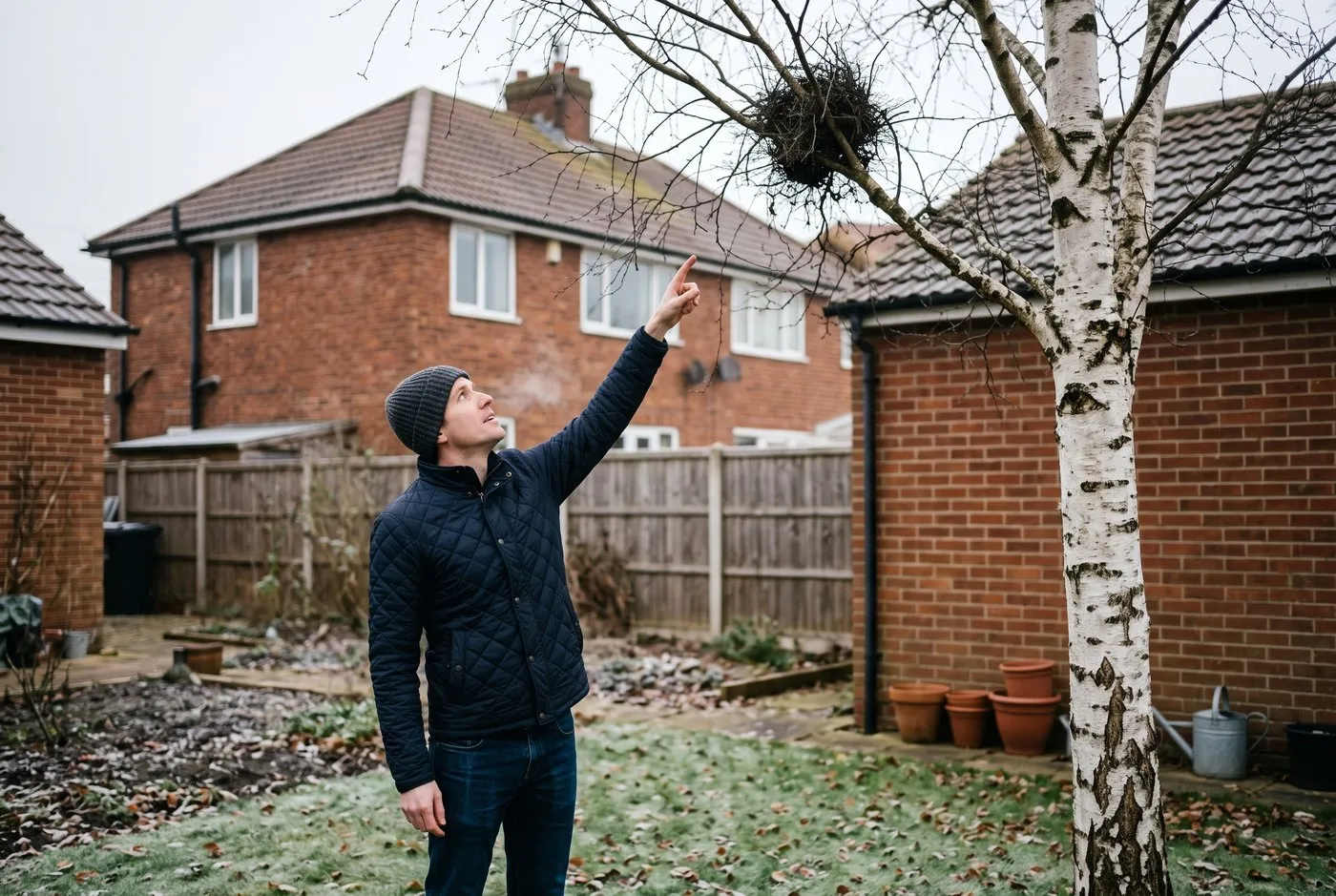 Spotting a broom is easiest in winter. Here a gardener points out a mass sitting two-thirds up a birch in a suburban semi garden, silhouetted against a grey sky.
What causes witches’ broom in UK trees
Several different agents can trigger a broom, and they all end at the same place: lost bud control. Knowing the cause helps you judge whether it will spread and whether it matters. In UK gardens the order of likelihood is well established from decades of records.
Fungi are the main cause here. Taphrina betulina makes the classic brooms on birch, and Taphrina wiesneri does the same on cherry and other Prunus. On silver fir, the rust fungus Melampsorella caryophyllacearum forms brooms and uses chickweed as its alternate host. Mites come next. Microscopic eriophyid mites, under 0.2mm long, provoke brooms on hornbeam and some other trees by feeding on buds. Phytoplasmas, bacteria-like organisms spread by sap-sucking leafhoppers, cause brooming in a range of trees and shrubs. Finally, a genetic mutation in a single bud can throw a permanent broom with no pathogen at all. That last type is the source of many garden dwarf conifers.
| Cause | Typical UK hosts | How to confirm it | UK likelihood |
|---|---|---|---|
| Taphrina fungus | Silver and downy birch, cherry | Pale, puckered leaves with a bloom in spring | 1st, most common |
| Eriophyid mites | Hornbeam, birch, some maples | Tiny galls or feeding damage on buds | 2nd |
| Phytoplasma | Various broadleaves and shrubs | Yellowing, many weak shoots, lab test needed | 3rd |
| Rust fungus | Silver fir (Abies) | Upright brooms, yellowed needles, chickweed nearby | 4th, conifers only |
| Genetic mutation | Conifers, occasionally broadleaves | Stable dwarf growth, no disease signs | 5th, but permanent |
For a garden birch or cherry, Taphrina is the safe first assumption. It is the most common by a wide margin, it is host-specific, and it does no real harm. If you want the full picture of the fungal problems that genuinely threaten a cherry, our guide to silver leaf disease sets those real threats in context.
Which UK trees get witches’ broom
Four trees account for most brooms seen in British gardens and parks. Recognising the host narrows the cause straight away.
Silver birch and downy birch are the headline hosts. Their brooms are the biggest and most numerous, driven by Taphrina betulina. A single mature birch can carry 10 or more, and street and park birches are riddled with them across much of the country. Our silver birch growing guide covers the tree’s wider health, of which brooms are the least of its worries.
Cherry, both ornamental and wild, comes second. Flowering cherries like ‘Kanzan’ and the wild gean throw compact brooms that flush early. If your flowering cherry shows one broom among healthy blossom, it is cosmetic. Hornbeam picks up mite-driven brooms, often in clipped hedges where the dense growth hides them until winter. Prune a hornbeam hedge hard and the odd broom shows up in the cut faces. Scots pine and silver fir carry conifer brooms, some fungal, some genetic.
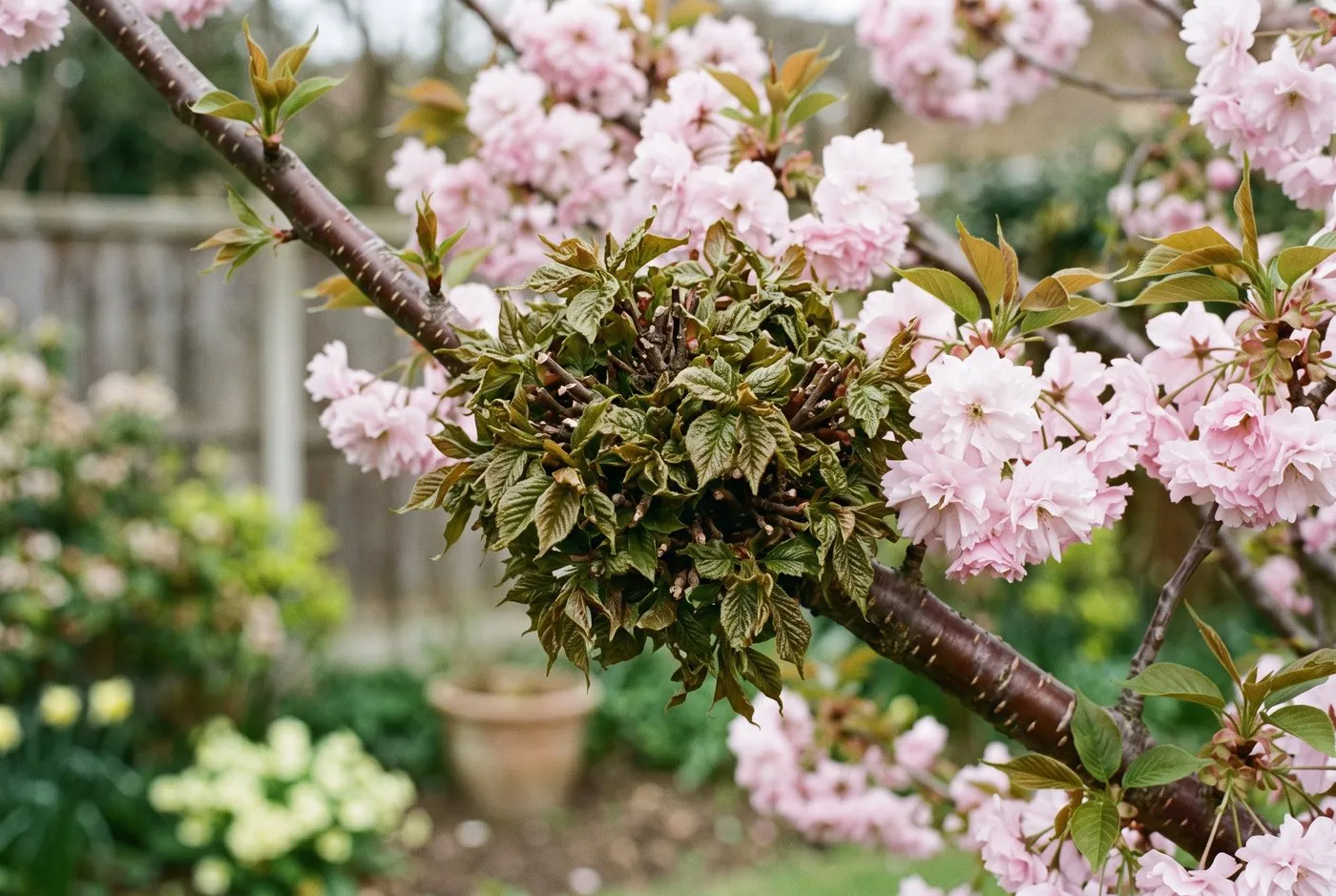 A cherry broom in a suburban garden flushes its small, puckered leaves a fortnight before the rest of the tree. The blossom around it is completely healthy.
The size and habit of a broom tells you the host at a glance. Birch brooms sprawl and hang. Cherry brooms are tighter and rounder. Conifer brooms often sit upright, like a small extra bush wedged into the branch.
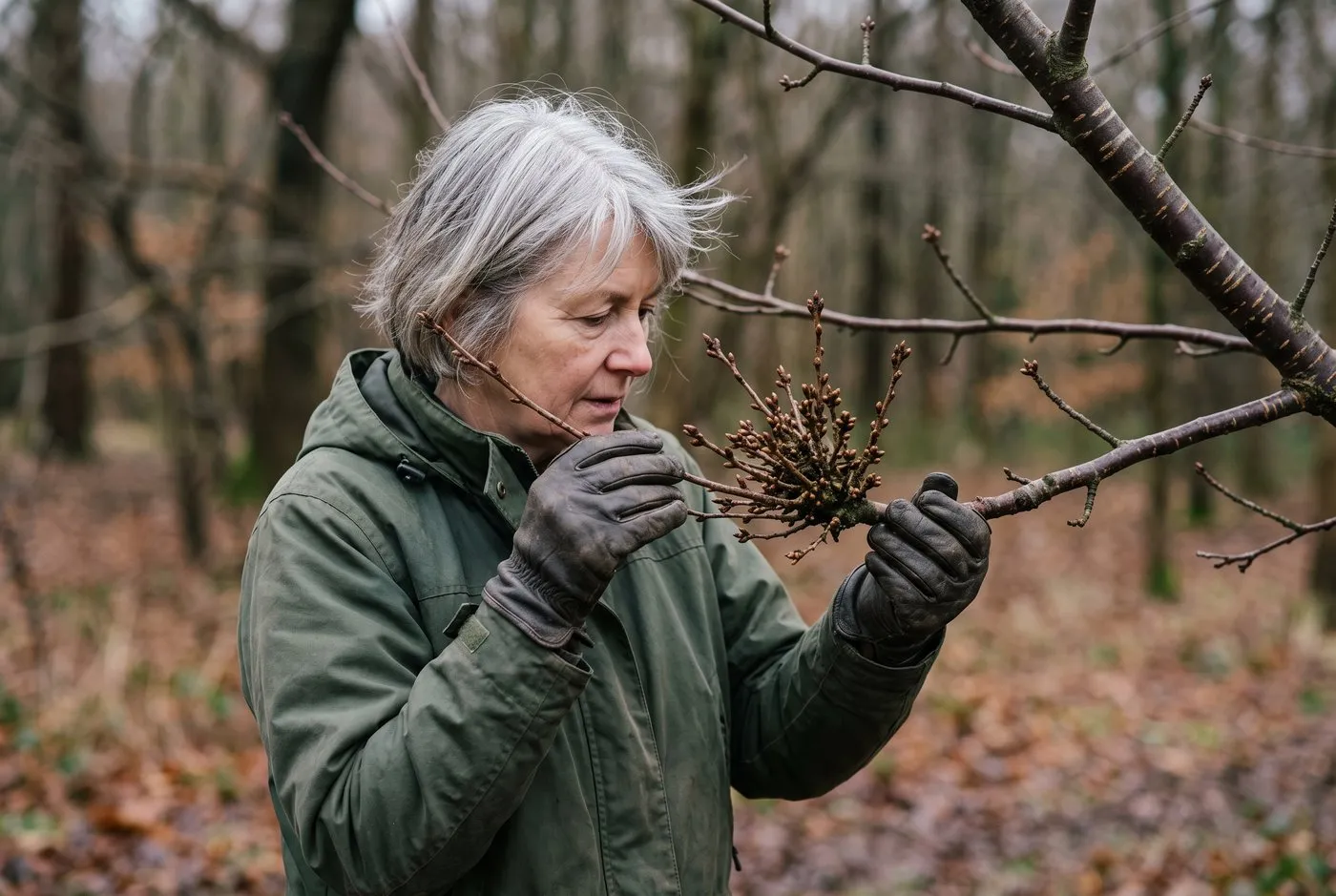 A low cherry broom at a woodland edge, at head height for a close look. The congested buds and shortened shoots are clear once you get near enough.
Telling witches’ broom apart from mistletoe and lookalikes
The most common mix-up is mistletoe, and the two could not be more different. Mistletoe is Viscum album, a green evergreen parasite that makes its own leaves. It hangs as a neat rounded ball, with paired oval leaves in forked stems and sticky white berries in winter. It is common on apple, lime, hawthorn and poplar, mostly across the West Midlands and the South West.
A witches’ broom, by contrast, is built entirely from the host tree’s own twigs. In winter it is bare and irregular, never evergreen, and it carries no berries. If you see green leaves in December, it is mistletoe. If you see a leafless tangle, it is a broom.
| Feature | Witches’ broom | Mistletoe | Squirrel drey | Frost or pruning regrowth |
|---|---|---|---|---|
| Made of | Tree’s own twigs | Separate green plant | Loose leaves and sticks | Tree’s own watershoots |
| Winter look | Bare tangle | Evergreen ball, berries | Solid leafy lump | Cluster of upright shoots |
| Attachment | Swollen woody base | Suckers into bark | Simply wedged in fork | From a cut or wound |
| Harm | Almost none | Mild parasite | None to tree | None, just untidy |
The other lookalikes are quick to rule out. A squirrel’s drey is a solid ball of leaves and sticks packed into a fork, not fine congested twigs from one point. Frost damage or hard pruning can trigger a cluster of vigorous watershoots, but these are long, upright and few, not the dense stubby mass of a true broom.
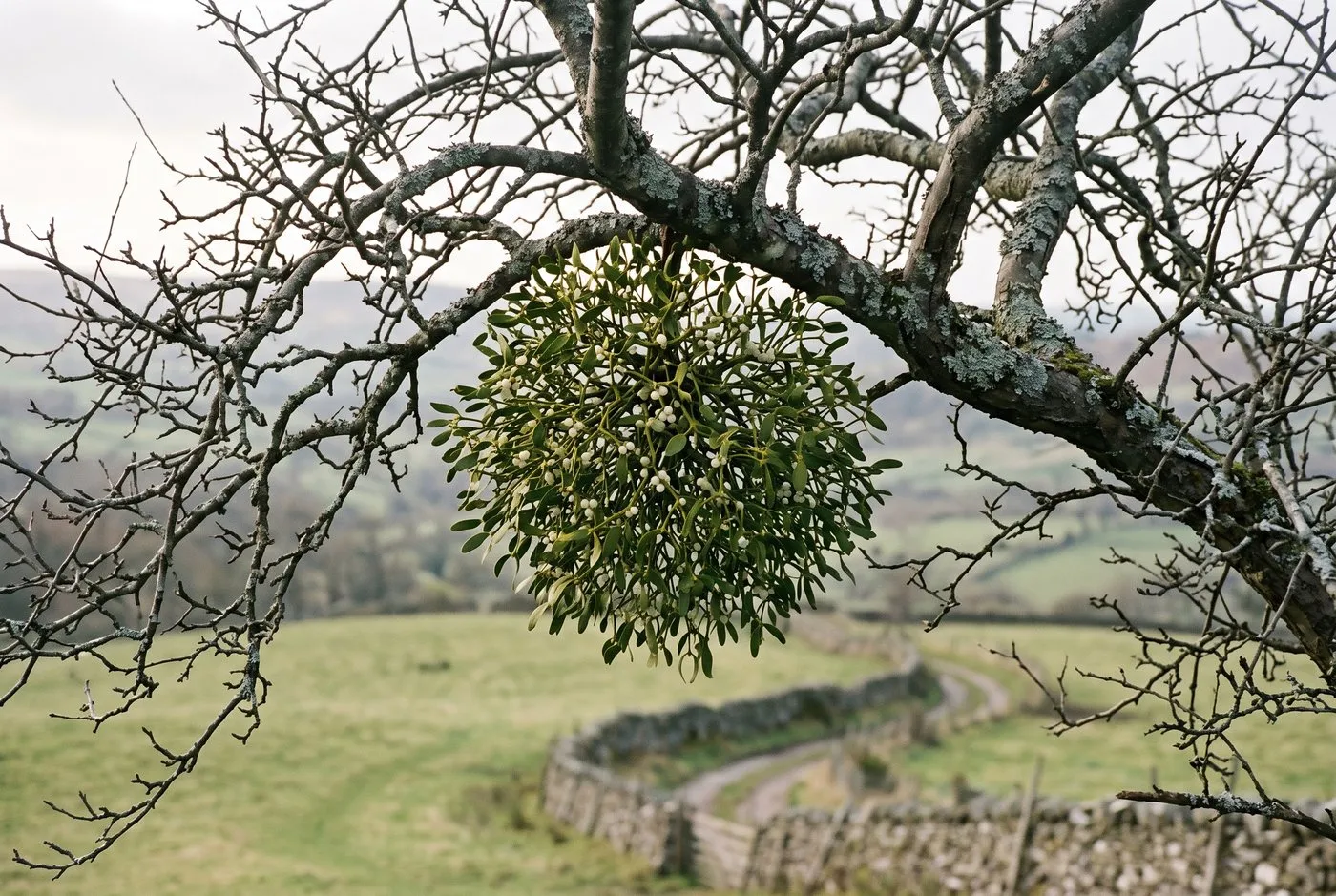 Mistletoe in a Welsh hillside orchard: evergreen paired leaves and white berries, hanging as a rounded ball. A broom is bare, twiggy and made of the tree’s own wood.
Should you remove a witches’ broom
Removal is a choice about appearance, not a treatment the tree needs. Because a broom is cosmetic, the best option in most gardens is to do nothing at all. When you do act, rank your options by what actually protects the tree.
| Option | What it does | Best use | Effect on tree health |
|---|---|---|---|
| Leave it in place | Nothing, just monitor | Brooms high in a large tree | Best, no wounds, no risk |
| Prune the broom out | Removes the visible mass | Low or unsightly brooms | Good, minor pruning wound |
| Feed and mulch the tree | Keeps the whole tree vigorous | A stressed or young tree | Supports the tree, not the broom |
| Fell the tree | Ends the problem completely | Only if the tree is failing anyway | Last resort, rarely justified |
Leaving the broom is the gold-standard choice for a healthy tree, because it needs no wound and carries no risk. Pruning is the next best step when a broom is low, hangs over a path, or grows heavy enough to threaten a branch in wind. To take one out, cut 20 to 30cm below the swollen base, back into clean, healthy wood, using a sharp pruning saw. Removing only the twigs leaves the fungus in place and it regrows within a season or two.
Gardener’s tip: Prune brooms in winter dormancy, between November and February, when the whole structure is visible and the tree is not in active growth. Wipe your saw blade with methylated spirit between cuts, especially on cherry, where you also want to avoid opening wounds in the silver-leaf infection season. A clean cut into sound wood heals fast and rarely lets the broom back.
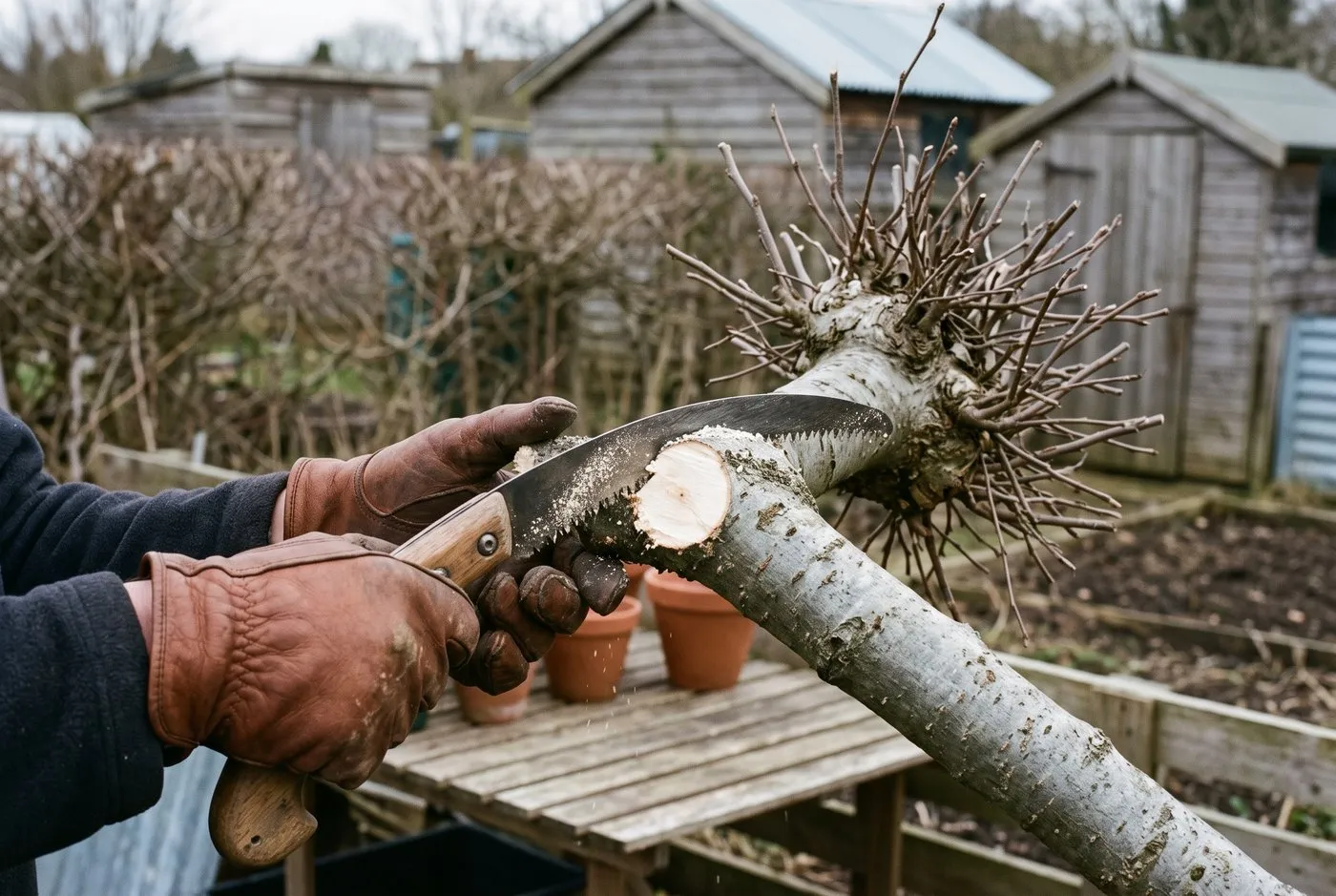 Removing a broom on an allotment boundary tree. The cut goes 20 to 30cm below the swollen base, into clean wood, so the fungus goes with it.
The point is worth holding on to. Real tree threats in the UK behave nothing like this. The difference between a harmless broom and a serious problem is stark, and it is the same lesson we draw in our guide to sudden tree death in the UK. A broom persists quietly for decades. Genuine killers act fast.
Why brooms keep coming back after pruning
The underlying cause of a persistent broom is that the pathogen lives inside the woody base, not in the twigs you can see. This is the single most misunderstood point. People saw off the tangle, feel they have solved it, then watch a new broom rise from the same swelling the following spring.
For a fungal broom there is no spray that reaches the fungus inside the wood. Permanent removal means cutting below the infected tissue, into wood the fungus has not colonised, which is why the 20 to 30cm margin matters. Cut short and you leave the engine running. Cut clean and the broom is gone for good from that spot.
You cannot stop new brooms forming, though. Airborne Taphrina spores drift in every wet spring, and a garden birch sits in that spore rain whether you like it or not. The honest prevention is tree vigour: a well-mulched, unstressed tree shrugs off brooms as the minor thing they are. There is no equivalent of the soil sterilisation you might consider for a real root pathogen like honey fungus, because a broom is simply not in that league of threat.
How dwarf conifers began as witches’ brooms
Here is the twist that makes brooms interesting rather than alarming. A large share of the dwarf conifers sold in the UK started life as a witches’ broom on a full-size tree. A genetic broom is a stable mutation. Take cuttings or grafts from it and you get a compact, slow, tight little plant that breeds true.
Collectors climb pines and spruces looking for promising brooms, a hobby known as broom hunting. Named results fill garden centres. Picea abies ‘Little Gem’ and ‘Nidiformis’, and Pinus sylvestris ‘Beuvronensis’, all trace back to brooms. These plants stay under 50cm to 1m for many years and suit troughs, rockeries and small beds. A broom on your birch is the same phenomenon that gave the trade some of its best small conifers.
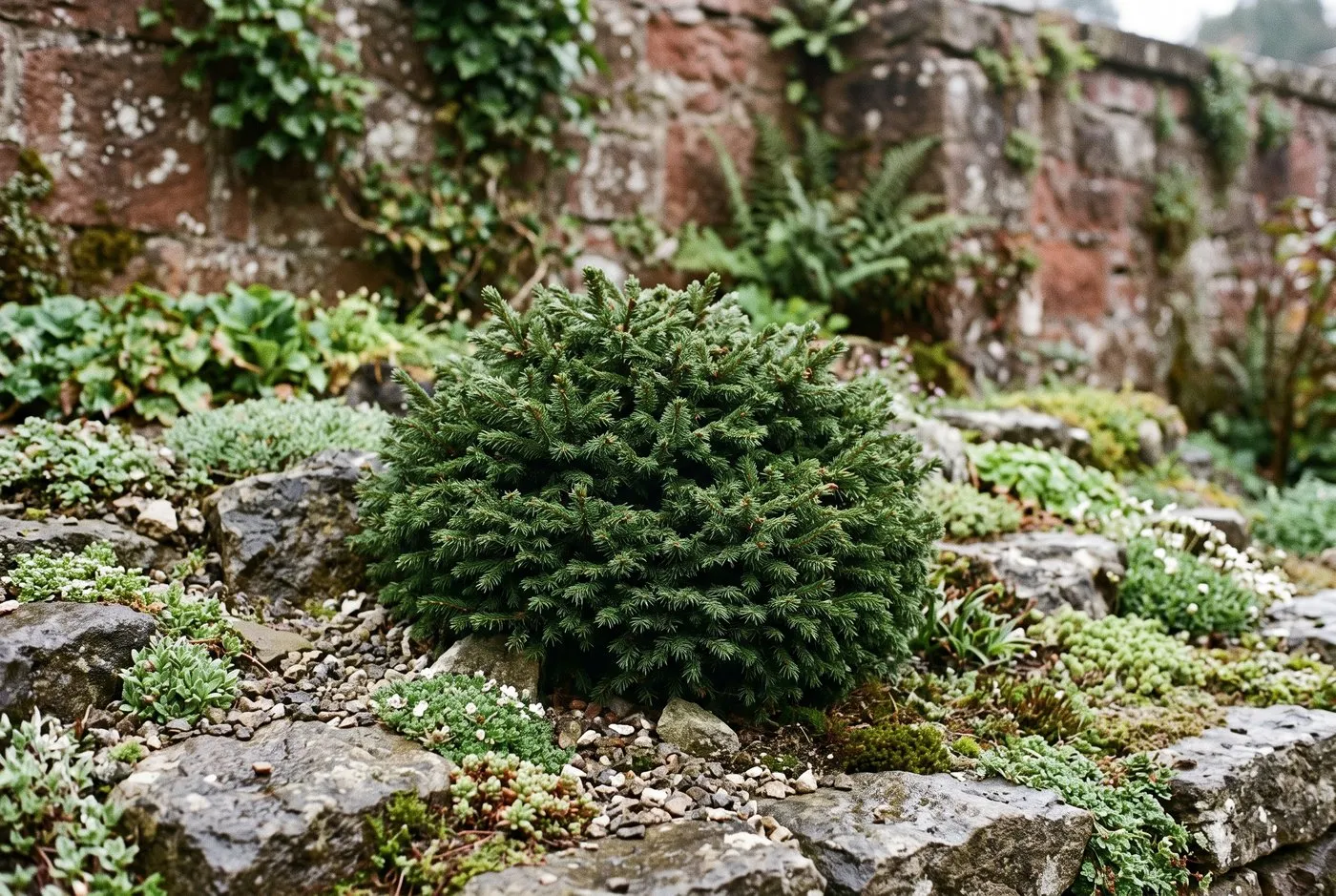 A dwarf conifer in a Scottish walled garden. Its tight, congested habit is exactly the broom growth pattern, bred into a stable garden plant.
So a broom is not always a defect to remove. In conifers it can be a discovery. It is the friendly cousin of a genuinely cosmetic problem, in the same low-worry bracket as acer tar spot, which looks dramatic and changes nothing.
Month-by-month: when to spot and prune brooms
| Month | What to do |
|---|---|
| January | Best month to spot brooms. Survey bare trees against the sky and count what you find. |
| February | Prune out any low or unwanted brooms now, into clean wood, before the sap rises. |
| March | Watch for early flush on birch brooms. They green up a week or two before the tree. |
| April | Note pale, puckered leaves and any white bloom on birch, confirming Taphrina. |
| May | Leave brooms alone in growth. Feed and mulch the whole tree if it looks stressed. |
| June | Cherry brooms are now hidden in full canopy. Mark their positions for winter. |
| July | Monitor only. A broomed tree in leaf should look no different from a clean one. |
| August | Check heavy brooms for any branch strain in summer storms and wind. |
| September | Photograph brooms before leaf fall to compare size against last year. |
| October | Leaves drop and brooms reappear. Reassess which, if any, you want to remove. |
| November | Start winter pruning of large or hazardous brooms once the tree is dormant. |
| December | Tell brooms from mistletoe now. Bare tangle is a broom, green ball is mistletoe. |
Common mistakes with witches’ broom
- Mistaking a broom for mistletoe. People try to strip out a harmless broom thinking it is a parasite draining the tree. Check the season and the material. A bare winter tangle of the tree’s own twigs is a broom, and it is not a parasite at all.
- Panic-felling a healthy tree. A crown full of brooms looks alarming, so out comes the chainsaw. This is the costliest error. A broomed birch can be a sound 15m tree with 40 years left in it. Felling it can cost £150 to £400 and gains nothing.
- Pruning too shallow. Cutting off only the visible twigs leaves the infected swollen base, and the broom regrows within a season. Always cut 20 to 30cm below the swelling, into wood the fungus has not reached.
- Reaching for a fungicide. No spray penetrates the wood to kill the fungus inside a broom. Money spent on fungicide is wasted. Pruning is the only removal that works, and even that is optional.
- Assuming it spreads like honey fungus. Brooms do not creep through the soil from tree to tree. Taphrina is host-specific and slow to spread even between birches. One broomed tree does not doom the garden.
Warning: Never climb a tree to reach a high broom without proper training and equipment. Brooms are often two-thirds up the crown, well beyond safe ladder height. If a large broom truly needs removing for safety, use a tree surgeon registered with the Arboricultural Association. A cosmetic tidy-up is never worth a fall from a birch.
For the wider tree-health picture, the Woodland Trust and the RHS both hold sound, current advice on which tree problems matter and which, like brooms, do not.
Now you know a witches’ broom is a harmless curiosity, not a threat, learn to tell the real dangers apart with our guide to sudden tree death in the UK, or browse more of our tree and plant problem guides for the next diagnosis.
Frequently asked questions
Is witches’ broom harmful to trees?
No, witches’ broom is almost always harmless and cosmetic. It draws a little energy from the branch it sits on, but a healthy tree carries brooms for decades with no loss of vigour. Only step in if a broom grows heavy enough to risk breaking a branch.
What causes witches’ broom in trees?
Fungi, mites, phytoplasmas or genetic mutation cause witches’ broom. In the UK the fungus Taphrina is by far the most common trigger, especially on birch and cherry. Each agent upsets the tree’s normal bud control, so many shoots erupt from one point instead of one.
Should I remove a witches’ broom?
Only remove a witches’ broom for looks or if it grows heavy. It is not a threat to the tree’s health, so removal is a choice, not a cure. On a large tree in the crown, it is safest to leave the broom well alone.
Is witches’ broom the same as mistletoe?
No, mistletoe is a green evergreen parasite and a broom is the tree’s own twigs. Mistletoe hangs as a rounded ball with paired oval leaves and white berries. A broom is a leafless tangle of the host’s own bare shoots in winter.
Which trees get witches’ broom in the UK?
Birch, cherry, hornbeam and pine most often get witches’ broom. Silver and downy birch are the classic hosts through the Taphrina betulina fungus. Ornamental and wild cherries, hornbeam hedges and Scots pine all carry brooms too, though less often.
Can witches’ broom spread to my other trees?
It rarely spreads far, and Taphrina is fairly host-specific. The birch fungus will not jump to your apple or oak. Spores can infect other birches nearby in wet spring weather, but garden spread is slow and nothing like honey fungus.
How do you get rid of a witches’ broom?
Prune it out 20 to 30cm below the swelling, into healthy wood. Cutting off just the visible twigs leaves the infected base, which simply regrows. Use a clean pruning saw, cut back to a sound branch, and there is no need for any fungicide.
Our team produces practical UK gardening guidance from source research, contributor records and established horticultural practice. Editorial standards are overseen by Matt W.