Key takeaways
- Pot tubers horizontally 5cm deep in March or April at 18 to 21 Celsius to start
- WARNING: every part is highly poisonous (colchicine); wear gloves, keep away from children and pets
- Provide canes or netting early; the leaf-tip tendrils grab support, they do not twine
- Feed weekly with high-potash tomato feed once buds form; flowers run July to September
- Lift and store the tuber dry at 10 to 12 Celsius; below 8 Celsius it dies, wet means rot
This guide covers buying and planting the brittle tubers, the warm indoor start, training the leaf-tip tendrils, feeding for flower, and the dry winter storage that keeps a tuber going for years. The toxicity section is first because it matters most.
Warning: Every part of gloriosa is highly poisonous. It contains colchicine, the same compound that makes autumn crocus deadly. Swallowing any part can be fatal. The tubers hold the highest concentration and look enough like a sweet potato or yam to be dangerous around children. Always wear gloves when handling tubers or cut stems, wash your hands afterwards, and keep plants, fallen petals and stored tubers well away from children, pets and livestock.
What gloriosa is and where it comes from
Gloriosa superba is a tender, deciduous climbing tuber from tropical Africa and Asia. It is the national flower of Zimbabwe, where the common name flame lily comes from. In the UK trade you will mostly see the variety ‘Rothschildiana’, with large crimson petals edged in gold. The plant is also sold as glory lily and climbing lily.
The growth habit is unusual. Slender green stems carry glossy lance-shaped leaves, and each leaf ends in a curling tendril. These tendrils are how the plant climbs. It does not twine around a pole like a runner bean; it hooks the leaf tips onto thin supports. By midsummer a single tuber throws stems 1.5 to 2m tall.
The flowers are the reason to grow it. Six narrow petals sweep backwards (botanists call this reflexed), so the bloom points down and the long stamens stick out like the spokes of a wheel. New flowers open red and yellow, then deepen to crimson as they age. A healthy plant carries a dozen or more in succession.
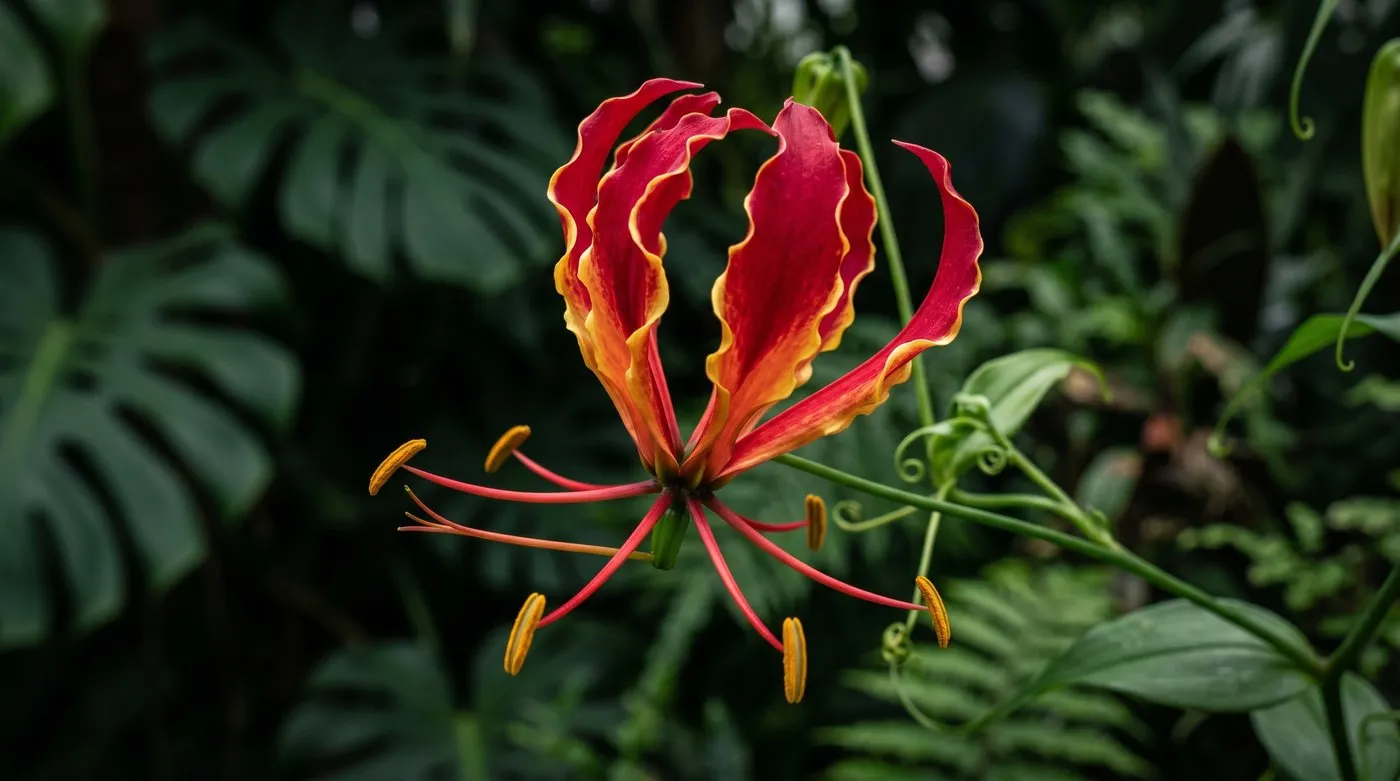 A ‘Rothschildiana’ flower at full stretch. The six petals reflex right back and the long stamens splay outward like flames.
The colchicine toxicity warning every grower needs
Gloriosa is not a plant to grow casually. Every part contains colchicine, a potent alkaloid. In medicine, colchicine treats gout in carefully measured doses. In a garden plant, the dose is uncontrolled and the margin between a small amount and a fatal one is narrow.
The tubers are the most dangerous part. They are starchy and have caused fatal poisonings where people mistook them for yams or sweet potatoes. Leaves, stems, flowers and seeds all hold colchicine too. Symptoms of ingestion begin with burning in the mouth and throat, then severe vomiting and organ failure. There is no simple antidote.
- Wear nitrile or rubber gloves whenever you pot, divide, lift or cut the plant.
- Wash your hands thoroughly even after wearing gloves.
- Keep tubers locked away from children, labelled clearly, never near food storage.
- Pick up fallen petals and leaves from greenhouse floors and patios.
- Keep pets and livestock out of reach; dogs and grazing animals are at serious risk.
If you have young children, curious pets, or anyone who might confuse a tuber for food, this is not the plant for you. Grow something safer like calla lilies instead. Most generic growing guides skip past this. They should not.
Buying and handling the brittle tubers
Gloriosa tubers are not round bulbs. They are long, V-shaped or finger-like structures, often 10 to 20cm long and only a centimetre or two thick. They are brittle and snap like a dry twig if you bend them. At one tip sits a single, delicate growth bud.
That bud is everything. It snaps off easily and it will not regrow if broken. A tuber with no bud is dead stock, however plump it looks. This is the single point most buyers and growers miss, and it accounts for most failures.
Buy firm, plump tubers in late winter or early spring, from January to March. Inspect them carefully:
- Look for firm, slightly flexible flesh, not shrivelled or chalky.
- Check the bud at the tip is intact and undamaged.
- Reject any tuber that is soft, black, mouldy or snapped.
- Larger tubers (15cm plus) flower more strongly in year one.
UK suppliers worth knowing include Sarah Raven, J Parker, and Brighter Blooms, all of whom list ‘Rothschildiana’ in spring. Tubers cost roughly £4 to £9 each. Order early; gloriosa sells out fast and late stock is often dried out. Understanding how tubers differ from bulbs and corms helps here, and our guide to bulbs, corms, tubers and rhizomes explained covers the storage differences that matter.
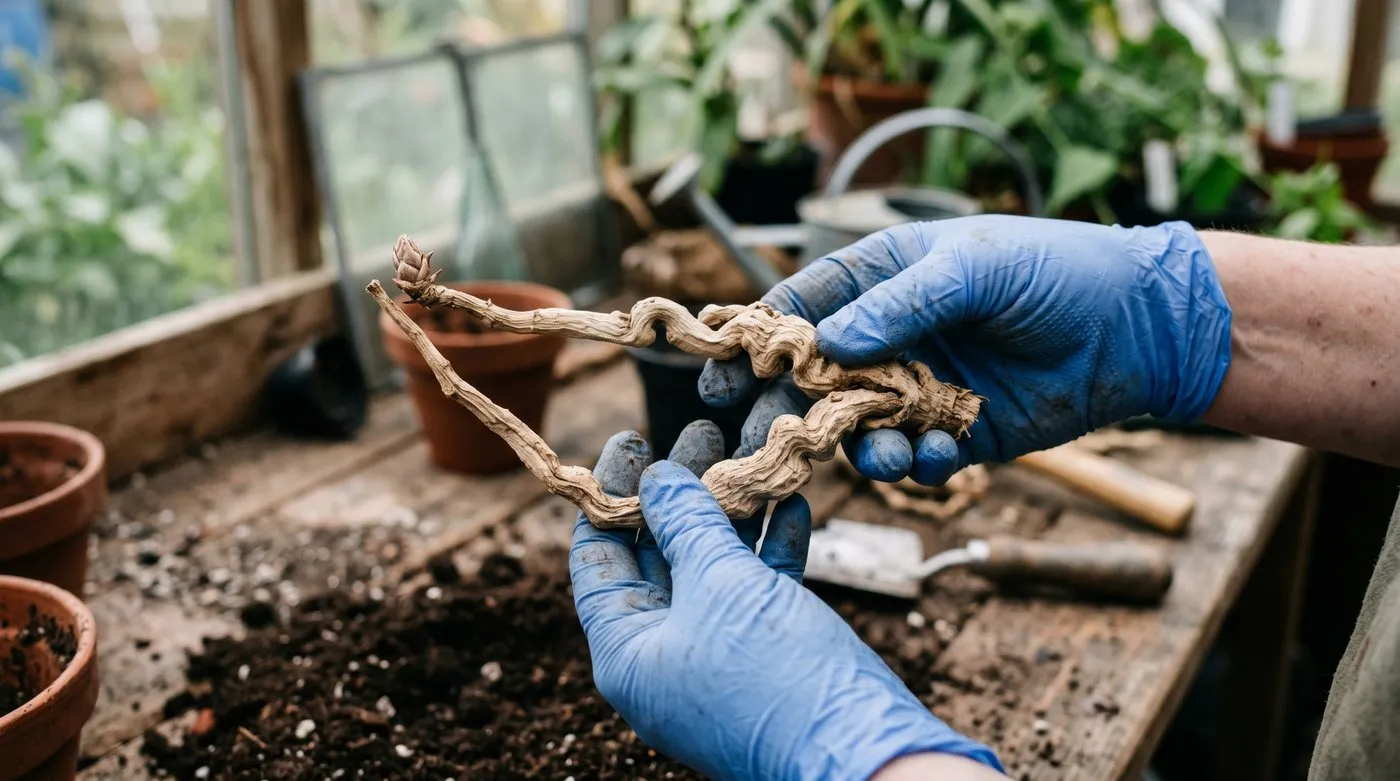 The fragile growth bud sits at one tip of the finger-like tuber. Snap it off and the tuber will not grow. Always handle with gloves.
Starting gloriosa tubers indoors
The UK season is too short and too cool to start gloriosa outside. Pot tubers indoors in March or April to get them growing while the weather warms.
Use a 3 to 5 litre pot filled with John Innes No 2 or No 3 mixed with a third grit for drainage. Lay the tuber horizontally, about 5cm deep. The bud can point sideways or slightly up; what matters is that you handle it with great care and never force the tuber bud-first into the compost. Back-fill gently around it.
Give it warmth of 18 to 21 Celsius to start it into growth. A heated propagator is ideal. A warm windowsill in a heated room works, as does a heated greenhouse bench. Keep the compost barely moist, never wet, until shoots appear. A cold, wet pot at this stage rots the tuber before it ever sprouts.
Shoots usually emerge in two to four weeks. Once the stem is up and growing, increase watering gradually and move the pot into its bright, warm final position. Here is the planting in cross-section.
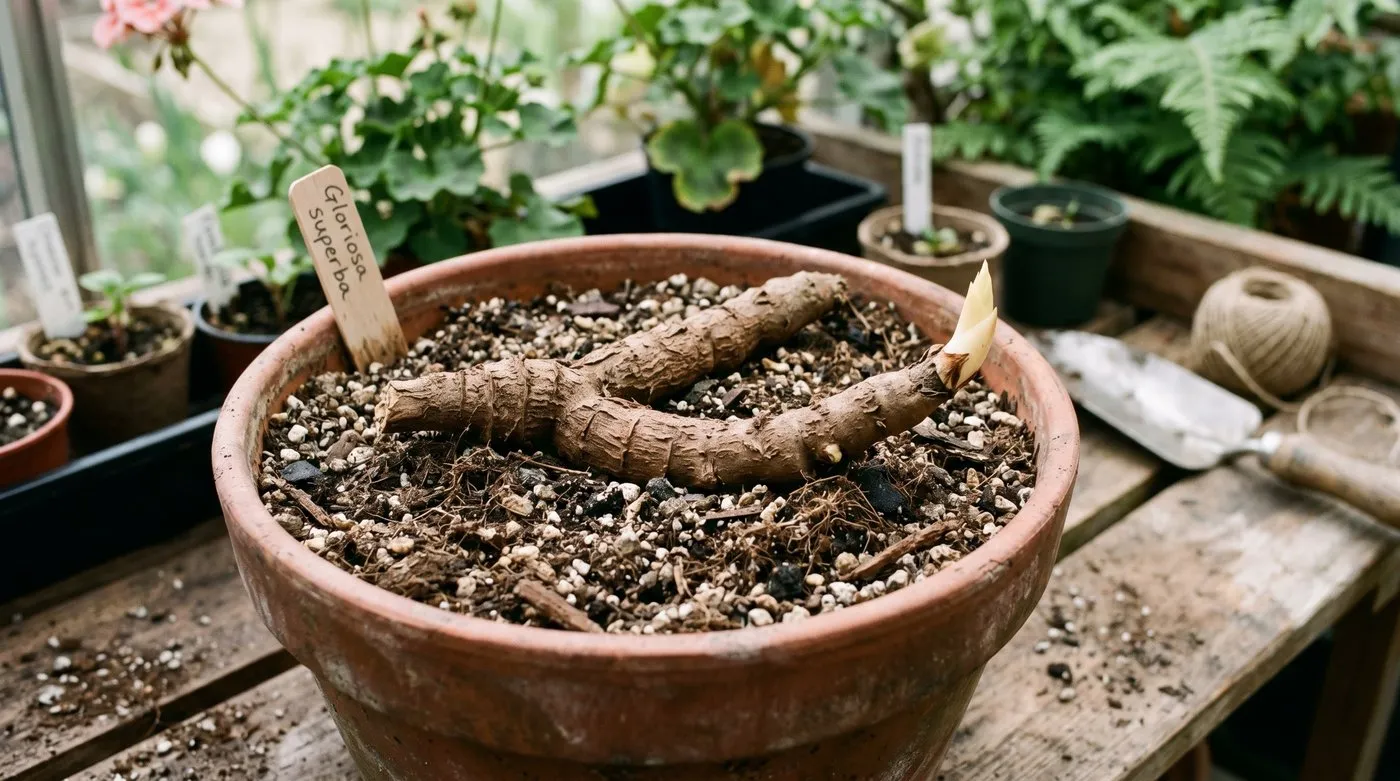 Lay the tuber flat at about 5cm deep in gritty John Innes. Horizontal planting protects the fragile tip and gives the strongest emergence.
Where to grow gloriosa in the UK
Gloriosa needs heat and shelter, more than most UK gardens give outdoors. It is not reliably hardy here. The best homes are a greenhouse, a conservatory, or a warm sheltered sunny patio where you can move the pot under cover in cool spells.
Light matters as much as heat. Gloriosa flowers poorly in shade. Give it the brightest spot you have, but ventilate well in a closed greenhouse so the foliage does not scorch on the glass on hot afternoons. Good airflow also keeps red spider mite down.
Give it support early
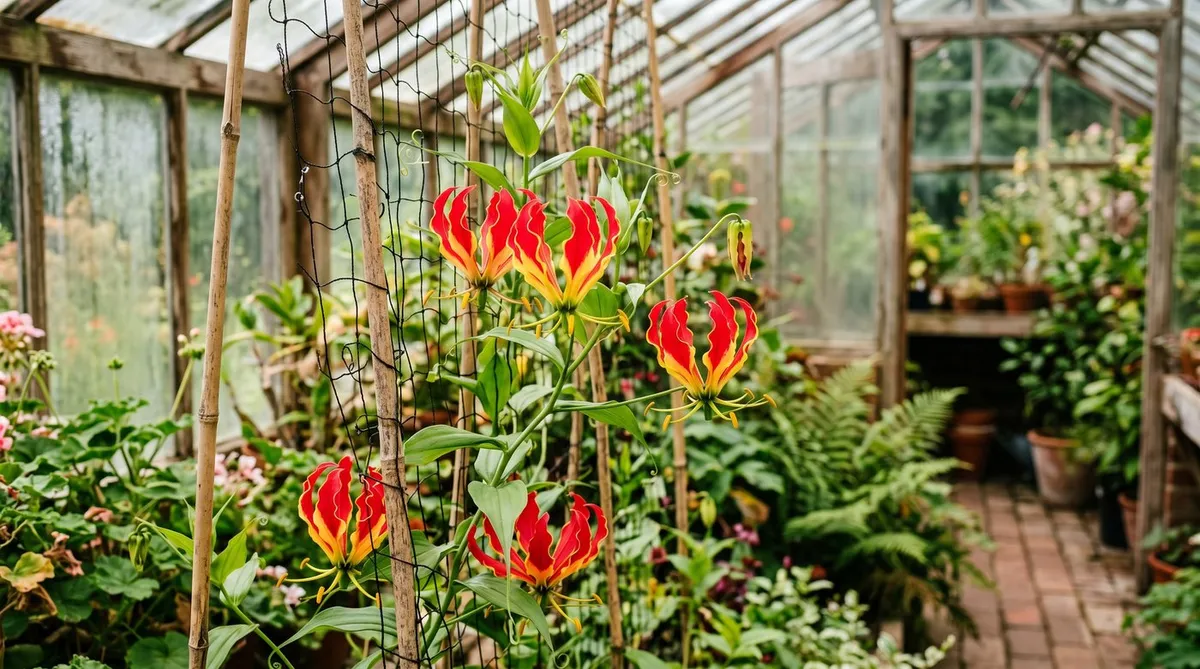
Put the support in before the stems get tall. Gloriosa climbs by hooking its leaf-tip tendrils onto thin supports. It cannot grip a thick cane or a smooth pole. Use:
- Thin canes (split bamboo or 6mm canes) arranged as a wigwam.
- Pea netting or trellis with a small mesh the tendrils can catch.
- Wires or strings run vertically up a greenhouse frame.
Once the leaf tips find the support they climb fast. Tie in the first stems loosely to start them off, then let the tendrils do the rest. For more on choosing supports for vigorous climbers, our guide to fast-growing climbers for fences and walls covers the netting and wire options.
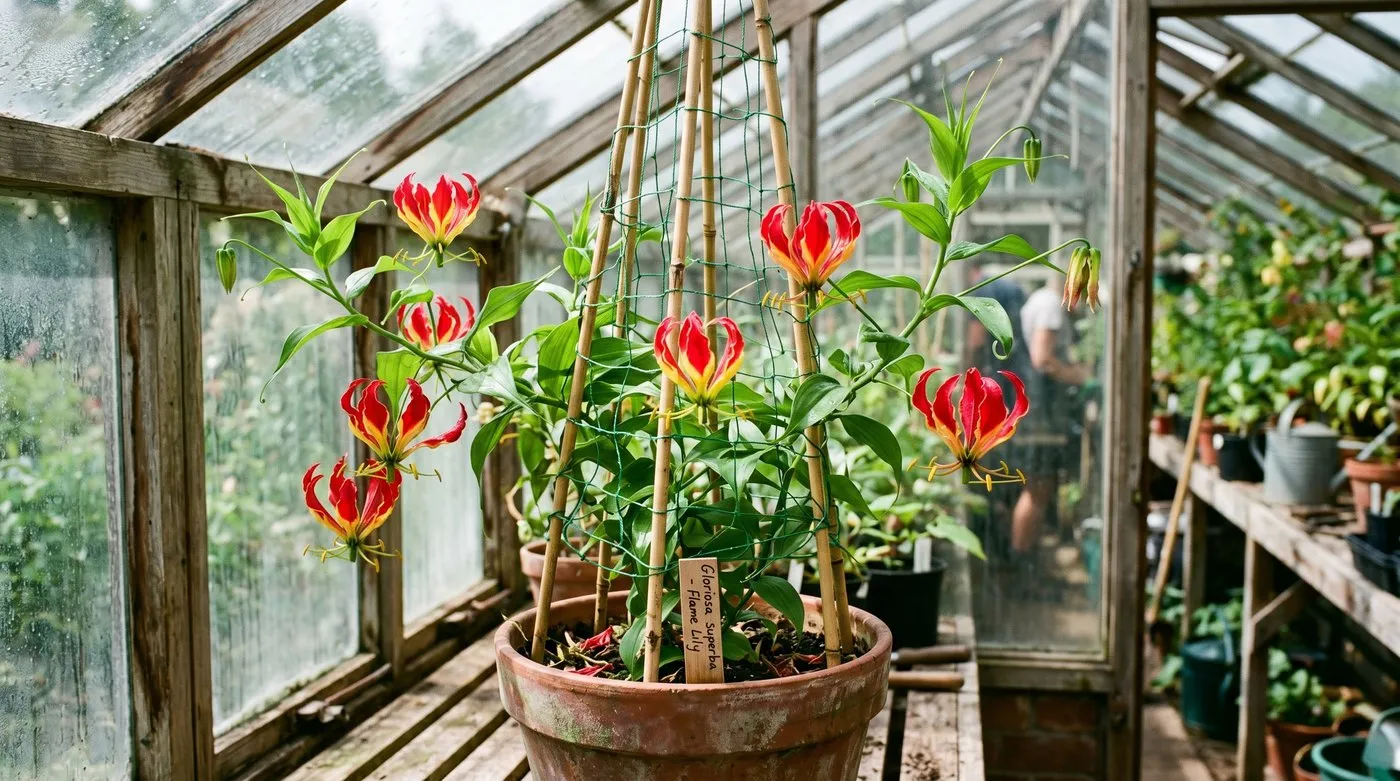 Thin canes and pea netting set up early. The leaf-tip tendrils need fine support to grab; a thick pole gives them nothing to hook.
Feeding and watering through the season
Gloriosa is a hungry plant once it is in full growth. Get the water and feed right and it rewards you with weeks of flower.
Water moderately while the plant is growing strongly. Keep the compost evenly damp but never sodden. The tuber rots fast in waterlogged compost, so a pot that drains freely is essential. In hot greenhouse weather a 5 litre pot may need water every day; in cool spells, far less.
Start feeding once flower buds appear. Use a high-potash tomato feed weekly, at the dilution on the bottle. Potash drives flowering rather than leaf, which is exactly what you want from July onward. Stop feeding by early autumn as the plant prepares to die back.
Keep it in good light at 20 to 25 Celsius and ventilate to avoid leaf scorch. Too cool and it sulks; too hot and dry under closed glass and the buds drop. The sweet spot is bright, warm and airy.
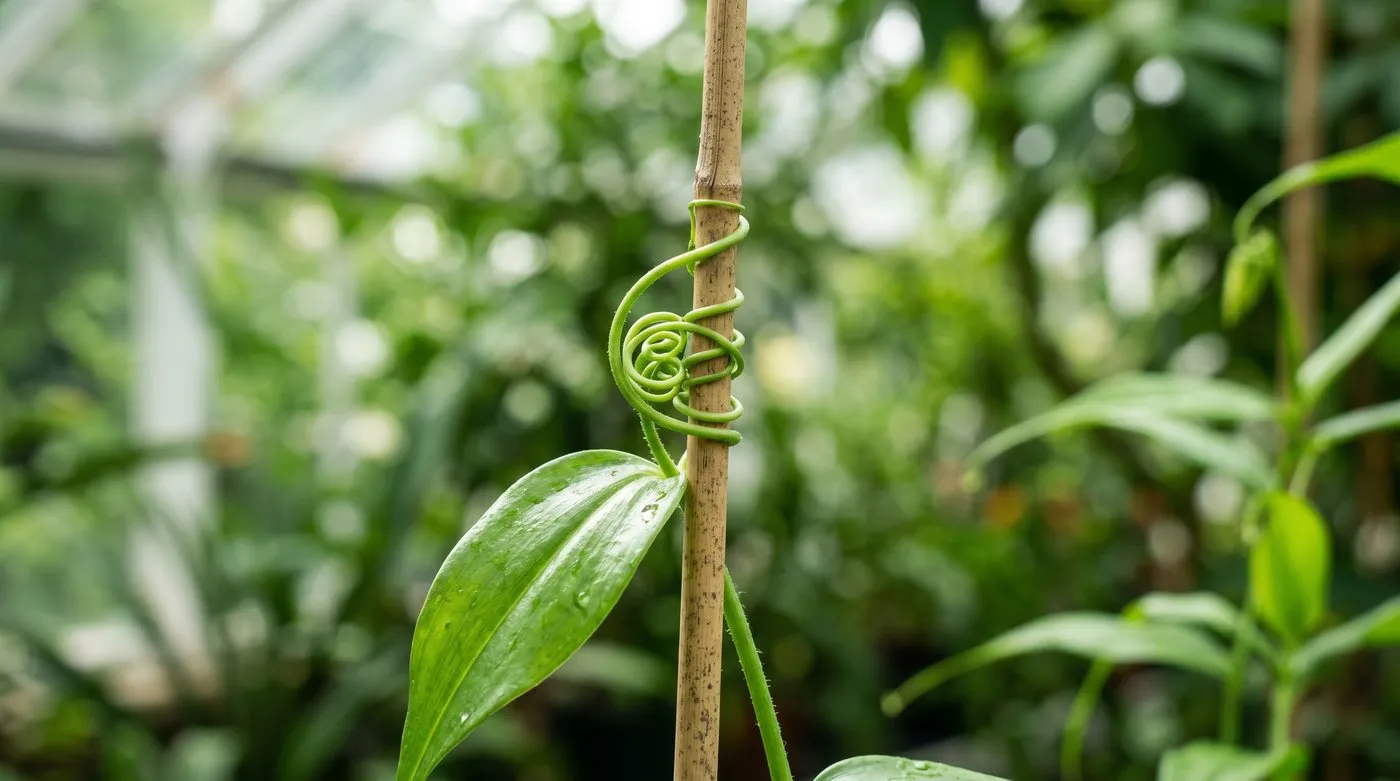 Each leaf ends in a curling tendril. This is how gloriosa climbs, hooking the leaf tip around thin supports rather than twining.
The flowers and how to use them
The flowers run from July to September and a single plant opens a dozen or more in succession. Each bloom carries six narrow petals, red with yellow margins, that reflex right back on themselves. The prominent stamens stand out from the centre, giving the flame effect.
New flowers open with more yellow and deepen to crimson over a few days. Individual blooms last well, and the whole plant stays in flower for weeks given warmth and light. As the season runs, the colour balance shifts redder.
Gloriosa cuts well for the house and the cut stems last over a week in water. Cut in the morning with sharp snips and always wear gloves; the sap and every part carry colchicine. Keep arrangements away from where children, pets or food might reach them.
Gloriosa varieties and how it compares to other tender climbers
The species is Gloriosa superba. The variety almost everyone grows is ‘Rothschildiana’, the large red-and-gold form. A few others appear in specialist lists. The table below compares the common forms.
| Variety | Flower colour | Height | Notes |
|---|---|---|---|
| superba (species) | Red and yellow, slightly smaller | 1.5-2m | The wild parent, vigorous and reliable |
| ’Rothschildiana’ | Deep crimson with gold margins | 1.8-2m | The standard UK variety, largest flowers |
| ’Lutea’ (yellow form) | Pure clear yellow | 1.5-2m | Scarce, a striking all-yellow flame |
| ’Carsonii’ | Deep reddish-purple and yellow | 1.2-1.8m | More compact, richer dark tones |
It also helps to see how gloriosa sits against other tender bulbs and climbers grown the same way under glass. The toxicity and support needs set it apart.
| Plant | Hardiness | Support needed | Flowering | Toxicity |
|---|---|---|---|---|
| Gloriosa (flame lily) | Tender, under glass | Yes, tendril climber | Jul-Sep | Very high (colchicine) |
| Calla lily (Zantedeschia) | Half-hardy | No | Jun-Aug | Moderate (oxalates) |
| Lily (Lilium) | Hardy | Stake tall types | Jun-Aug | High to cats |
| Canna | Tender | No | Jul-Oct | Low |
| Caladium | Tender, under glass | No, grown for leaf | Foliage plant | Moderate (oxalates) |
If you want the colour without the colchicine risk, grow lilies or cannas instead. For another tender exotic grown for foliage under glass, see our guide to growing caladium.
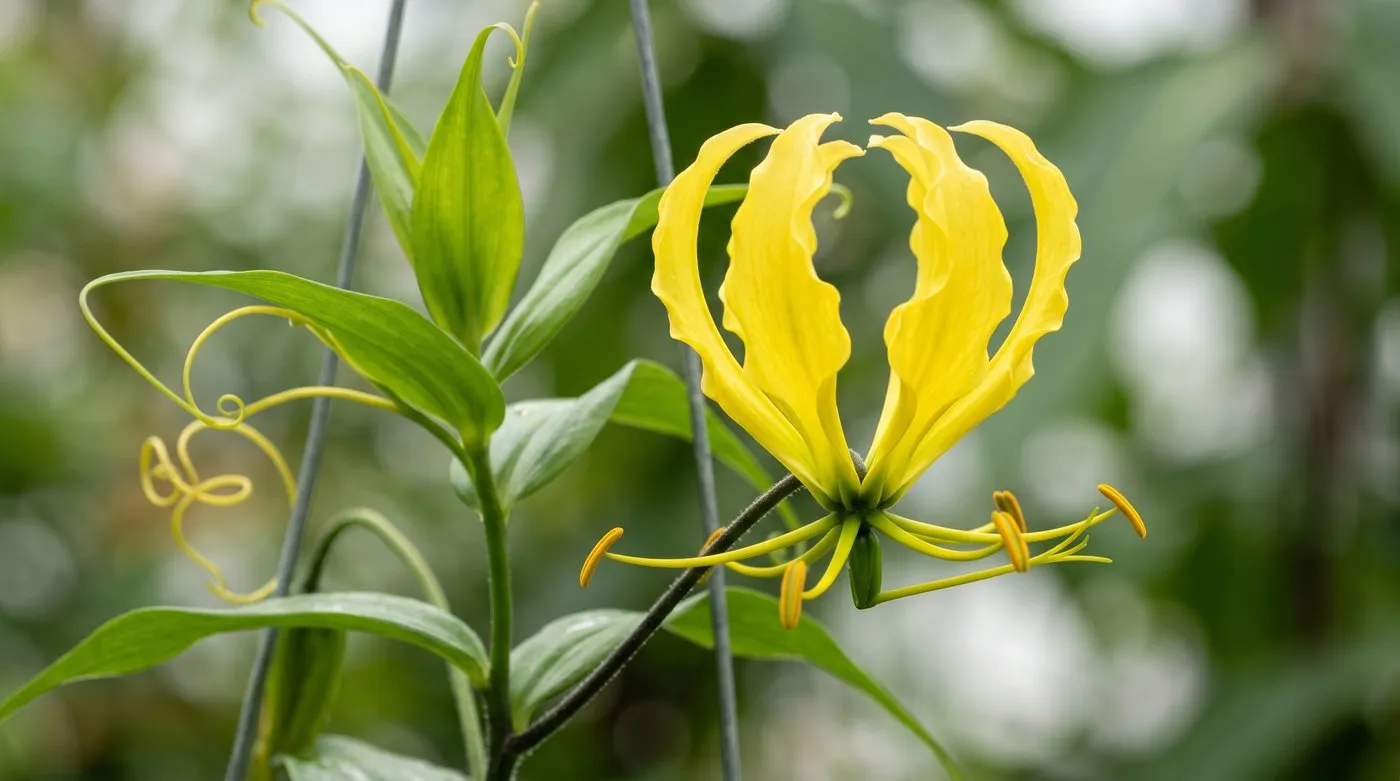 The scarce yellow form, sold as ‘Lutea’. Same flame shape as ‘Rothschildiana’ but in pure clear yellow rather than red and gold.
Lifting and storing the tuber over winter
Gloriosa is deciduous. It dies back each autumn and the tuber rests dry through winter, then restarts in spring. Getting the storage right is what carries the plant from one year to the next.
As the foliage yellows in autumn, reduce watering steadily. Let the plant die back naturally; the leaves feed the tuber as they fade. Once the top growth has gone, you have two storage routes.
Route one, lift the tuber. Tip the pot out carefully and find the brittle tuber in the compost. Brush it clean (gloves on), check it is firm, and pack it in dry compost or vermiculite in a tray or paper bag. Store at 10 to 12 Celsius, frost-free and dry.
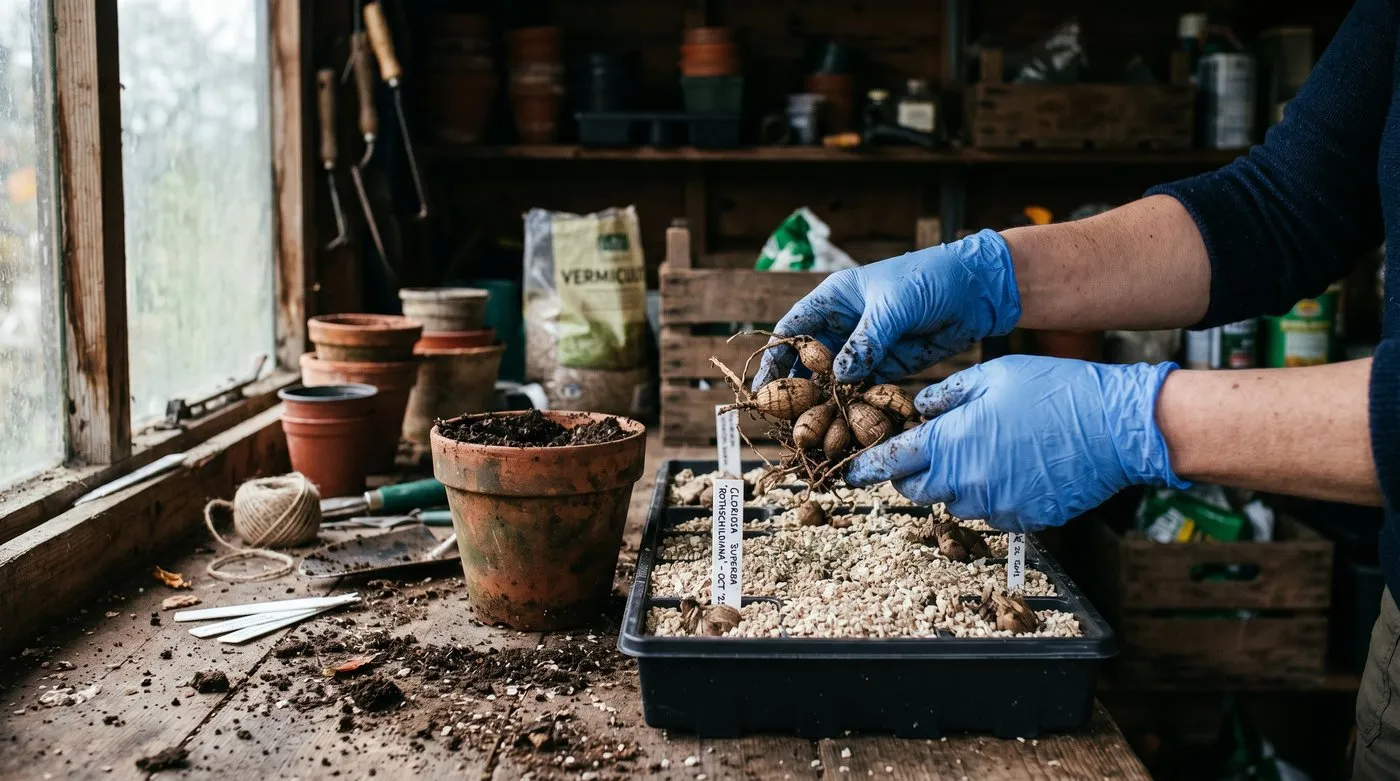 Lifting the dormant tuber in autumn. Pack it dry in vermiculite at 10 to 12 Celsius. Cold or damp storage rots it; gloves stay on throughout.
Common problems and how to fix them
Cold and rot. A tuber started too cold and too wet rots before it sprouts. Keep it barely moist at 18 to 21 Celsius to start. Free-draining gritty compost is essential.
Aphids and red spider mite under glass. Aphids cluster on soft new shoots; red spider mite thrives in hot, dry, still air. Ventilate well, mist around (not on) the plant in heat, and treat aphids early with a soft soap spray. Our organic pest control approach for lilies works on gloriosa pests too.
No flowers. Almost always too cold or too little light. Move it to the warmest, brightest spot, feed high-potash from budding, and ventilate to prevent scorch.
Tuber rot in winter storage. Storing too cold or too damp kills the tuber. Keep it dry at 10 to 12 Celsius, never below 8 Celsius, and check it once a month.
The five mistakes that kill gloriosa
- Breaking the growth tip. The bud at the tuber tip never regrows once snapped. Handle like a fragile match.
- Planting vertically or too deep. Lay the tuber flat at 5cm. Deep, upright planting risks the bud and slows emergence.
- Growing it too cold. It needs 18 to 21 Celsius to start and 20 to 25 Celsius to flower. A cold greenhouse gives leaf, not flower.
- Overwatering. Wet compost rots the tuber fast. Keep it barely moist until growing, then moderate, in free-draining mix.
- Storing the tuber too cold or too damp. Below 8 Celsius or in wet compost, the tuber dies. Dry, frost-free, 10 to 12 Celsius.
Month-by-month gloriosa calendar
| Month | Task |
|---|---|
| January | Order firm plump tubers from specialist suppliers before stocks sell out. Check the growth bud is intact. |
| February | Keep stored tubers dry and frost-free at 10 to 12 Celsius. Prepare pots and gritty John Innes compost. |
| March | Pot tubers horizontally 5cm deep at 18 to 21 Celsius in a propagator or warm windowsill. Keep barely moist. |
| April | Continue the warm start. Shoots emerge in two to four weeks. Set up thin canes or netting ready for climbing. |
| May | Move into the greenhouse or conservatory. Tie in first stems. Increase watering as growth speeds up. |
| June | Train stems onto support. Begin high-potash feed as the first buds form. Ventilate on hot days. |
| July | First flame flowers open from mid-month. Feed weekly, water moderately, keep at 20 to 25 Celsius. |
| August | Peak flowering. Maintain feed and ventilation. Cut flowers for the house wearing gloves. |
| September | Flowering tails off. Begin to reduce watering as foliage starts to yellow. |
| October | Let the plant die back. Stop feeding. Reduce water to nothing as leaves fade. |
| November | Lift and pack tubers in dry vermiculite, or keep the pot bone dry. Store at 10 to 12 Celsius. |
| December | Check stored tubers monthly for rot. Keep frost-free and dry. Plan next year’s display. |
The lesson is simple. Order early, inspect the bud, and reject anything shrivelled or snapped. A good tuber repays you for years if you store it dry and warm each winter.
Frequently asked questions
Is gloriosa poisonous?
Yes, gloriosa is highly poisonous in every part. It contains colchicine, and swallowing any part can be fatal. The tubers hold the most colchicine. Wear gloves when handling, wash your hands afterwards, and keep the plant well away from children, pets and livestock.
How do you plant a gloriosa tuber?
Lay the tuber flat, horizontally, about 5cm deep. The single growth bud sits at one tip and snaps off easily, so handle it with great care and never push the tuber in bud-first. Use a 3 to 5 litre pot of John Innes No 2 or 3 mixed with grit. Start at 18 to 21 Celsius.
Can gloriosa grow outside in the UK?
Not reliably outdoors across most of the UK. Gloriosa is tender and needs heat and shelter. Grow it in a greenhouse, conservatory, or a warm sheltered sunny patio in a pot you can move under cover. It will not survive a UK winter in open ground.
Why is my gloriosa not flowering?
Cold and low light are the usual causes. Gloriosa needs 20 to 25 Celsius and bright light to set buds. A plant grown too cool puts out leaf but few flowers. Give it the warmest brightest spot you have, feed high-potash from budding, and ventilate to stop heat scorch.
How do you overwinter a gloriosa tuber?
Let it die back in autumn, then store the tuber dry and frost-free at 10 to 12 Celsius. Reduce water as the foliage yellows, then lift the brittle tuber or keep the pot bone dry. Pack lifted tubers in dry compost or vermiculite. Never let it freeze or sit wet, as both cause rot.
How long does a gloriosa tuber take to flower?
Grow your exotic collection further
Now you have the flame lily in hand, the next step is to widen your tender collection with plants that share the same heat-and-shelter routine. Read our guide to hardy exotic and tropical plants for UK gardens for the full warm-border palette, browse the rest of our plant growing guides, or for another summer climber try morning glory. When the tuber goes dormant, our guide to storing flower bulbs covers the dry, frost-free principles that keep gloriosa alive through winter. For trusted background on colchicine toxicity, the Royal Horticultural Society holds detailed plant safety guidance.
Our team produces practical UK gardening guidance from source research, contributor records and established horticultural practice. Editorial standards are overseen by Matt W.