Key takeaways
- Wind above about 7mph (11km/h) grounds midges completely, beating every repellent sold
- Only the female Highland midge bites; she needs blood protein to develop her eggs
- DEET at 20-50% and 20% picaridin (Saltidin) are the only two repellents with strong field evidence
- The clouds of midges over your pond are almost certainly harmless non-biting chironomids
- Bug zappers kill mostly beneficial insects: one study found biting flies were 0.22% of the catch
- Ultrasonic repellers have failed every controlled field trial and citronella is marginal at best
Midges turn a good UK summer evening into a retreat indoors. The advice online is 90% folklore: candles, plants in pots, plug-in gadgets, vitamin pills. Most of it has been tested and most of it fails. Midges are beatable, but only if you know which insect is actually biting you and which defences have evidence behind them.
This guide separates the four things people call midges, ranks the repellents honestly, and names the myths. The single most useful fact comes first: a midge is a feeble flier, and a breeze above about 7mph grounds it completely. No product does better than that, and the wind is free.
Which midge is actually biting you
Four completely different insects get called midges in the UK, and only one of them bites. Getting this wrong sends people to war with something harmless.
Highland biting midge (Culicoides impunctatus). The famous one. Around 1.4mm long, so small that a swarm reads as smoke before you feel anything. Only the female bites, because she needs blood protein to develop her eggs. Roughly 35 Culicoides species live in Scotland but this one accounts for the great majority of bites. It dominates the west Highlands, and it turns up in damp parts of Wales, Cumbria and Ireland too.
Non-biting midges (Chironomidae). Over 600 UK species. They have no biting mouthparts at all. The males form mating swarms, often a shifting column over water or a lawn at dusk, which is what most people photograph and panic about. Their larvae are bloodworms living in pond silt, and they are important food for fish and birds.
Fungus gnats and sciarid flies. These come out of houseplant compost, not from outdoors. Different problem entirely, covered in our guide to getting rid of houseplant flies.
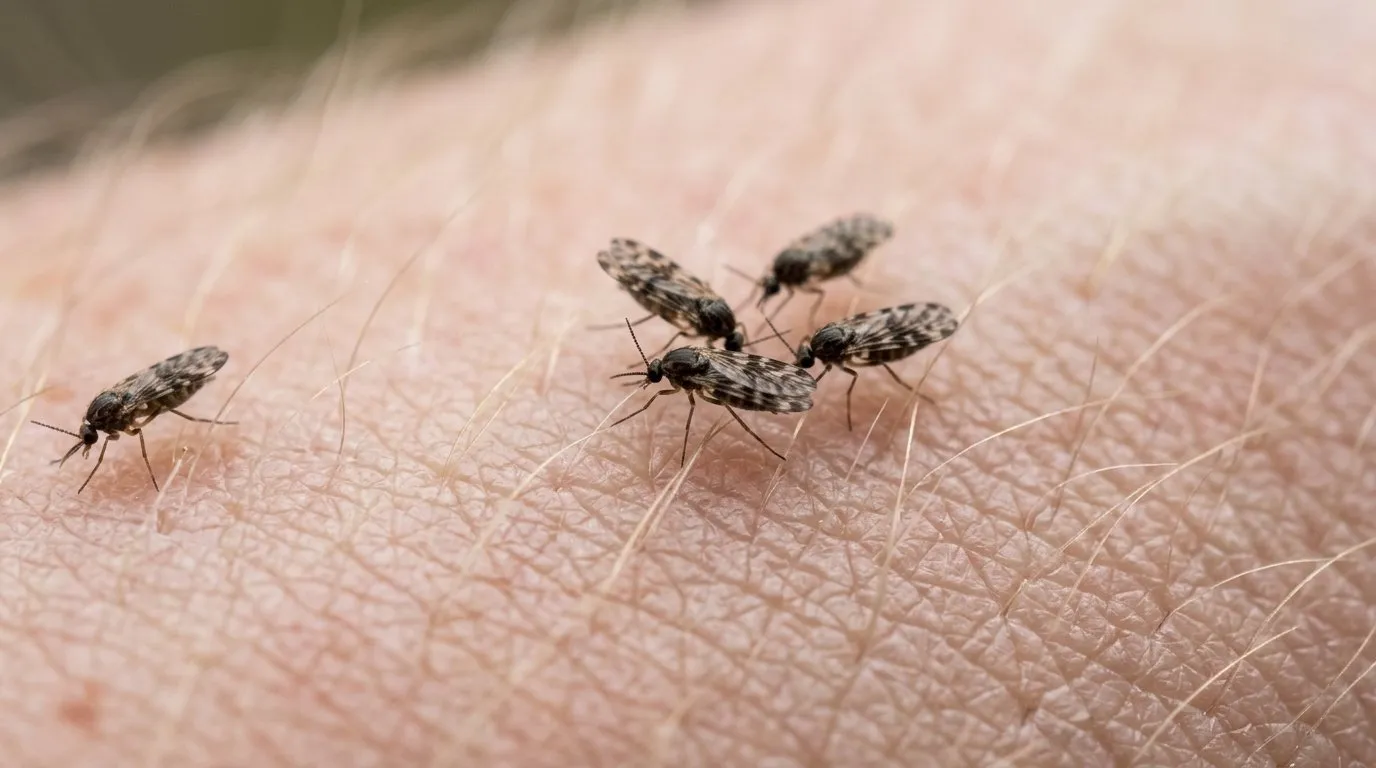 Highland biting midges on a forearm. At 1.4mm a swarm reads as drifting smoke before you feel the first bite.
Owl midges (Psychodidae). Small, hairy, moth-like, about 2mm. They breed in the gel film inside drains and overflow pipes, then appear on bathroom walls. Harmless.
Note on names: Pear midge has nothing to do with any of this. It is a gall midge whose larvae destroy developing pear fruitlets, and no adult ever bites a human. If your pears are turning black and dropping in June, you want our guide to pear midge control instead. The shared word is a coincidence.
Midges are also not mosquitoes. Mosquitoes are far larger, whine audibly, breed in standing water, and bite through the night. Midges are silent, tiny and dawn-and-dusk creatures. The distinction matters because the prevention advice is completely different, as our guide to plants that repel mosquitoes explains.
The Highland midge and why Scotland gets the worst of it
The Highland midge needs three things, and the west of Scotland supplies all three better than anywhere else in Britain.
It needs damp, acidic peaty ground, typically around pH 4 to 5.5. The larvae live in the top few centimetres of wet peat, feeding on decaying organic matter. Not in ponds. Not in water butts. In wet soil. Boggy moorland, rush-filled hollows and the margins of forestry plantations are ideal.
It needs high humidity, generally above 80%, and it needs shelter from wind and sun. It needs temperatures above roughly 9 to 10C to fly at all.
 The nursery. Highland midge larvae live in the top few centimetres of wet peaty soil, never in standing water.
The season runs late May to September, in two waves. The first generation emerges from late May into June. The second, usually larger, peaks from late July into August. That second wave is the one that empties campsites.
Females find you by carbon dioxide from your breath, plus body heat, moisture and dark colours. They will follow a CO2 plume a surprising distance, which is why standing still and breathing hard after a walk uphill is the worst possible move.
The numbers are brutal in the right conditions. A still, overcast, muggy August dusk beside a Lochaber loch is peak midge weather. The same spot at midday in bright sun with a stiff westerly is empty.
Wind speed beats every repellent you can buy
This is the fact that should headline every midge article and almost never does.
A Highland midge is a poor flier. Above roughly 7mph (11km/h, about 3 metres per second) it simply cannot make headway and stops flying. Some individuals give up nearer 5mph. Below about 4mph they fly freely. There is no gradual decline: there is a threshold, and past it they are gone.
The practical consequences are large and cost nothing.
 Above about 7mph midges stop flying altogether. An exposed seat beats every repellent on the market.
The awkward corollary: anything that relies on a vapour cloud, including citronella and Thermacell devices, only works in the still air where midges are worst. When conditions are good enough for the vapour to sit around you, the midges are flying. When there is enough breeze to disperse it, you did not need it.
Those clouds over the pond are not biting anything
Every summer someone photographs a swirling column of insects above their pond at dusk and asks how to kill it. Almost always the answer is: do not.
These are male chironomids in a mating swarm. They gather over a landmark, often water, a light-coloured patch of lawn, or a hedge line, and dance in a column so that females can find them. They have no functioning biting mouthparts. They cannot bite you. They live a few days as adults and do not feed.
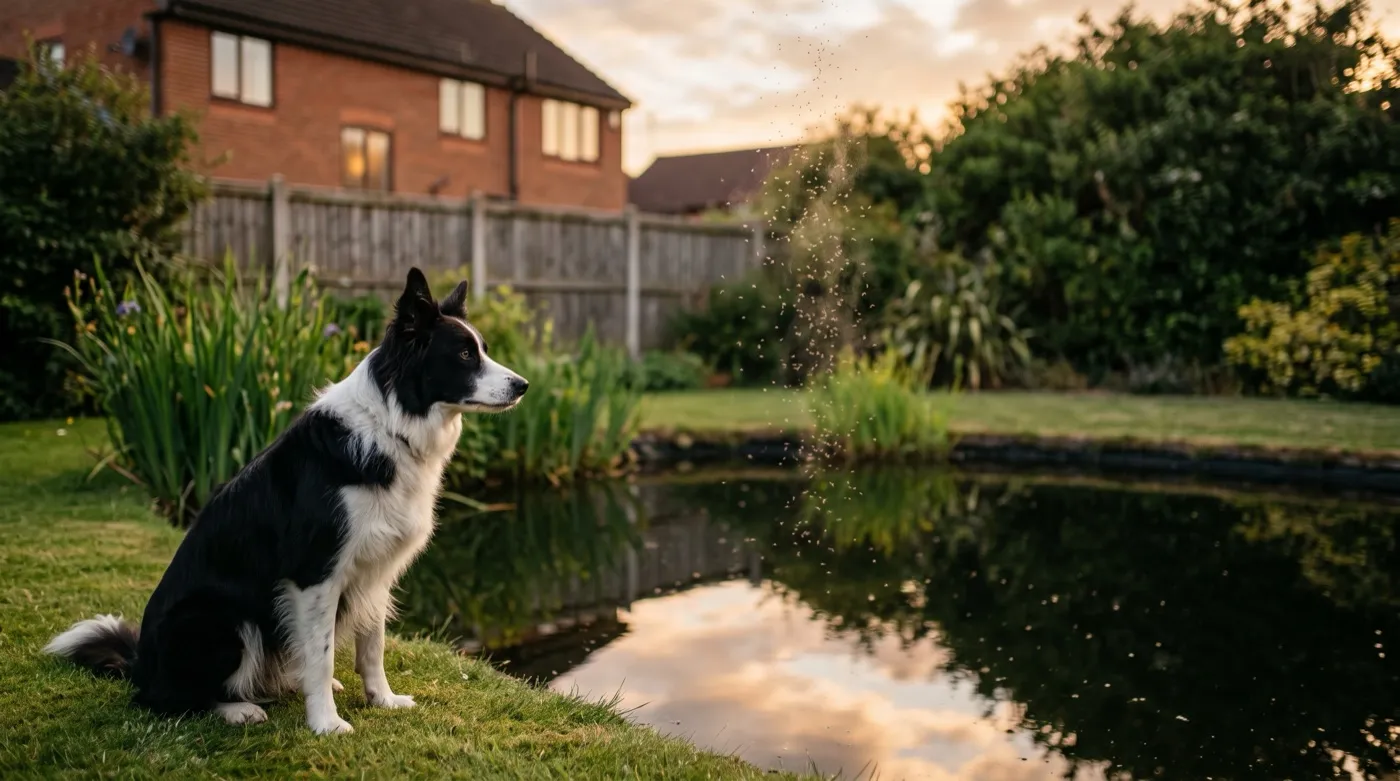 A mating column of male chironomids over a still garden pond at dusk. No biting mouthparts, no threat to the dog sitting under them, and important food for birds.
The swarm looks alarming because of the numbers, not the risk. Walk through one and you will breathe a few in. That is the extent of it.
Chironomid larvae are bloodworms, red from the haemoglobin that lets them live in low-oxygen sediment. They are among the most important invertebrates in a UK pond, feeding sticklebacks, newts, dragonfly nymphs and birds. Buglife treats them as a marker of a functioning freshwater system rather than a pest.
A healthy pond full of chironomids is a pond that supports dragonflies and damselflies, whose nymphs eat the larvae in quantity. If you want fewer midges of any sort near water, the answer is more predators, not fewer insects. Our guide to building a wildlife pond covers how to get that balance.
Repellents ranked by what the evidence shows
Ordered by field evidence and duration, not by marketing.
The gold standard is wind plus a net, with DEET or picaridin as the portable fallback. That is an unglamorous answer, which is why nobody sells it.
 A midge net needs mesh under 1mm. Standard 1.2mm mosquito netting lets a 1.4mm midge straight through.
Two notes on the physical barriers. A midge net must be finer than a mosquito net. Standard mosquito mesh at around 1.2mm lets a 1.4mm midge through without touching the sides. Buy one sold specifically for midges. And midges bite readily through a loose knit, so a thin tightly woven shirt beats a chunky jumper.
The Avon Skin So Soft story, told accurately
This one deserves accuracy rather than either the usual breathless repetition or a flat dismissal.
The claim is true in outline. Avon Skin So Soft Original Dry Oil Spray does reduce midge biting. The story that Royal Marines training in Scotland used it is real, and Scottish outdoor workers have used it for decades. It is one of the few pieces of gardening folklore with something behind it.
But be precise about what it is. It is a body oil, not a designed repellent. It carries no repellent approval and it was never formulated for the job. The active effect appears to come from isopropyl myristate, an emollient that seems to interfere with midges landing and feeding rather than repelling them at distance.
 Picaridin at 20% held midges off for six to eight hours in paired testing. Skin So Soft managed 30 to 60 minutes.
Where it earns its place: a short spell in the garden, on children whose skin you would rather not put DEET on, and as the thing already in the bathroom cupboard when the midges arrive unannounced. Where it does not: a full evening, a Scottish August, or anywhere ticks are a concern.
The myths that fail, and why they persist
Four popular defences have been tested properly and do not work.
Citronella candles. The vapour forms a small plume that any air movement destroys. Trials on biting flies put candles far below topical repellents, sometimes at no measurable benefit. The persistence of the myth is easy to explain: people light them on breezy evenings, get no bites, and credit the candle rather than the wind.
Ultrasonic repellers. Reviewed repeatedly and rejected every time. Field trials find no reduction in landing or biting rates. Cochrane reviews of electronic mosquito repellents concluded there is no justification for promoting them. No mechanism has ever been demonstrated.
Garlic, vitamin B and repellent plants in pots. Ingested garlic and vitamin B1 have failed controlled trials for biting insects. As for plants, a lemon-scented pelargonium sitting in a pot releases almost no volatile oil. Crushing the leaves onto your skin does something briefly. The pot on the table does nothing at all, as our honest look at plants that repel flies sets out.
Midge traps deserve a fairer hearing. Large CO2 traps genuinely catch enormous numbers, sometimes millions over a season. But catch is not the same as protection. In an open garden, new midges drift in continuously from surrounding ground, and measured reductions in actual bites are modest for a £400 to £700 outlay. They perform better on enclosed sites with a clear boundary.
Why midges breed where they do, and what to fix
The root cause is habitat, and the standard advice gets it wrong in an interesting way.
Almost every article tells you to remove standing water. For mosquitoes, that is correct. For chironomids, it reduces the swarms. For the Highland midge, it does nothing at all, because C. impunctatus does not breed in standing water. It breeds in permanently damp, acidic, peaty soil. A pristine garden with not a bucket of water in it, sitting on wet ground next to a rushy field, will still have midges.
Why is this missed? Because midges get lumped in with mosquitoes, and mosquito advice is what gets copied. The two insects use completely different nurseries.
What actually reduces breeding habitat:
Standing water still deserves attention for the other three insects.
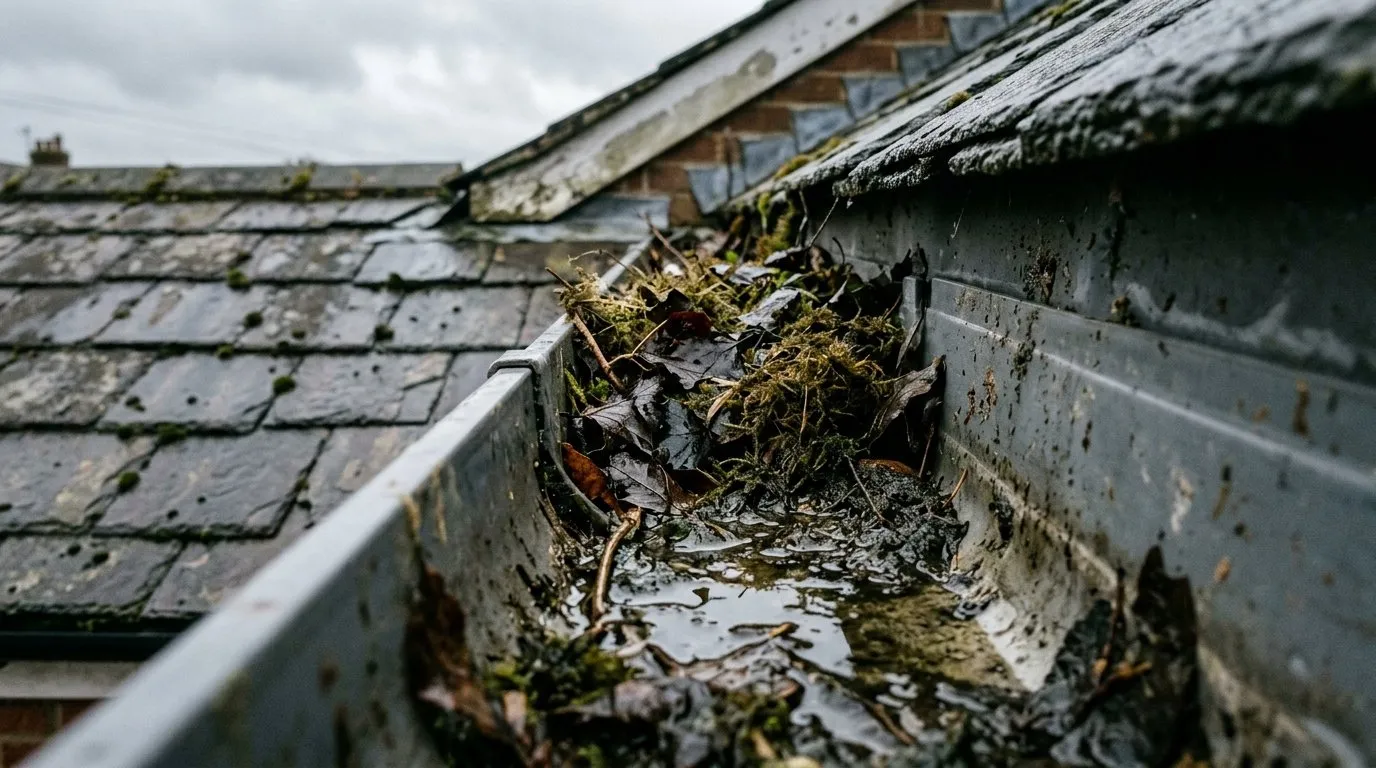 The most-missed breeding site on any house. A centimetre of silty water in a gutter breeds chironomids and owl midges.
- Clear blocked gutters. A gutter holding a centimetre of silty water breeds chironomids, mosquitoes and owl midges. This is the single most-missed site on a house.
- Flush drains and gullies. Owl midges breed in the organic film inside them. A kettle of hot water and a brush every couple of months clears it.
- Keep water butts lidded. Mosquito prevention, mainly.
Timing beats habitat work in any case. Midges bite hardest in the two hours around dawn and the two hours around dusk. Move your evening outside to between 2pm and 6pm on a still summer day and the problem largely disappears.
Month-by-month midge calendar for UK gardens
| Month | What to expect and do |
|---|---|
| January | No adult activity. Larvae dormant in wet soil. Good time for drainage work. |
| February | Still nothing flying. Clear gutters before spring. |
| March | Larvae developing as soil warms past 6C. Cut back rushes in damp corners. |
| April | Occasional early chironomid swarms. No biting midges yet. |
| May | First Highland midge generation emerges from late May. Buy repellent now. |
| June | Biting begins in earnest in the west and north. Chironomid swarms peak over ponds. |
| July | Second generation building. Still muggy evenings are the worst conditions. |
| August | Peak biting, especially late month. Head net season in Scotland and Cumbria. |
| September | Numbers fall as nights cool below 9C. Biting tails off through the month. |
| October | Activity essentially over. Assess which damp corners stayed wet all summer. |
| November | Install land drains or a soakaway while the ground shows you the problem. |
| December | No activity. Plan seating for an exposed spot next year. |
Common mistakes people make with midges
- Fighting the wrong insect. The column over the pond is non-biting chironomids and the flies from the houseplant are sciarids. Neither has ever bitten anyone. Identify before you spend.
- Buying gadgets before checking the wind. A £600 trap in a sheltered corner performs worse than moving the table 15 metres into the open. Wind is the strongest variable and it is free.
- Emptying every bucket to stop Highland midges. They breed in wet peaty soil, not standing water. The advice is copied from mosquito guidance and does nothing for the insect actually biting you.
- Using a mosquito net against midges. Standard 1.2mm mosquito mesh passes a 1.4mm midge straight through. Buy mesh sold specifically for midges, under 1mm.
- Trusting citronella on a still night. Still air is when midges bite and when candles work least well relative to need. If a candle seems to be working, check whether there is a breeze doing the job.
The honest summary on midges
Midges are one of the few garden problems where the cheap answer is the best answer. A breeze, an open seating spot, an hour’s difference in timing and a £7 bottle of picaridin will do more than every gadget in the catalogue put together.
The reason the folklore persists is that midges are so weather-driven that any remedy tried on a breezy evening looks like a triumph. Test anything on a still, muggy August dusk beside damp ground and the truth arrives quickly.
Now you know which midge is biting and what stops it, read our guide to dragonflies and damselflies in the UK for the predators that do this job for you all summer.
Frequently asked questions
What actually keeps midges away?
Wind above 7mph, DEET or picaridin repellent, and a fine-mesh midge net. Everything else is marginal. Midges are weak fliers, so an exposed seating spot beats a sheltered one every time. For repellents, only DEET at 20-50% and 20% picaridin have strong field evidence behind them. Timing helps too: midges bite hardest at dawn and dusk.
Do citronella candles repel midges?
Barely, and not at all in a breeze. Citronella gives a small protected zone in perfectly still air. Any air movement disperses the vapour and the effect disappears. Studies on biting flies consistently rank citronella candles far below topical DEET. They are pleasant garden lighting, not pest control.
Why do midges only bite at dawn and dusk?
They avoid bright sunlight and low humidity, which dry them out. The Highland midge is most active in the low light and high humidity of dawn and dusk, typically above 9C. Bright sun and dry air ground them just as effectively as wind. Overcast, muggy, still days can bring biting at any hour.
Are the midges swarming over my pond dangerous?
No. Those are almost certainly non-biting chironomids, which have no biting mouthparts. Male chironomids form mating swarms over water, ponds and lawns at dusk. Their larvae are bloodworms and are important food for fish and birds. They cannot bite you and need no control at all.
Does Avon Skin So Soft really work on midges?
It has a real but short effect, roughly 30 to 60 minutes. The oil is not designed as a repellent; the isopropyl myristate in it appears to interfere with midges landing. It is not comparable to DEET for duration. Reapply constantly or use a proper repellent for a full evening outdoors.
Do ultrasonic midge repellers work?
No. Controlled field trials have found no reduction in bites from ultrasonic devices. Reviews of multiple studies have reached the same conclusion repeatedly. There is no plausible mechanism: midges do not respond to the frequencies these devices emit. Save your money and buy a head net.
How do I stop midges breeding in my garden?
Improve drainage on permanently damp, boggy ground. Highland midge larvae live in wet peaty soil, not in standing water. That means the usual advice about emptying water butts and buckets does nothing for them, though it does help against mosquitoes and chironomids. Clearing blocked gutters removes a different set of breeding sites.
Our team produces practical UK gardening guidance from source research, contributor records and established horticultural practice. Editorial standards are overseen by Matt W.