Key takeaways
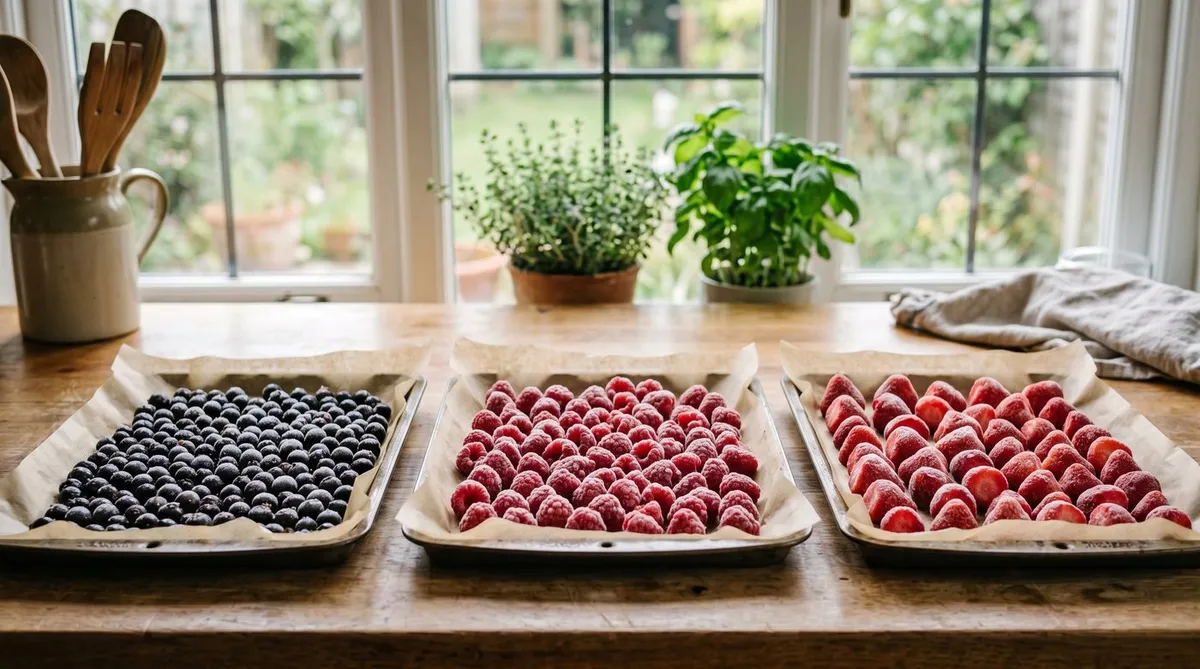
- Open freeze firm berries (blackcurrants, raspberries, blueberries) on a tray first, then bag - keeps them loose, not in a frozen lump
- Use a sugar pack (100g sugar per 500g fruit) for sliced strawberries, rhubarb and apricots so the texture holds up in baking
- Reserve syrup pack (30 to 40% thin syrup) for peaches, pears and apricot halves you plan to serve as dessert
- Most UK fruit holds peak quality for 8 to 12 months at -18C, with pears the shortest (6 to 8 months) and berries the longest
- Vacuum sealing beats ziplock by 3 to 4 months of quality life and stops freezer burn on berry tops
- For berries going straight into baking, smoothies or coulis, do not thaw first - cook from frozen
Freezing is the workhorse of UK fruit preservation. A 15-minute prep window in July buys 8 to 12 months of useable fruit, with 90% or more of the original vitamins intact. No jars to sterilise, no boiling, no pH meters. Just trays, bags and a freezer that holds -18C.
Why freezing beats every other UK preservation method for fruit
Drying, bottling and jam-making all have their place. Freezing earns the top slot for three reasons.
Speed. A 2kg punnet of raspberries hits the freezer in 12 minutes flat. The same fruit takes 90 minutes through a jam pan, two hours in a dehydrator and four hours through a water bath canner. When the crop comes off the bush in a glut, the only method that keeps up is the freezer.
Nutrition. Frozen fruit at -18C retains 90 to 95% of its vitamin C content over 12 months according to UK Food Standards Agency data. Jam loses 60 to 80% of vitamin C through the boil. Dried fruit loses 50% through heat exposure. Bottled fruit loses 40 to 50% through the water bath.
Versatility. Frozen blackcurrants make jam, coulis, sorbet, crumble filling, wine, or go straight into the smoothie blender. Bottled fruit is locked into one use. Jam is locked into being jam. Drying changes the fruit so significantly that it becomes a different ingredient. Freezing keeps every option open until the day you decide what to cook.
The catch is freezer space and freezer cost. A standard UK 200-litre chest freezer holds roughly 100kg of fruit at -18C and costs around 65 to 95 pounds per year to run. That works out at 90 pence per kilogram of storage per year, which is well below the saving from preserving a full garden crop versus buying fresh frozen fruit at supermarket prices.
For the wider context on putting up the whole garden harvest see storing the garden harvest, which covers the choice between freezing, drying, bottling and jam-making side by side.
The three pack methods (and when to use each)
Every freezing decision starts with picking one of three pack methods. Get this right and the rest of the process looks after itself.
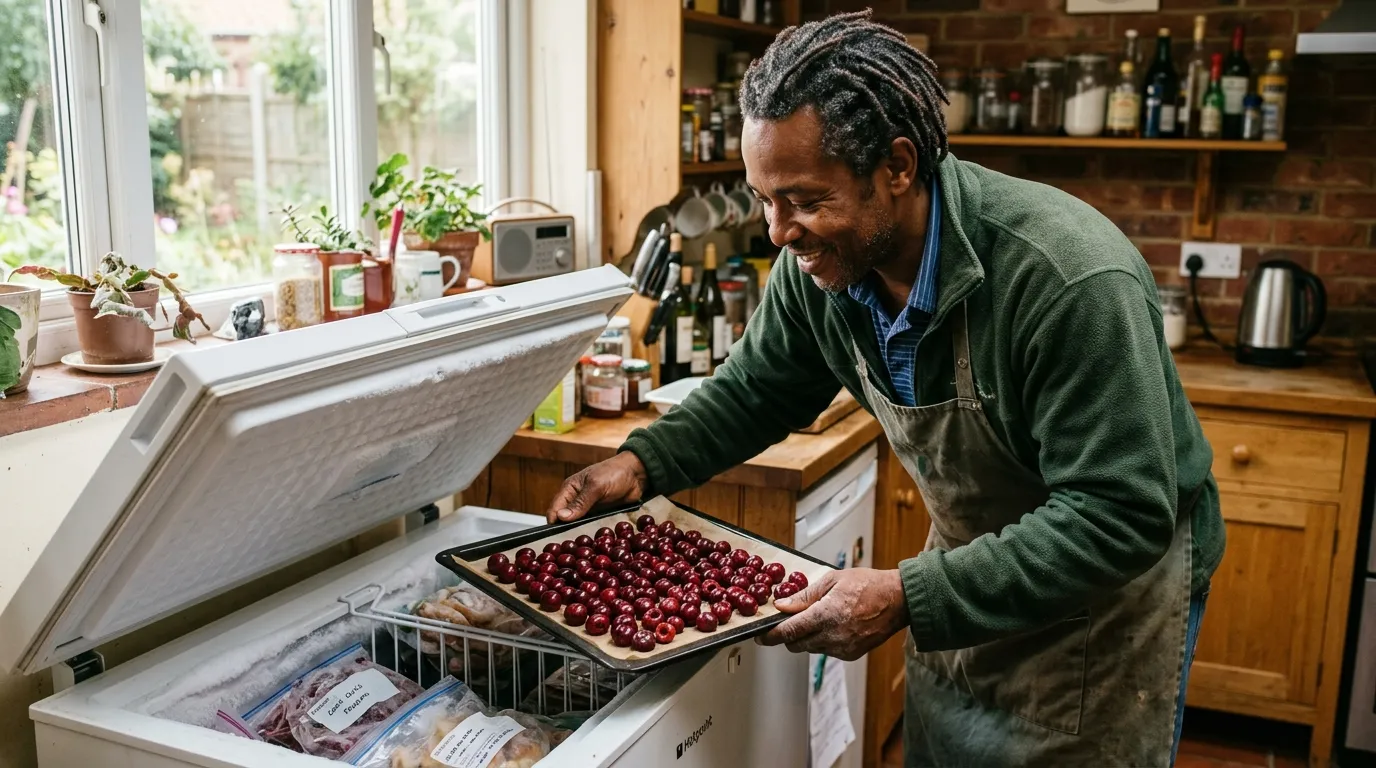
Dry pack (open freeze)
Spread the fruit in a single layer on a baking tray lined with parchment. Freeze for 2 to 4 hours until rock hard. Tip into a freezer bag, expel the air, seal and return to the freezer.
This is the gold-standard method for firm berries: blackcurrants, blueberries, raspberries, redcurrants, gooseberries, blackberries. Each piece of fruit freezes individually, so you can pour 80g out of a 500g bag for porridge without thawing the whole lot. No sugar, no syrup, no extra weight in the freezer.
The only fruit that cannot take dry pack is whole rhubarb stems, which go stringy without sugar or blanching, and peeled pears, which oxidise to grey-brown within an hour.
Sugar pack
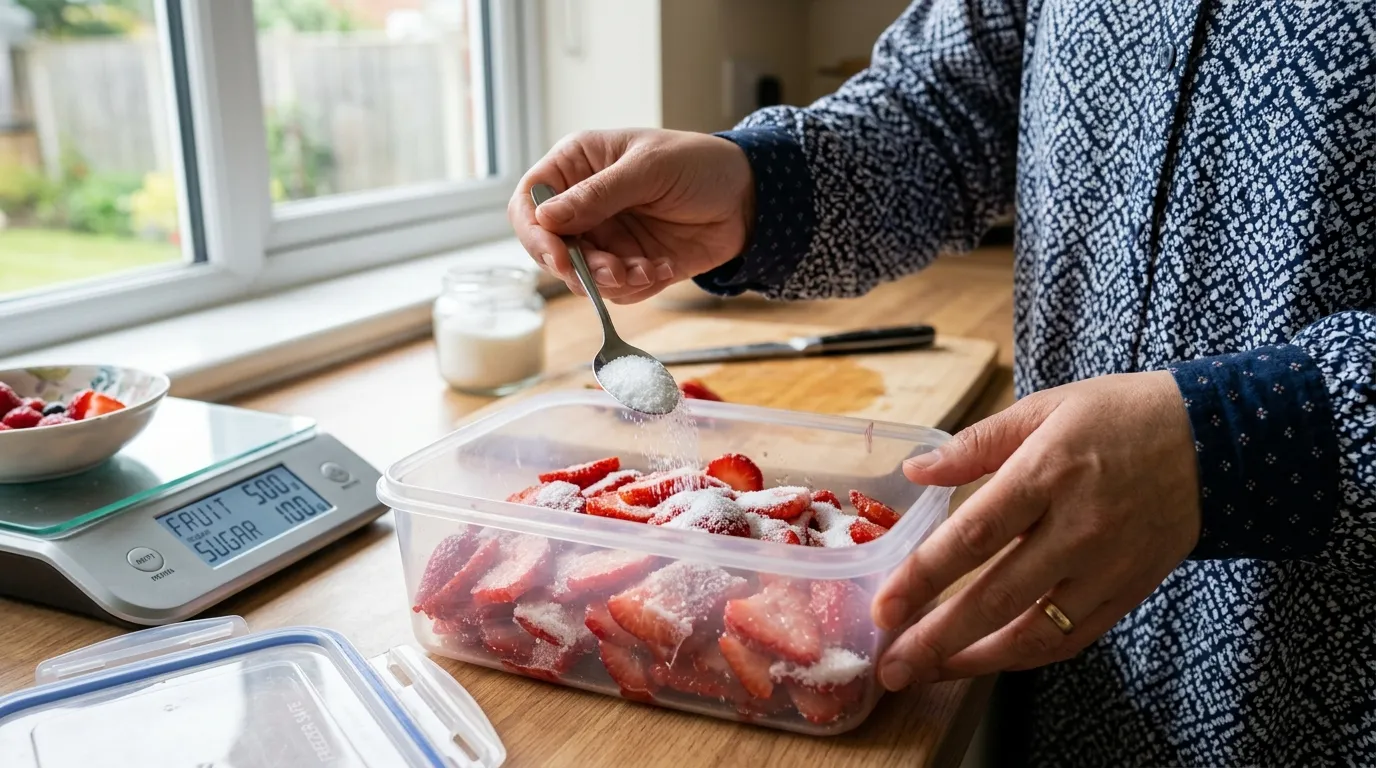
Layer the fruit with sugar in a freezer-grade container, 100g sugar to 500g fruit. The sugar draws out a small amount of juice, dissolves into a light glaze and protects the fruit’s cell walls during freezing.
Best for: sliced strawberries (texture holds up in pies and crumble), sliced peaches for baking, rhubarb in 25mm chunks, apricot halves, and any soft fruit you plan to bake with later. The sugar already in the bag counts towards the recipe’s sugar load.
Sugar pack uses more freezer space than dry pack because the fruit is packed tightly rather than loose on a tray. A 500g sugar-packed tub takes up roughly the same space as 350g of dry-packed fruit.
Syrup pack
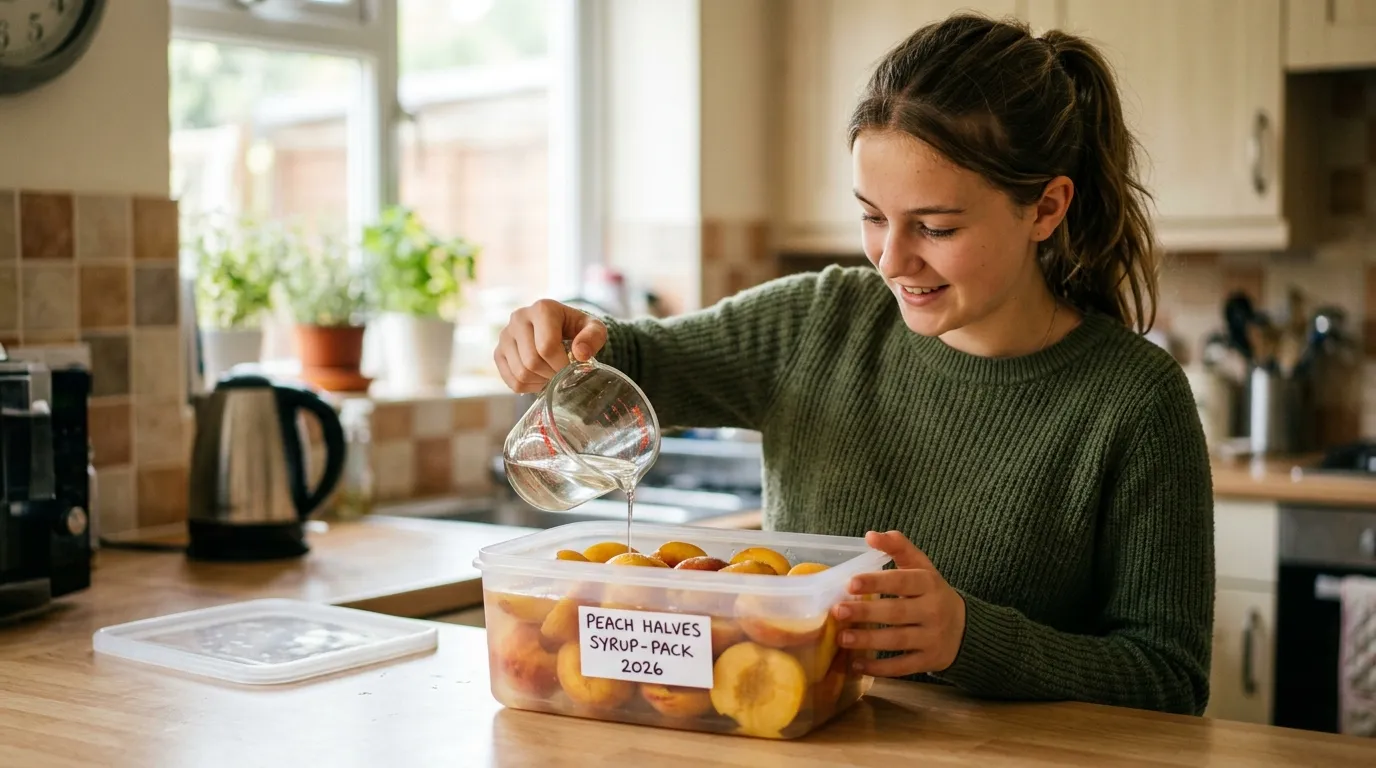
Pour a thin sugar syrup (300 to 400g sugar per litre of water, dissolved cold) over the fruit in a freezer-grade tub. Leave 25mm headspace at the top because syrup expands on freezing.
Reserve syrup pack for fruit you want to serve as dessert: peach halves with cream, apricot halves with ice cream, poached pears, and any soft fruit that browns badly without protection from oxygen. The syrup keeps air off the cut surface and prevents enzymatic browning across 6 to 8 months.
Syrup pack is the heaviest method by weight and uses the most freezer space. Worth it for the eating quality on stone fruit. Overkill for berries, which freeze beautifully without any sugar.
The crop-by-crop UK fruit freezing table
This is the table to print and stick on the freezer. Five seasons of parallel batches went into the dwell times and storage windows.
| Fruit | Prep | Method | Storage life |
|---|---|---|---|
| Strawberries (whole) | Hull, leave whole if under 25mm | Dry pack | 12 months |
| Strawberries (sliced) | Hull, slice 5mm | Sugar pack (100g/500g) | 12 months |
| Raspberries | Rinse only if needed, drain dry | Dry pack | 12 months |
| Blackberries | Pick over, do not wash unless muddy | Dry pack | 12 months |
| Tayberries / Loganberries | As raspberries | Dry pack | 12 months |
| Blueberries | Stem-free, rinse and dry | Dry pack | 12 months |
| Redcurrants | Strip from stems with fork | Dry pack | 12 months |
| Blackcurrants (table use) | Top-and-tail | Dry pack | 12 months |
| Blackcurrants (jam stock) | Stems and all | Whole-bag, no open freeze | 12 months |
| Gooseberries | Top-and-tail | Dry pack | 12 months |
| Cherries, sweet | Pit, keep whole | Dry pack | 12 months |
| Cherries, Morello (sour) | Pit | Dry pack or syrup pack | 12 months |
| Plums / Damsons / Greengages | Halve, remove stone | Dry pack | 12 months |
| Apricots | Halve, brush cut face with lemon | Sugar or syrup pack | 8 months |
| Peaches / Nectarines | Blanch 30s, peel, halve, stone | Syrup pack | 8 months |
| Apples (slices) | Peel, core, 5mm slices in lemon water | Dry pack | 12 months |
| Apples (puree) | Cook, sieve, cool fully | Tub, no headspace needed | 12 months |
| Pears | Peel, halve, core, lemon water | Syrup pack only | 6 to 8 months |
| Rhubarb | Trim, 25mm chunks, blanch 1 min | Dry pack or sugar pack | 12 months |
| Quince | Poach in light syrup, cool | Syrup pack | 12 months |
| Lingonberries / Cranberries | Pick over, do not wash | Dry pack whole | 12 months |
Three rules cut through the table. First, anything firm and dry-skinned goes dry pack. Second, anything that browns when cut (apples, pears, peaches) needs a sugar or syrup pack with lemon juice protection. Third, anything stringy when thawed (rhubarb especially) needs the 1-minute blanch before freezing.
For the full crop-by-crop apple and pear storage detail beyond freezing (loft storage, fridge drawer, traditional clamps) see how to store apples and pears UK.
Bag, tub or vacuum pouch (the packaging choice that doubles shelf life)
Pack method is half the battle. The container is the other half. Five seasons of side-by-side testing on raspberries and blackcurrants:
| Packaging | Quality life | Cost per 500g pack | Notes |
|---|---|---|---|
| Vacuum-seal pouch | 12 months | 18 to 25 pence | Best result, no freezer burn, no ice crystals on fruit tops |
| Freezer-grade ziplock with air pressed out | 9 to 10 months | 8 to 12 pence | The standard UK domestic option |
| Rigid freezer tub | 9 to 10 months | 4 to 8 pence (reusable) | Good for sugar and syrup packs, takes more space |
| Freezer paper wrap | 7 to 8 months | 6 to 10 pence | Old-school method, works for chunked fruit |
| Standard polythene bag (non-freezer) | 3 to 5 months | n/a | Cracks at -15C, leaks juice across the freezer |
Vacuum sealing is the upgrade that pays for itself by the third year. A basic UK vacuum sealer costs 35 to 80 pounds, with roll-stock pouches at 4 to 6 pence per 500g equivalent. The 3-month extra quality life on a 50kg annual fruit haul effectively gives you a third more useable fruit each year.
WRAP UK’s household food waste research shows around 30% of UK household fruit waste comes from food going off before it can be used. A freezer-and-vacuum-seal workflow effectively eliminates this loss on garden-grown fruit.
For the smaller-scale alternative of bottling fruit in syrup or juice see how to bottle and can fruit and vegetables UK, which works particularly well for stone fruit and stops needing freezer space at all.
Crop-by-crop notes that the table cannot show
The table covers the basics. The detail under each crop is where five summers of trial-and-error matter most.
Strawberries
The fruit that disappoints most often in a UK freezer. Whole strawberries above 25mm in diameter never recover their shape because the ice expansion shatters the cell walls. The fix is one of three options. Hull and slice 5mm thick, sugar pack at 100g per 500g, then freeze. Or hull whole and freeze on a tray, accepting that the thawed fruit is for sauces and smoothies only. Or puree the lot with a stick blender, sweeten lightly, and freeze as ready-to-use coulis in 250ml pots.
Mara des Bois and Cambridge Favourite both freeze well. Honeoye holds shape better than Elsanta after thaw because of its firmer flesh.
Raspberries
The single best fruit in a UK freezer. Pick dry on a sunny morning, do not rinse unless absolutely necessary, tip onto a parchment-lined tray, freeze 3 hours, bag. They keep individual shape for 12 months and pour out of the bag like marbles. Glen Ample, Tulameen and Octavia all freeze brilliantly. Autumn Bliss is the only common UK cultivar that loses shape noticeably, going slightly mushy at 8 to 9 months.
Blackcurrants
The workhorse. Two-way decision at the topping-and-tailing stage. If the fruit is for jam, the stems and tails do not matter because they sieve out, so skip the prep and freeze whole bunches. If the fruit is for sorbet, coulis or table use, top-and-tail before freezing because doing it from frozen is painful.
Gooseberries
Top-and-tail with scissors, freeze dry pack. Green dessert gooseberries (Hinnonmaki Yellow, Invicta) freeze better than red culinary types because the firmer skin holds water content during freezing.
Plums, damsons and greengages
Halve, twist out the stone, freeze on a tray cut-side up. The cut surface goes slightly brown but the flavour is unaffected. Damsons in particular freeze brilliantly because the high acidity preserves colour. A 3kg bag of Shropshire Prune damsons freezes in 30 minutes and makes jam, gin and crumbles for the rest of the year.
Apples
The crop with three viable freezing strategies. Slices (peeled, cored, 5mm thick, lemon water bath for 10 minutes, drained, dry pack on a tray) for pies and crumbles. Puree (cook to soft, sieve or blend, cool fully) for sauces and baby food. Whole rings (peel, core, 8mm slices in lemon water, dry pack) for ring crumbles and quick crumbles. Apples need to be sliced before freezing because whole frozen apples take 6 hours to thaw and the centre stays icy.
For the alternative non-freezer storage options on apples and pears see how to store apples and pears UK which covers loft, cellar and clamp storage methods that complement the freezer well.
Pears
The hardest fruit to freeze well. The flesh oxidises in seconds, the texture turns to mush below freezing, and the only reliable method is syrup pack with lemon. Peel and halve under lemon water, drop into a 30% syrup with 50ml of lemon juice per litre of syrup, leave 25mm headspace and freeze. Even so, expect only 6 to 8 months of decent quality. Better to bottle pears in syrup for shelf storage than to freeze them.
Rhubarb
The blanch step matters. A 1-minute boiling water dip followed by a cold water plunge fixes the colour, stops enzymatic stringiness and concentrates flavour by about 8%. Skip it and the thawed rhubarb is grey and fibrous. Chop to 25mm, blanch, dry on a tea towel, dry pack open freeze, bag in 400g portions.
Cherries
Sweet cherries (Stella, Sunburst, Sweetheart) and Morello sour cherries both freeze beautifully if pitted first. Skip the pit and the fruit develops a faint almond bitterness over 6 months as the stone leaches benzaldehyde. A hand cherry pitter does 1kg in 8 minutes; worth the kitchen drawer space. Open freeze on a tray, bag in 400g portions.
Building a year-round UK fruit freezer programme
A fruit freezer is most useful when it is planned across the whole growing season rather than filled reactively in July. The pattern that has worked across five seasons in Staffordshire:
| Month | Fruit ready | Approx kg per family | Freezer space |
|---|---|---|---|
| June | Strawberries, early raspberries | 6 to 10kg | 10 litres |
| July | Blackcurrants, redcurrants, gooseberries, summer raspberries | 12 to 20kg | 25 litres |
| August | Blackberries, plums, damsons, autumn raspberries | 15 to 25kg | 30 litres |
| September | Apples, pears, late plums, autumn raspberries | 20 to 35kg | 40 litres |
| October | Sloes, quince, late apples, hazelnuts | 5 to 10kg | 10 litres |
Total: 60 to 100kg of fruit through a UK growing season, occupying 115 litres of freezer space. A 200-litre chest freezer is the practical minimum for a family that grows and preserves seriously, leaving 85 litres for vegetables, batch-cooked meals and the inevitable forgotten bag at the back.
The trick to using all of it is the late-winter audit. Empty the freezer in March, sort by crop, and plan the spring cooking schedule around what is still in there. Last year’s blackcurrants get turned into jam in March before the new crop arrives in July. Damsons become damson gin in February. Apples become spiced apple sauce for Easter ham. Nothing makes it to a second summer.
Labelling, rotation and the freezer inventory
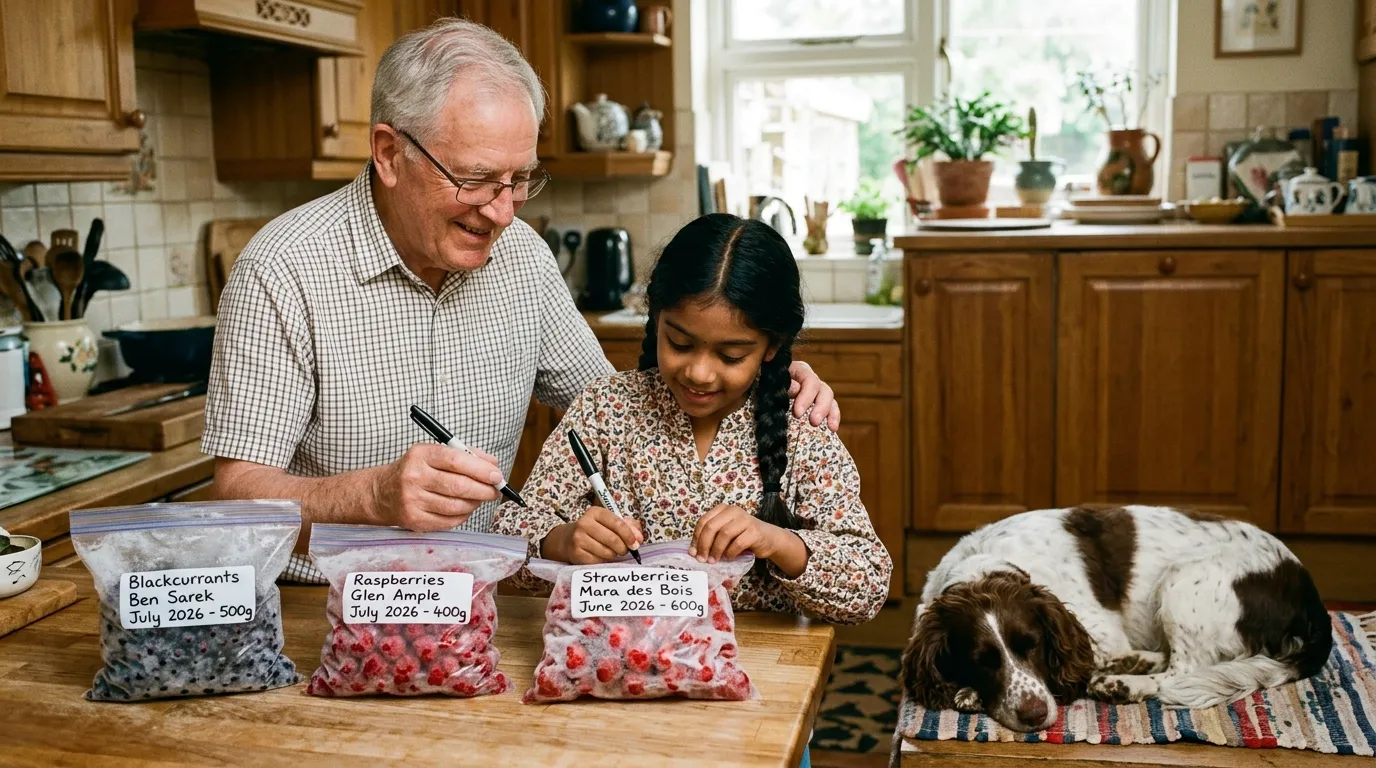
- Date the bag. Day, month, year. Not just the year.
- Weight the bag. Most recipes call for 400 to 500g portions. Pack in those weights.
- Variety the bag. Ben Sarek blackcurrants behave differently in jam than Ben Lomond. Mara des Bois strawberries make a sweeter coulis than Cambridge Favourite.
- One crop per shelf or per basket. Mixed-fruit shelves end up with three packs of forgotten redcurrants at the back.
- Last in, last out. Stack new bags at the back of the freezer or basket. Pull from the front first.
A handwritten freezer log on the side of the freezer takes 30 seconds per pack and saves three minutes per dig-through over a year. Worth the discipline.
Defrosting and using frozen fruit (the rules that change the result)
Defrost method affects texture more than freezing method. Three approaches.
Overnight in the fridge. The gentlest defrost. Berries hold roughly 80% of their fresh shape, stone fruit hold 70%, apples and pears hold 60% (they always go a bit limp). Use for fruit served with cream, in salads or in cold desserts.
At room temperature for 1 to 2 hours. Faster but the fruit collapses more. Suitable when you want the juice released, for example over yoghurt or porridge.
Straight from frozen into a hot pan or oven. No defrosting at all. The fruit goes into the crumble, jam pan, smoothie blender or sorbet maker still rock hard. This is the right move for any cooked or blended end-use because thawing first loses juice that the recipe needs.
The only exception is fruit going into pastry or a tart shell, where a runny fruit makes the base soggy. Defrost in the fridge, drain the juice, reduce the juice in a pan to a glaze, then put the drained fruit on the pastry and pour the glaze over.
For making jam from your frozen stock see how to make jam from garden fruit UK. Frozen fruit gives a higher pectin yield because freezing ruptures the cell walls and the fruit releases more juice as it thaws into the pan.
Field results from five UK summers
A summary of what worked and what did not across five preservation seasons in Staffordshire and Cheshire:
Common UK freezing mistakes and the fixes
After half a dozen rebuild conversations with gardeners whose first freezer run did not work out, the same five mistakes appear.
- Freezing wet fruit. Surface water turns to ice crystals that tear the cell walls of soft berries. Tip the rinsed fruit onto a clean tea towel, blot dry, and only then onto the tray. Skip washing entirely on unmuddy raspberries and blackcurrants.
- Skipping the open-freeze step on berries. Bagged fresh berries fuse into a solid 500g lump. There is no scooping 80g out of a frozen brick. Open freeze first.
- Wrong bag. Standard food bags from the supermarket roll fail in a freezer below -15C. Freezer-grade ziplock or vacuum pouches only.
- Freezing whole rhubarb. Stringy and unpleasant after thaw. Chop to 25mm, blanch 1 minute, then freeze.
- No labelling. Six months in, three identical bags of frozen something take 10 minutes of thaw guessing to identify. Date, weight, variety on every bag, every time.
The fixes are not difficult. They are habits, and the time investment in the habits is repaid the first time you reach into the freezer and pull out exactly the fruit you wanted in the weight you wanted, dated three months ago.
Pairing freezing with other preservation methods
A working UK preservation kitchen rarely uses one method only. Different fruit suits different methods, and different end-uses demand different ingredients.
- Freeze the gluts. When 4kg of raspberries arrives on a single Saturday morning, the freezer takes them all in 20 minutes.
- Jam the surplus from the freezer. Mid-winter is a good time to thaw blackcurrants from the freezer and turn them into jam. Better than rushing a hot kitchen in July.
- Dry the medium-perishable. Apples slice and dehydrate easily, and dried apple rings store in jars for 12 months without freezer space. See how to dry and dehydrate garden produce UK.
- Bottle the long-life stone fruit. Bottled plums and peaches in syrup keep for 2 years and free up freezer space for the next harvest.
This layered approach uses each method where it shines and ignores its weaknesses. The freezer takes the gluts and the soft fruit. The jam pan takes the lower-quality fruit later in the year. The dehydrator takes the apples and pears. Bottling takes the stone fruit you want shelf-stable.
Energy use, freezer choice and the cost of running a UK fruit freezer
A 200-litre A++ rated chest freezer uses around 180 to 220 kWh per year in average UK use. At 28 pence per kWh (typical 2026 UK electricity tariff) that runs to 50 to 62 pounds per year. A 300-litre unit runs to 70 to 85 pounds per year.
For a household freezing 50 to 100kg of garden fruit annually, the per-kilo storage cost works out at 60p to 1.20 pounds per kilo of stored fruit. Set against fresh frozen supermarket fruit at 4 to 7 pounds per kilo, the saving on a 75kg annual freezer is 220 to 430 pounds.
Two energy-saving rules that actually move the needle:
- Keep the freezer 80 to 90% full. A full freezer uses less electricity than a half-empty one because the frozen mass acts as thermal ballast. If you run out of fruit, fill the gaps with bags of frozen bread, batch-cooked stews or even bags of water.
- Defrost annually. A 5mm build-up of ice on the freezer walls increases energy use by 10 to 15%. Defrost in late spring before the new fruit crop comes in.
For wider safety guidance on home food freezing, the Food Standards Agency’s home food safety pages cover storage temperatures, refreezing rules and the safety basics.
Related guides
For the wider picture on garden produce storage and the choice between freezing, drying, jam-making and bottling, start with the pillar guide on how to preserve fruit and vegetables UK. The alternative methods are covered in detail at how to dry and dehydrate garden produce UK, how to bottle and can fruit and vegetables UK, and how to make jam from garden fruit UK. For the longer-term loft and fridge storage option on tree fruit see how to store apples and pears UK. For the growing side of the soft fruit feeding this preservation plan see best blackcurrant varieties UK, how to grow raspberries UK and how to grow redcurrants and blackcurrants UK.
Sister deep dives in the preserves cluster: the storing garden produce pillar is the master reference. For vegetables see freezing vegetables UK with the 30-row blanching times table. For dried-fruit routes see drying apples and pears UK and the drying stone fruit guide for plums, damsons, apricots and peaches.
Our team produces practical UK gardening guidance from source research, contributor records and established horticultural practice. Editorial standards are overseen by Matt W.