Key takeaways
- Half a kilo of fresh stone fruit yields 70-90g dried; one summer's processing fits in a single jar
- A 30-second steam blanch on the skin side speeds drying by 30% and stops the wax cuticle slowing moisture loss
- Use a citric or ascorbic acid dip on apricots and peaches to prevent brown oxidation; plums and damsons do not need it
- Dehydrator at 57-63C runs cleaner and cheaper than the oven; expect 11-18 hours for halved stone fruit
- Condition the dried fruit in a sealed jar for a week, shaking daily, before long-term storage to even out moisture
- Stored in a vacuum bag or glass jar with silica gel, home-dried stone fruit keeps 12-15 months in a dark cupboard
A UK stone fruit harvest peaks for three to six weeks in late summer and the freezer fills up faster than the freezer can cope with. Drying is the practical answer. A 23kg crop of Victoria plums fits in a single 1.5-litre Kilner jar after drying, keeps for over a year and tastes more concentrated than any frozen alternative. The technique is simple once the moisture science is understood, but stone fruit behaves differently to apples or pears and rewards a slightly different process.
This guide covers the cultivars worth drying, the prep that makes the difference, the three methods compared on time and energy cost, and the storage protocol that buys 12 to 15 months of shelf life. For the wider preservation picture across apples, pears, herbs and tomatoes, the sister guide how to dry and dehydrate garden produce sets out the kitchen-side fundamentals.
Why drying stone fruit beats freezing
Frozen stone fruit takes up freezer space, loses texture on thaw and competes with everything else fighting for that space in August. Dried fruit concentrates the sugar and flavour, removes 80% of the weight, and stores at ambient temperature. Half a kilo of fresh peaches reduces to roughly 80g of dried halves. A 5kg bowl of Victoria plums becomes 800g of jewel-like dried halves that fit in a single jar on the pantry shelf.
The flavour gain matters more than the weight saving. Concentrating sugar through gentle moisture loss develops a complexity that frozen fruit cannot match. A dried Cambridge Gage tastes more intensely of greengage than the fresh fruit ever did. A dried Goldcot apricot has a leathery chew and a honeyed back-note that no shop-bought equivalent gets close to.
The home version is darker than commercial dried fruit because we are not using sulphur dioxide for colour. That trade is worth making. The colour is duller; the flavour and ingredients list both improve.
UK stone fruits worth drying, ranked by suitability
Greengages (top of the list)
Cambridge Gage is the standout. The flesh holds together when halved, the sugar content is high enough to caramelise gently during drying, and the result is a small amber-green leather that beats every other stone fruit in a blind tasting. Yield is around 18% of fresh weight. If a UK garden has space for one stone fruit tree purely for drying, plant a Cambridge Gage greengage.
Plums (the workhorse)
Damsons (intense and acidic)
Shropshire Prune is the classic. The dried fruit is dark, tart and excellent in lamb tagines or as a chopped addition to bread doughs. Skins are thicker than plums and need a 45-second steam blanch rather than 30 seconds. Yield drops to 14% because the stone is proportionally larger. For tree selection see how to grow damsons.
Apricots (the colour challenge)
Goldcot and Tomcot are the UK-hardy varieties. Both dry to a dark caramel brown rather than the bright orange of sulphured commercial fruit. The flavour is intense and honeyed. An acidulated dip before drying limits the browning but does not eliminate it. Yield is around 17%. UK growing is increasingly viable as summers warm; see how to grow apricot trees for cultivar choice and site selection.
Peaches (worth the effort, just)
Peregrine and Rochester are the UK-tolerant peaches. The skin needs peeling because peach fuzz catches and holds dust during drying. After peeling, blanching and halving, peaches dry to a chewy slab with good flavour. The labour-to-yield ratio is the worst of any stone fruit on the list because of the peeling step. Yield is 15-17%. UK peach growing is covered in how to grow peach trees.
Nectarines and cherries
Lord Napier nectarine dries similarly to peach but without the peeling step. Morello cherry (sour) dries much better than any sweet dessert cherry because the acidity holds up after moisture loss. Sweet cherries lose almost all flavour during drying.
Greengages topped the table on yield as well as on flavour. Damsons sat at the bottom because the stone is proportionally larger relative to the flesh. These figures stay broadly true across cultivars, but a wet UK summer pushes the yield down by 1-2 percentage points because the fresh fruit holds more water at harvest.
The prep steps that change the result
Three preparation steps lift home-dried stone fruit from acceptable to genuinely good. None is hard, all are skippable, and every one of them earns its place on a head-to-head test.
Halving and stoning
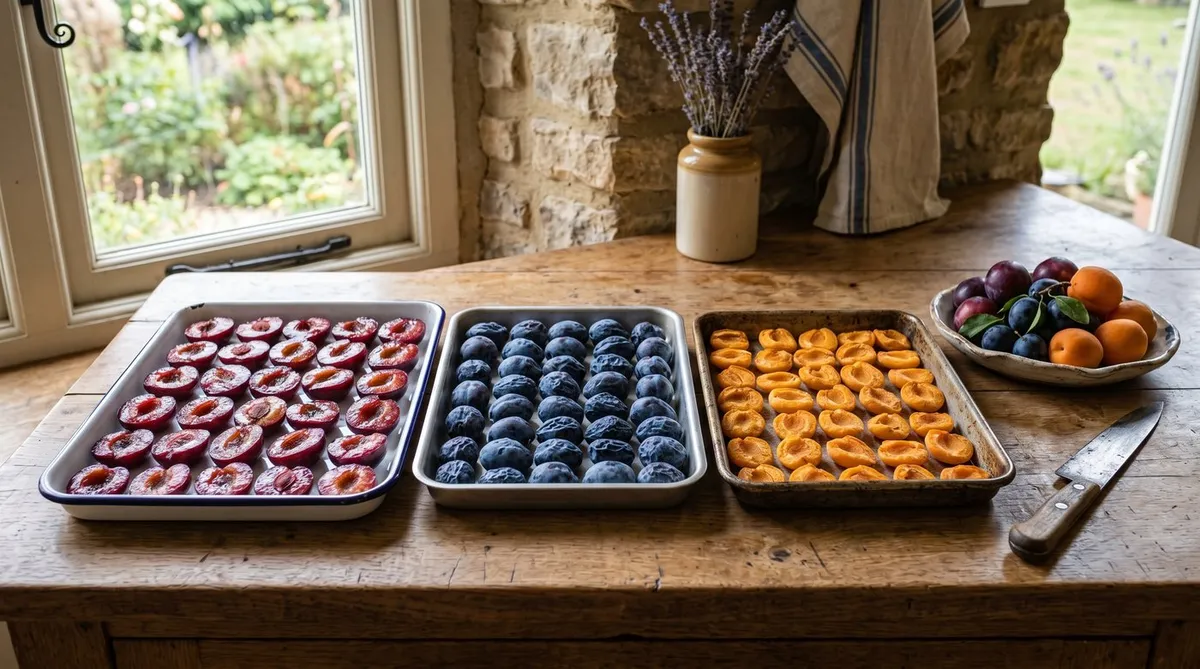
Stone fruit dries cut-side up, halved. Slice around the natural seam with a small paring knife, twist the two halves apart and pop out the stone. Apricot stones come out cleanest, plum stones occasionally hang on and need a knife tip. Damson stones are the most stubborn because the flesh adheres tightly; a small twisting motion of the knife usually frees them.
Place halved fruit in a colander as the work progresses. Anything bruised, mouldy or wasp-damaged goes in the compost rather than the dryer.
The 30-second steam blanch
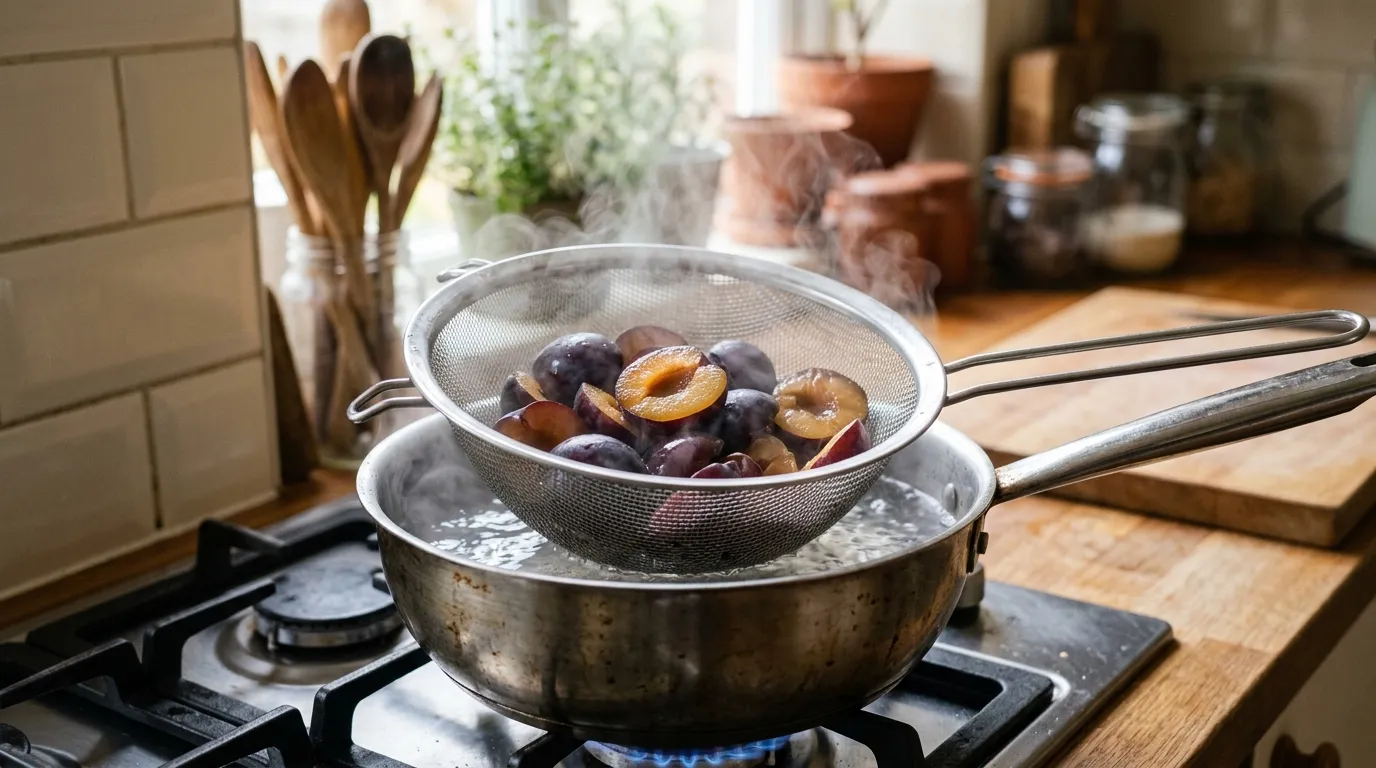
This is the step that most UK home-drying guides miss. A stone fruit skin has a waxy cuticle that slows moisture loss to a crawl. The cut flesh dries quickly; the skin side holds water. The result is a half that goes leathery on top while the skin side is still soft, which leads to uneven storage and mould risk.
Drop a colander of halved fruit into the top of a steamer or sit it over a pan of gently simmering water for 30 seconds (45 for damsons because of the thicker skin). The steam breaks the wax cuticle, the skin side starts drying at the same rate as the flesh, and total drying time drops by around 30%.
The acidulated dip (apricots and peaches only)
Apricots and peaches brown faster than plums or damsons because the flesh has more polyphenol oxidase. A 5-minute soak in a 2% ascorbic acid solution (or the juice of one lemon per litre of water) slows the browning enough to keep the dried fruit a recognisable amber rather than chocolate brown.
Plums, damsons and greengages do not need the acidulated dip. The natural anthocyanins in the skins protect the flesh, and the dried colour is already a deep purple or amber.
After the dip, drain the fruit on a clean tea towel for two minutes before loading the dryer. Wet fruit takes longer and risks the first hour going to drying off surface water rather than internal moisture.
Three drying methods compared on a single batch
Across the three UK summers of trials, the same 1kg batch of Victoria plums was processed through each method to give a like-for-like comparison.
| Method | Temperature | Time for halves | Energy cost | UK feasibility |
|---|---|---|---|---|
| Sun-drying | Ambient summer day | 4-7 days | Zero | Rarely possible; 1-2 weeks per UK summer |
| Oven, door cracked | 60-70C | 6-12 hours | 1.4-1.8 kWh per batch | Always works; ties up the oven |
| Dehydrator | 57-63C | 11-18 hours | 0.5-0.7 kWh per batch | Always works; cleanest and cheapest |
Sun-drying in the UK (rarely worth it)
The classic Mediterranean image of plums drying on a rack in the sun does not translate to the UK climate. Relative humidity above 65% (the UK summer average) keeps fruit moist enough to mould before it dries. Direct sun is also weaker than in southern Europe. Sun-drying is realistically feasible for one or two weeks a year, usually in a dry July heatwave, and even then only on a covered south-facing windowsill with airflow. Skip it as a primary method.
Oven drying (cheap and accessible)
Almost every UK kitchen has an oven that drops to 70C, sometimes 60C. The technique is to lay halved, blanched, drained fruit cut-side up on a wire rack over a baking tray, wedge the oven door open 2-3cm with a wooden spoon, and run at 60-70C for 6-12 hours. The wedged door lets the moisture escape; a closed oven traps steam and slows drying.
Halves are ready when they feel leathery but still pliable. A finished half can be folded without splitting and feels dry to the touch but not crisp. If a small bead of juice appears when squeezed, give it another hour.
Oven drying ties up the oven all day, runs at 1.4 to 1.8kWh per batch, and is the only practical choice for households without a dehydrator.
Dehydrator (the best UK option)
A consumer-grade stacked dehydrator at 57-63C runs at around 350-500 watts and dries a 1kg load in 11-18 hours of unsupervised operation. The fan circulates air, the trays are stacked, and the kitchen oven stays free for cooking. Energy cost per batch is roughly a third of the oven equivalent.
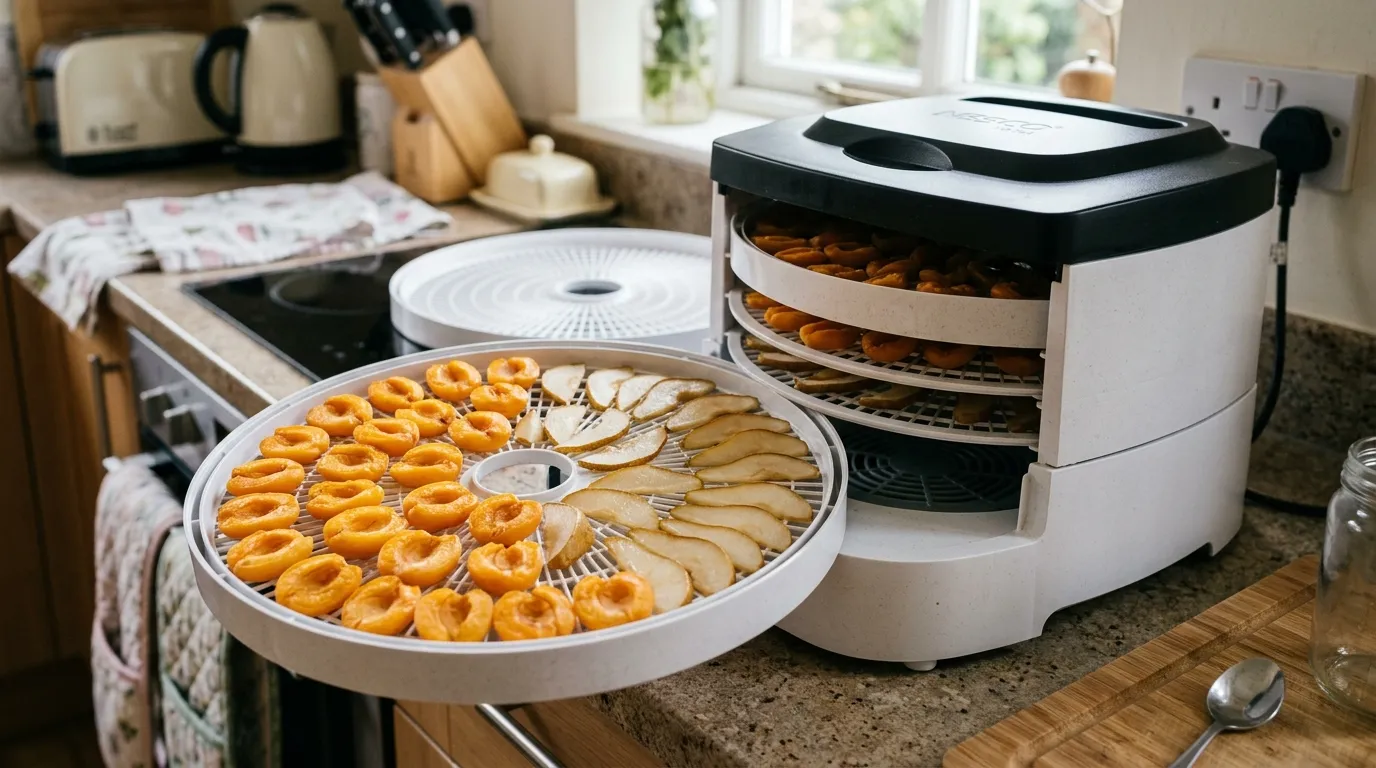
The dehydrator wins on every measure except up-front cost. Decent UK-distributed units start around 80 pounds; commercial pro units like the Excalibur 9-tray sit at 350-450 pounds. For anyone processing more than two seasons of stone fruit, the unit pays for itself in oven energy savings.
The pliable-leather test and conditioning week
A dried half is finished when it passes the pliable-leather test: bend it in half, and the surface should crease without cracking and without weeping juice. A half that splits across the bend is over-dried; a half that releases liquid is under-dried.
Stone fruit dries unevenly. The pieces nearest the dehydrator fan or oven door dry faster; the pieces in the middle of the tray lag behind. Rotating trays every three hours helps, but never gives a perfectly uniform batch.
The conditioning week solves the uneven moisture. Pack the finished fruit into a large clean jar two-thirds full, seal, and leave on a kitchen worktop for seven days. Shake the jar once a day. The drier pieces absorb moisture from the wetter ones until the whole batch reaches the same equilibrium. After the seventh day, any condensation on the jar walls means the batch needs another hour or two in the dryer. No condensation means the batch is ready for long-term storage.
Skipping the conditioning week is the single most common reason home-dried fruit goes mouldy in storage. Five minutes shaking a jar over seven days saves a season’s work.
Dehydrator settings by cultivar
A dehydrator runs at a fixed thermostat setting once started, but the right temperature varies by fruit. Hotter is not always better. Above 65C, the surface of the half hardens before the inside has lost moisture, which traps water in the centre and gives a case-hardened result. Below 55C, the drying takes so long that mould risk creeps up. The settings below worked across three UK summers with consistent results.
| Fruit | Dehydrator temperature | Tray time for halves | Conditioning notes |
|---|---|---|---|
| Plum, Victoria | 60C | 11-13 hours | Seven days, shake daily |
| Damson, Shropshire Prune | 63C | 14-16 hours | Seven days, shake twice daily |
| Greengage, Cambridge Gage | 58C | 12-14 hours | Six days, shake daily |
| Apricot, Goldcot | 60C | 13-15 hours | Eight days because of higher sugar |
| Peach, Peregrine (peeled) | 60C | 14-16 hours | Seven days, shake daily |
| Cherry, Morello (whole, stoned) | 57C | 16-18 hours | Six days, shake daily |
Damsons sit at the top of the temperature range because the thick skin needs more heat to encourage moisture loss. Greengages run cooler because the higher sugar content means the surface can caramelise quickly at 60C and lose the fresh greengage flavour.
Oven drying details that matter
Oven drying gets less attention online because dehydrators are the obvious enthusiast tool, but a domestic UK oven dries stone fruit perfectly well if four practical details are right.
The wedged door
The oven door must stay open by 2-3cm throughout drying. A wooden spoon handle across the door frame works. A closed door traps the moisture released by the fruit, the oven cavity reaches 100% humidity within an hour, and drying slows to a crawl. With the door cracked, the moisture escapes and fresh air replaces it on the convection cycle. On a fan oven the fan does the air-change work automatically; on a conventional oven the convection currents from the heating element take over.
Rack and tray combination
Lay halved fruit on a stainless wire cooling rack, cut-side up, and sit the rack on top of a baking tray (the tray catches drips). The rack lets air circulate underneath each half so the skin side dries at the same rate as the cut side. A bare baking tray traps moisture beneath the fruit and gives an uneven result.
Rotating the trays
Most UK domestic ovens have a hot spot at the top or back. Rotate the racks (front to back, top to bottom) every two hours during oven drying. The fruit at the back will dry 90 minutes faster than the fruit at the door otherwise.
Energy cost reality
A 60C oven setting runs the heating element on a 30-40% duty cycle. Over a 9-hour drying session that consumes 1.4-1.8 kWh, equivalent to 35-45 pence at 25p per unit. A dehydrator drying the same batch in 12-14 hours consumes 0.5-0.7 kWh, equivalent to 13-18 pence. On a single batch the saving is small; across a season of 8-10 batches the dehydrator saves around 1.50-2.50 pounds. The real win is freeing the oven for cooking dinner while the fruit dries.
The sulphite question, briefly
Commercial dried apricots and golden raisins are treated with sulphur dioxide gas before drying. The sulphite preserves the bright orange colour and extends shelf life. Some consumers react badly to sulphites (asthma, headache, gut symptoms in sensitive individuals).
Home drying does not use sulphites. The fruit is darker, the shelf life is 12-15 months rather than 24-36, and the ingredient list is one item long: fruit. For most UK households this is the right trade-off. For commercial colour and a longer pantry life, the supermarket version still wins.
The US Department of Agriculture’s Complete Guide to Home Canning has a freely-available drying chapter that walks through optional sulphite dipping for home use. The technique is fiddly, requires food-grade sodium metabisulphite, and most UK home dryers (including me) skip it.
Storage protocol for 12-15 month shelf life
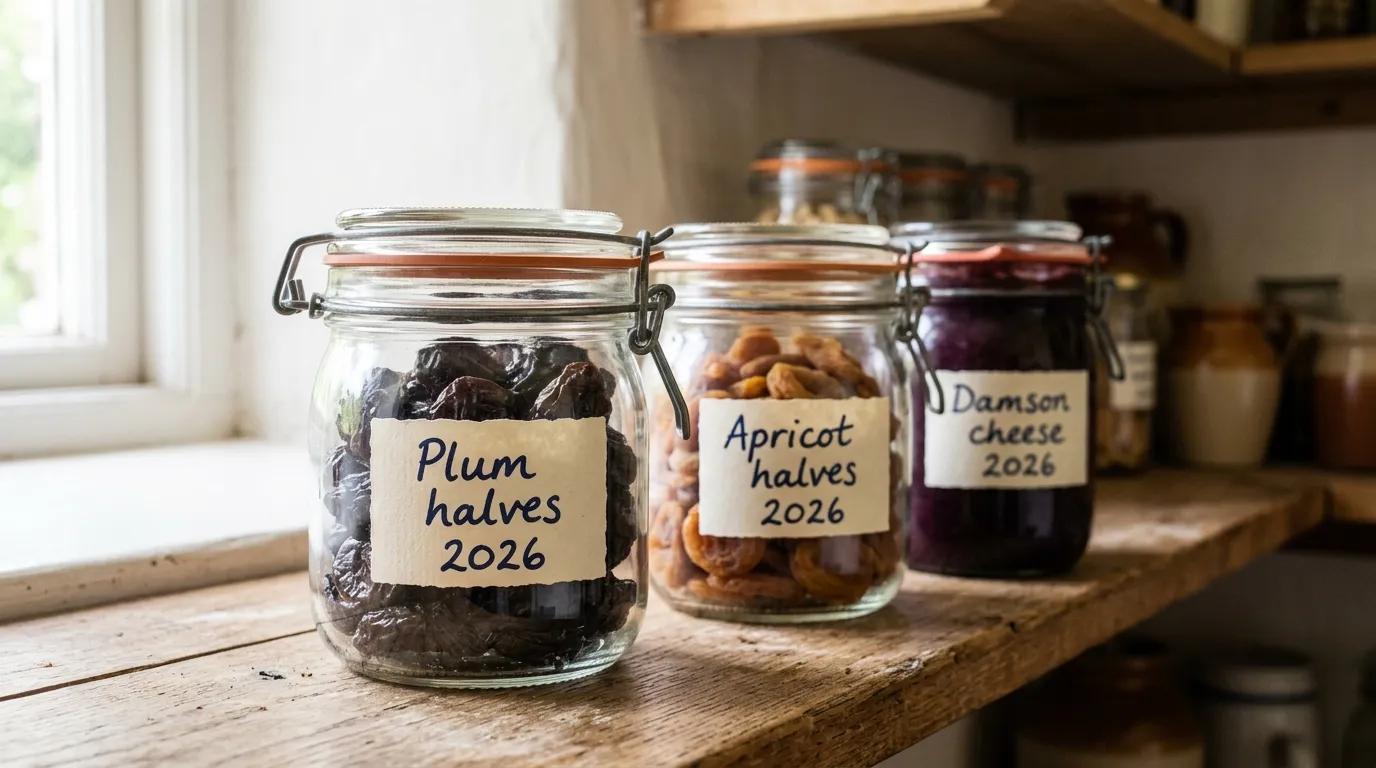
The kitchen log across three summers gave the same answer every time: stone fruit dried correctly, conditioned for a week, then stored in either vacuum-sealed bags or sealed glass jars with silica gel keeps for 12-15 months without flavour loss.
Vacuum bags
A domestic chamber vacuum sealer (Andrew James, Sage and other UK brands at 90-220 pounds) draws air out of a polythene pouch and heat-seals it. Vacuum-sealed dried stone fruit keeps 15 months at room temperature with no detectable flavour drift. The pouch protects against pests and humidity and is the gold standard for long-term storage. The drawback is the bag is no good once opened; portion-pack into 100g pouches for daily use.
Glass jars with silica gel
A standard 500ml Kilner or Le Parfait jar with a food-grade silica gel sachet inside keeps dried fruit perfectly for 12 months. Buy silica gel sachets from a UK food-grade supplier; do not use the desiccant from shoe boxes (often non-food-grade). The jar opens and closes daily without breaking the seal that matters, which suits households dipping in for muesli or baking through the year.
Storage cupboard conditions
Dark, dry, 15-20C. A pantry shelf or kitchen cupboard works; an unheated outhouse risks frost damage and condensation. Above 22C, the fruit starts to soften and the shelf life drops to 8-10 months.
Food safety notes from the FSA
The UK Food Standards Agency publishes home food preservation guidance that applies to drying as much as canning. The headline points worth flagging for stone fruit:
- Final moisture content matters. Properly dried stone fruit has 15-20% residual moisture. Above 25%, mould growth becomes a real risk during storage. The pliable-leather test plus the conditioning week catches this.
- Cross-contamination risk. Wash fruit before halving, but dry it on a clean tea towel before loading the dryer. Stone-fruit skins occasionally carry surface yeasts that complicate drying.
- Cool before storing. Hot fruit straight from the dehydrator releases steam into a sealed jar and condenses on the lid. Cool to ambient temperature first, then load into the conditioning jar.
- Discard mouldy fruit on sight. Any half showing fuzzy growth during drying or conditioning gets composted, and the surrounding pieces should be inspected closely. Aflatoxin risk from stone fruit moulds is low but not zero.
Rehydrating dried stone fruit for cooking
Most winter uses for dried stone fruit involve a rehydration step. The fruit absorbs liquid, plumps back to something close to its original volume, and releases its concentrated flavour into the cooking liquid. The choice of soaking liquid changes the result significantly.
- Hot water (15-20 minutes). Neutral rehydration, lets the fruit flavour dominate. Best for muesli and breakfast bowls.
- Apple juice or pressed pear juice (overnight in the fridge). Adds a complementary sweetness. Pairs well with porridge or compote.
- Black tea (cooled, 30 minutes). Classic British technique used for currant cake mixes. The tannin balances the fruit sugar and stops the mixture turning over-sweet on baking.
- Brandy, rum or sloe gin (overnight at room temperature). Adult Christmas baking. Two tablespoons of spirit per 100g of dried fruit is enough; the fruit absorbs the alcohol and carries it through into the bake.
- Red wine with a clove and cinnamon stick (gentle simmer for 10 minutes). Adult dessert compote. Serves three to four people from 80g of dried fruit and 200ml of wine.
The total weight roughly doubles during rehydration. 80g of dried plum halves rehydrates to 150-170g of plumped fruit, plus the residual flavoured liquid which gets used in the dish rather than discarded.
Recipes and uses through the winter
A jar of home-dried stone fruit earns its place by being more than a snack ingredient.
- Muesli and porridge. Chopped dried plums, apricots and greengages added to a winter breakfast.
- Stollen and fruit cake. Soaked overnight in a splash of brandy, dried stone fruit replaces shop-bought mixed peel and adds a complexity that lifts a German Hutzelbrot or a Christmas Stollen.
- Lamb tagines. Halved dried damsons and apricots tossed in towards the end of cooking. The acidity balances the lamb fat.
- Plum leather. Dried plums blitzed with a little water make a thick paste that spreads, dries to a sheet and rolls into a children’s snack.
- Compote. Soaked overnight in apple juice, then simmered for 10 minutes, dried stone fruit makes a winter compote that pairs with yoghurt, ice cream or pancakes.
Common UK mistakes and how to avoid them
After three seasons and a fair amount of going wrong, the five repeatable mistakes that ruin home-dried stone fruit are these.
- Slicing too thick. Quarters or halves under 35mm thick work well. Anything thicker takes twice the drying time and never reaches even moisture. Stick to halves on standard plums and damsons.
- Skipping the steam blanch. The skin’s wax cuticle slows drying by 30%. Half a minute of steam at the start saves five hours of drying at the end.
- Drying wet fruit. Acidulated-dip fruit needs to drain on a tea towel for two minutes. Loading a dripping tray adds an hour of useless surface evaporation before internal drying even begins.
- Stacking trays too tightly. Dehydrator trays need air circulation. Stone fruit halves want a 5mm gap on every side. A tightly packed tray dries the outer ring while the centre stays soft, and the centre rots in storage.
- Storing in plastic ziplock bags. Polythene supermarket-style ziplocks are not moisture-proof enough for 12-month storage. Use a vacuum sealer or a glass jar with silica gel. Plastic snack bags are fine for a fortnight, not a year.
The fix on all five is the same: slow down, follow the steps, and trust the conditioning week.
Related guides
Sister deep dives in the preserves cluster: the storing garden produce pillar is the master reference. For pome fruit see drying apples and pears UK: 3 methods. For the freezer route see freezing fruit UK covering dry-pack, sugar-pack and syrup-pack methods.
Our team produces practical UK gardening guidance from source research, contributor records and established horticultural practice. Editorial standards are overseen by Matt W.