Key takeaways
- Flagging is the first visible sign: yellow, wilting branches in a green crown, from June to August
- The ring test confirms it: cut a wilting twig 10-15mm thick across and look for brown staining 1-2mm inside the bark
- Ophiostoma novo-ulmi kills a mature elm in one to two seasons; the milder 1920s O. ulmi wave killed a far smaller share of trees
- Britain has lost more than 25 million elms since the aggressive strain arrived around 1967 on imported rock elm logs
- Two beetles carry it: Scolytus scolytus at up to 6mm and S. multistriatus at about 3mm; trees also infect each other through root grafts
- Nothing cures an infected garden elm. Resistant cultivars such as 'Lutece', 'New Horizon' and 'Sapporo Autumn Gold' are the only durable answer
Dutch elm disease is the reason most people under fifty have never seen a full-grown English elm. It removed a tree that defined lowland Britain, and it did it inside two decades. This guide covers what the disease actually is, the symptoms in the order you will see them, and the one simple cut that confirms a diagnosis in ten minutes rather than three weeks.
Be warned up front: this is an identification article, not a treatment one. There is no spray, no feed and no pruning regime that saves an infected elm. What you can do is recognise it early, stop your dying tree from infecting the neighbourhood, and plant something that will still be standing in fifty years.
The fungus behind Dutch elm disease
Dutch elm disease is not one organism but two, arriving in two separate waves. The name comes from the Dutch pathologists who identified the cause in the 1920s, not from the tree’s origin.
The first wave was Ophiostoma ulmi, which spread through Britain from the late 1920s. It was a moderate killer. Plenty of elms sickened, many recovered, and the great hedgerow elms of the Midlands and the South largely stood through it. By the 1940s the epidemic had faded and elm looked safe.
The second wave was Ophiostoma novo-ulmi, and it is a different proposition entirely. It reached Britain around 1967, almost certainly in a consignment of unbarked rock elm logs imported from Canada. Where O. ulmi killed a share of the trees it infected, O. novo-ulmi kills nearly all of them, and it kills a mature tree in one to two growing seasons.
The reason for the difference is partly temperature. O. novo-ulmi grows fastest at around 22C, while O. ulmi prefers roughly 27-28C. In a British summer that gives the aggressive strain a decisive edge, and it has now displaced the older strain almost everywhere. The fungus itself is microscopic and lives inside the tree’s water-conducting vessels. Everything you see from the outside is the tree’s own response to it.
Flagging: the first sign you will see in June
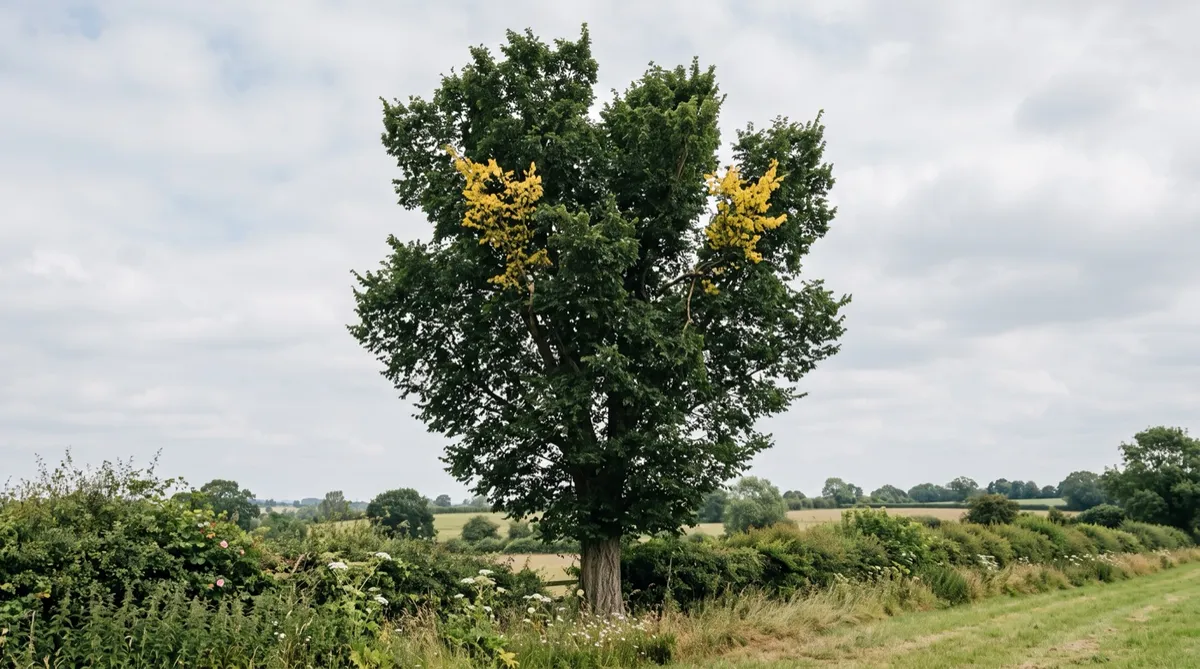
Flagging is the term for the first visible symptom, and it is unmistakable once you know it. A single branch, or a small group of branches, turns yellow while the rest of the crown stays deep green. From a distance it looks as though someone has hung a yellow flag in the tree.
Timing matters. Flagging appears from mid-June to August, with most first sightings in our hedgerows falling in the first three weeks of July. Anything wilting in April or May is usually frost, drought or a root problem, not this.
Watch what the leaves then do. Diseased leaves yellow, curl inward, turn brown and stay attached to the twig. That retention is a useful tell. Leaves killed by drought or by a broken branch generally drop; leaves killed by a vascular wilt hang on for weeks, sometimes into winter.
The pattern spreads downward and inward. One flag in July becomes four or five by August, then a bare crown with a green skirt of lower branches by the following June. On a wych elm the progression is often slower than on field elm, but the ending is the same.
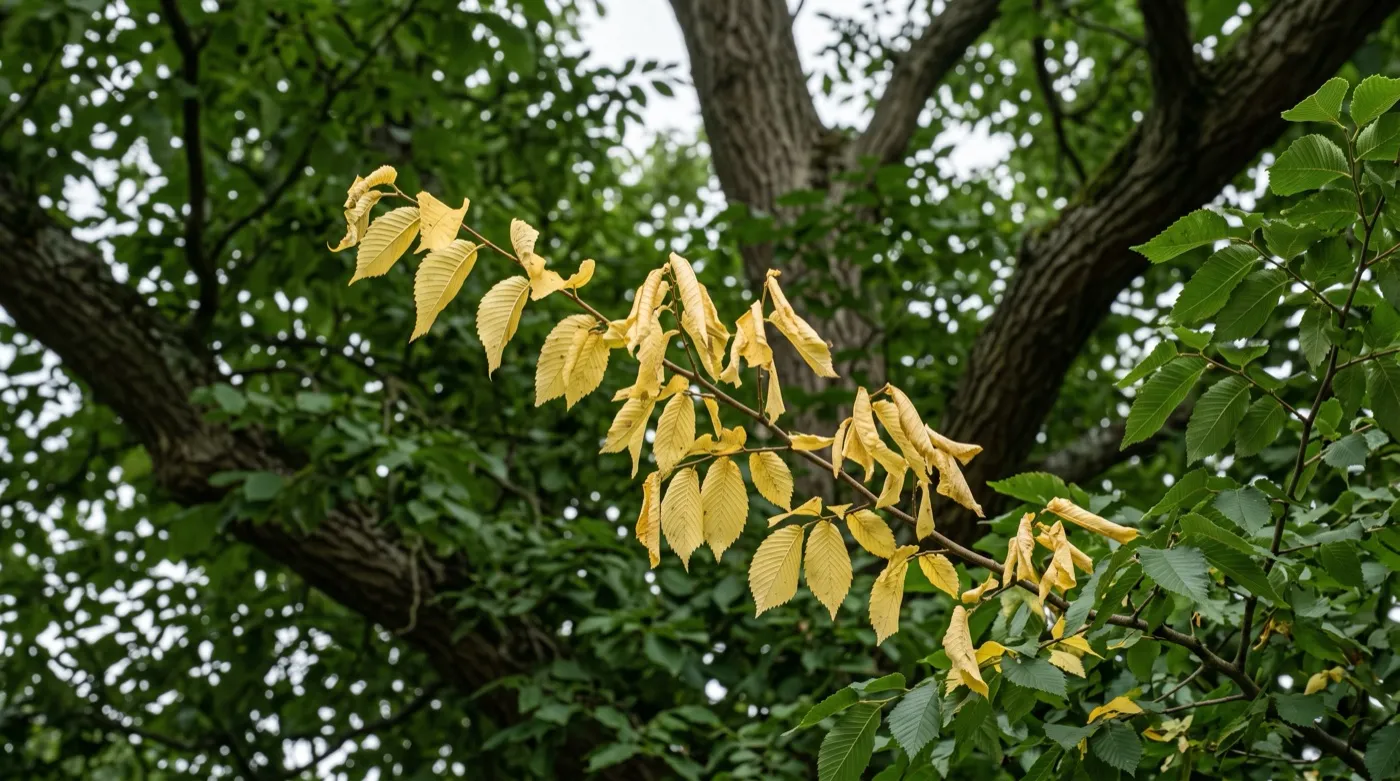 Flagging is the first sign. One branch yellows and wilts while the rest of the crown stays green, usually from mid-June.
The ring test that confirms Dutch elm disease
This is the single most useful thing in this article. It costs nothing, takes ten minutes, and it is what an arboriculturist does before sending anything to a laboratory.
Take secateurs and cut a wilting twig between 10mm and 15mm thick, from a branch that is actively flagging. Cut it straight across, not at a slant and not lengthways. Look at the fresh cut face, ideally with a hand lens.
In a healthy elm the cut face is uniformly pale cream. In an infected one you will see brown or dark olive staining in the outermost growth ring, roughly 1-2mm inside the bark. It rarely forms a solid circle. Far more often it reads as a broken, dotted ring of individual stained vessels, like a dashed line drawn just under the bark.
Cut three or four twigs, not one. Staining is patchy, and a single clean twig proves nothing. Cut one control twig from a green branch on the same tree so you have a genuine comparison in your hand.
Gardener’s tip: Cut across the twig, never along it. Everybody slices lengthways hunting for brown streaks, and on a 12mm twig those streaks are almost invisible. On a clean cross-section the dotted ring jumps out in seconds. Wipe your secateur blades with methylated spirit between trees.
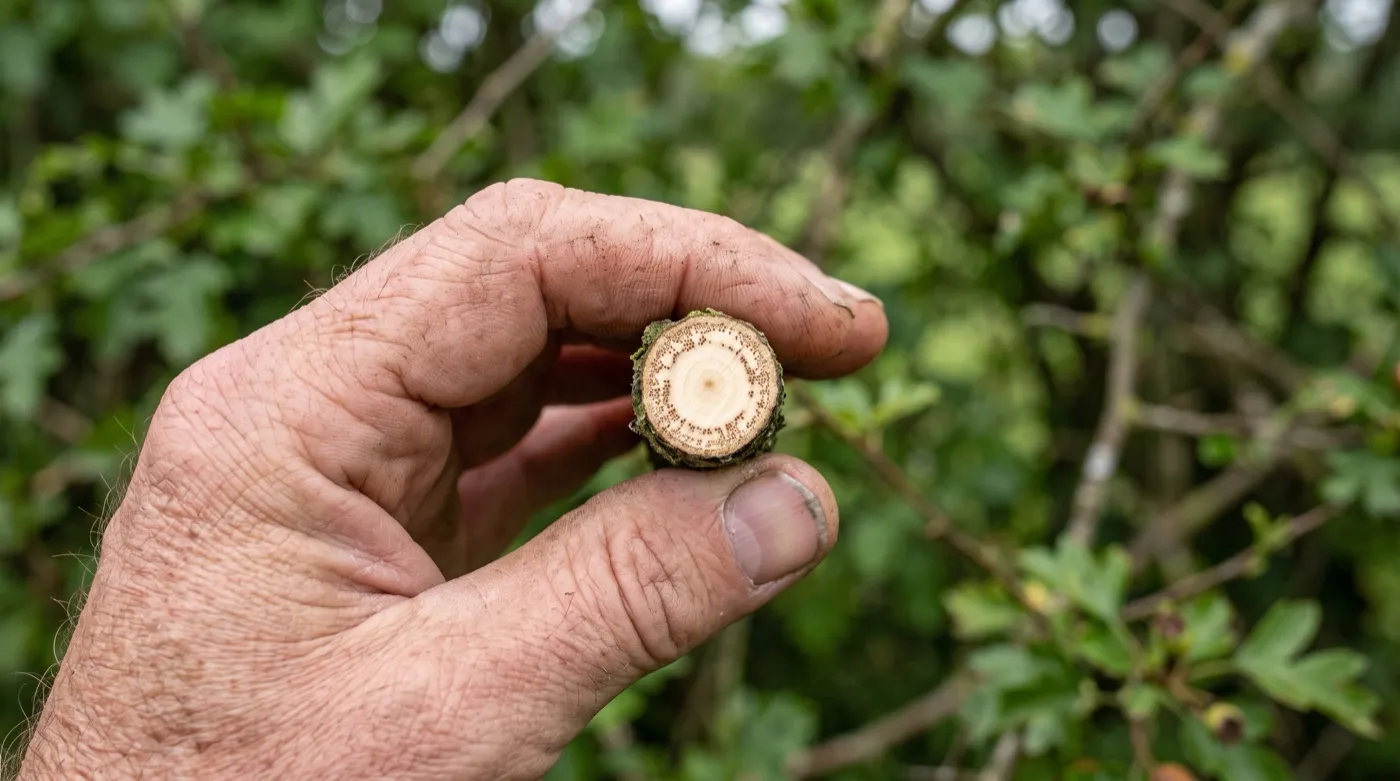 The ring test. Cut a wilting twig straight across and the brown stain shows as a dotted ring about 1-2mm inside the bark.
Dutch elm disease symptoms in the order they appear
Beyond flagging and staining, two further signs help you build a case. Neither is conclusive alone.
The shepherd’s crook is the classic one. As a young shoot loses water pressure, the soft tip wilts and curls over into a tight hook, exactly like the top of a crook. It happens because the tip is still growing and unlignified when the water supply fails behind it. On a diseased elm you will find several crooked tips on the same flagging branch.
Bark beetle exit holes are the second. Look at the bark of a recently dead limb for round holes about 2mm across, scattered like shot. Peel a loose flake of bark away and you may find the breeding galleries beneath, which are covered in the next section.
Symptoms in the order you will meet them: flagging in June or July, leaves browning and hanging on, shepherd’s crooks on the same branch, brown ring in the sapwood, more branches flagging by August, crown largely dead by the second summer, exit holes and loose bark on dead limbs.
What is not Dutch elm disease: leaves with zigzag trails eaten through them, which is the elm zigzag sawfly and its telltale trail, a leaf-feeding insect that is a separate problem entirely. Nor is a general thinning of the whole crown at once, which points towards drought or root damage. Our diagnostic guide to sudden tree death in the UK works through the alternatives.
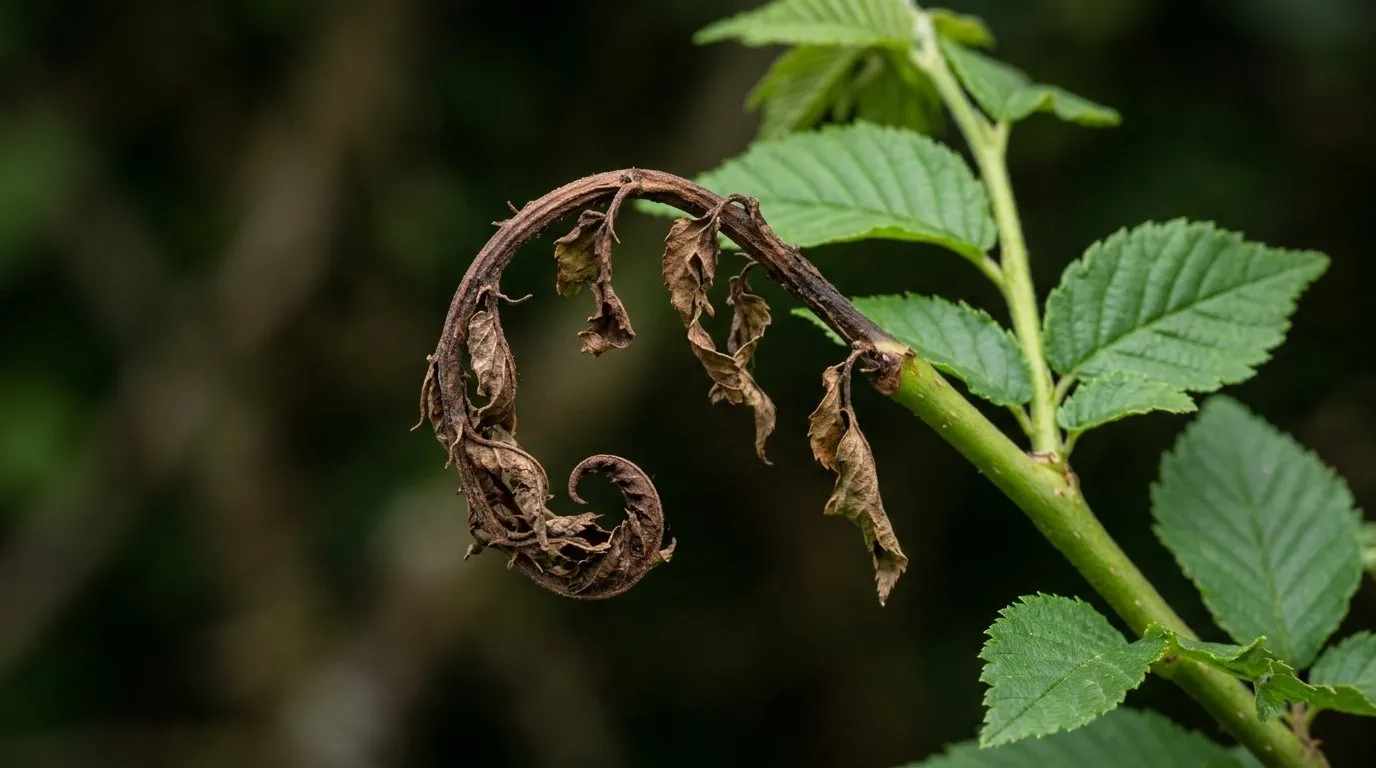 A shepherd’s crook. The soft, still-growing shoot tip loses water pressure and curls over into a hook.
How elm bark beetles move the fungus
The fungus cannot travel on its own. It relies on two beetles, and understanding their year explains every piece of advice that follows.
The large elm bark beetle (Scolytus scolytus) reaches 6mm long and does most of the work in Britain. The small elm bark beetle (S. multistriatus) is about 3mm and matters more on smaller-diameter stems. Both need one thing: dying or recently dead elm with the bark still on.
Adults emerge in May and June, once air temperatures reach roughly 20C, and in warm years a second generation flies in August and September. On emerging, each beetle is dusted with sticky fungal spores picked up from the galleries it grew in.
The critical step is maturation feeding. Young adults fly to a healthy elm and chew into the crotches of two- and three-year-old twigs to feed for several days before breeding. That feeding wound is the doorway. Spores drop straight into the freshly cut water vessels of a tree that was perfectly sound that morning.
The beetles then fly to a stressed or dying elm to breed. They tunnel between bark and wood, cut a vertical maternal gallery, and lay eggs along it. The larvae feed sideways, producing the fan of tunnels you find under the bark of a dead elm. They pupate, and the cycle restarts.
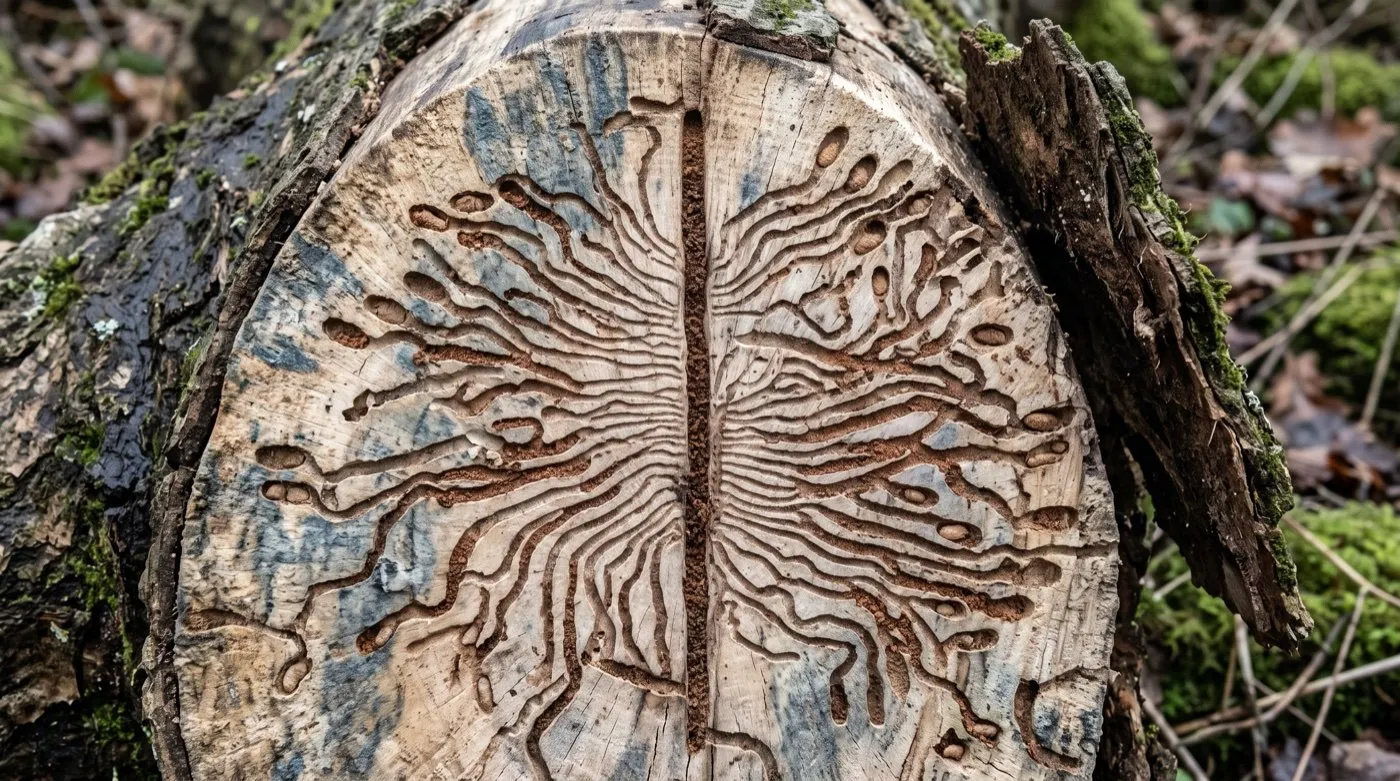 Scolytus galleries under the bark of a dead elm. The central tunnel is the maternal gallery; the fan of side tunnels is larval feeding.
Root grafts: why one dead elm takes its neighbours
Beetles get the blame, but in a hedgerow or an avenue the fungus often travels underground and never touches a beetle at all.
Elms growing close together graft their roots to each other. Where two roots cross and rub, the bark wears through and the tissues fuse, creating a continuous water connection between two separate trees. In dense hedgerow elm and in old planted avenues this is normal, not rare.
Once one tree is infected, the fungus moves along that plumbing directly into its neighbour. No beetle is needed, no feeding wound is needed, and the transfer can happen over winter when no beetle is flying. This is why elms in a line die in sequence, one after another down the row, rather than at random across a field.
The practical consequence is uncomfortable. Felling an infected elm does not protect the elm 8m away if their roots are already joined. To break the link you must sever the graft: a trench roughly 1m deep cut between the two trees, outside the drip line of the healthy one. On a garden scale that usually means a mini-digger and a willingness to damage some roots deliberately.
Warning: Never leave felled elm stacked with the bark on. A pile of bark-on elm logs is a perfect beetle nursery, and every adult emerging from it next May will carry spores to healthy elms up to a mile away. Debark it, burn it, or chip it. The single worst thing you can do with a dead elm is tidy it into a neat log pile and forget it. If you want a habitat pile, our guide to building a wildlife log pile explains which timber is safe to use, and elm is not on that list.
The Dutch elm disease infection cycle stage by stage
- Beetle emergence (May to June). Adults leave the bark of a dead elm through 2mm exit holes once air temperature passes about 20C, each carrying spores.
- Maturation feeding (days 1-10). Beetles fly to a healthy elm and chew twig crotches for five to ten days. Spores enter the xylem here.
- Fungal establishment (weeks 1-3). Spores germinate in the water vessels and bud like yeast. The sap stream carries them upward and through the crown.
- The tree’s own response (weeks 2-6). The elm detects the invader and plugs its vessels with tyloses, balloon-like growths, plus gums and resins. It is trying to wall the fungus in.
- Wilting (June to August). Those plugs block the tree’s own water supply. The branch above them wilts and flags. The damage you see is largely self-inflicted.
- Breeding (July onward). Beetles arrive at the now-dying tree, tunnel under the bark and lay eggs in maternal galleries.
- Root graft transfer (any month). In parallel, the fungus moves directly into grafted neighbours underground, entirely independent of the beetle year.
The critical mistake most people make is waiting through the winter to see whether the tree pulls round. It looks reasonable: the crown is only a quarter dead, the lower branches are green, and it has stopped getting worse in October. In reality the fungus is already in the trunk, the tree is a breeding site, and the beetles that hatch out of it next May will infect every elm nearby. The window when felling protects other trees is autumn to early spring, before that emergence. Wait until you can see the tree is finished and you have missed it.
| Air temperature | Beetle flight | Fungal growth in the tree |
|---|---|---|
| Below 10C | None | Effectively dormant |
| 10-15C | Little to none | Slow |
| 16-19C | Occasional flight on still days | Moderate |
| 20-25C | Main flight and maturation feeding | Fastest, optimum near 22C for O. novo-ulmi |
| Above 28C | Flight continues | Slows; favours the older, milder O. ulmi |
How Dutch elm disease killed 25 million British elms
The scale is hard to picture now. Estimates put British losses at more than 25 million elms since the aggressive strain landed around 1967, and some counts run considerably higher.
Elm was not a woodland tree here in any quantity. It was a hedgerow and field-boundary tree, and that is exactly why the loss changed how the country looks. English elm lined the ditches and lanes of the Midlands, East Anglia and the South in near-continuous rows. Those rows were also perfect infection corridors: touching crowns for the beetles, touching roots for the grafts.
By the mid-1970s the epidemic was running unchecked. Southern England lost the bulk of its mature elms inside about ten years. Local authority felling programmes could not keep pace, and the elm-heavy counties were changed permanently. Constable’s Suffolk skylines are elm skylines, and they no longer exist.
The loss cascaded. The white-letter hairstreak butterfly breeds only on elm, and its population collapsed with its foodplant; our guide to rare UK woodland butterflies covers what remains of it. Dozens of lichens and invertebrates tied to mature elm bark went with the trees.
The wider lesson has been learned twice more since. O. novo-ulmi arrived on imported unbarked logs. Ash dieback arrived on imported nursery stock, and the parallel is exact. The Woodland Trust makes the same argument about buying UK-sourced and UK-grown trees, and it is the single most useful thing a gardener can act on.
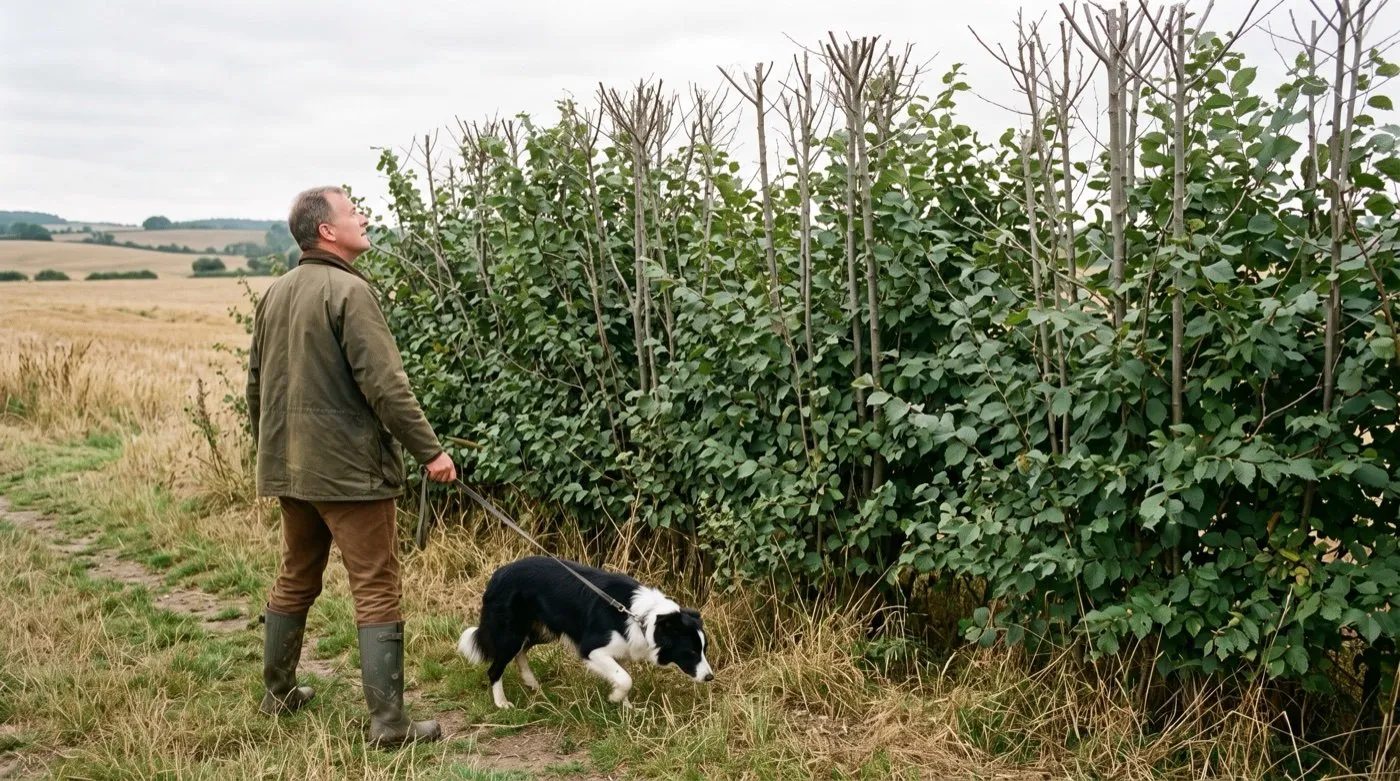 Scale on a hedgerow elm. The suckers behind this walker stand about 5m, roughly the height at which the bark thickens enough for Scolytus to breed and the stems die back again.
Why hedgerow elm dies at 5 metres
Elm is not extinct in Britain. It is everywhere, and that surprises people who expect a lost species. What has gone is not the elm but the elm tree.
English elm (Ulmus procera) barely reproduces from seed here. It spreads by root suckers, and the population is thought to be largely clonal, propagated by suckering and by human planting since Roman times. Genetically it is close to a single individual repeated across a country. That is the deep reason no resistance ever emerged: with almost no genetic variation, there was nothing for selection to work with.
When the tree above ground dies, the root system does not. It suckers, and the regrowth races away. In our Staffordshire hedgerows those suckers grow strongly for 15 to 20 years and reach around 5m. Then the stems thicken, the bark reaches the depth Scolytus needs to breed in, the beetles find them, and they die back. The roots sucker again.
So elm persists as a permanent shrub layer, cycling on a two-decade loop, never living long enough to flower and set seed. It also keeps the beetle population fed, which is why the disease has never burned itself out.
Dutch elm disease control methods compared
Nothing on this list saves an infected tree. They are ranked by what they actually achieve, which is protecting other elms and replacing the one you lost.
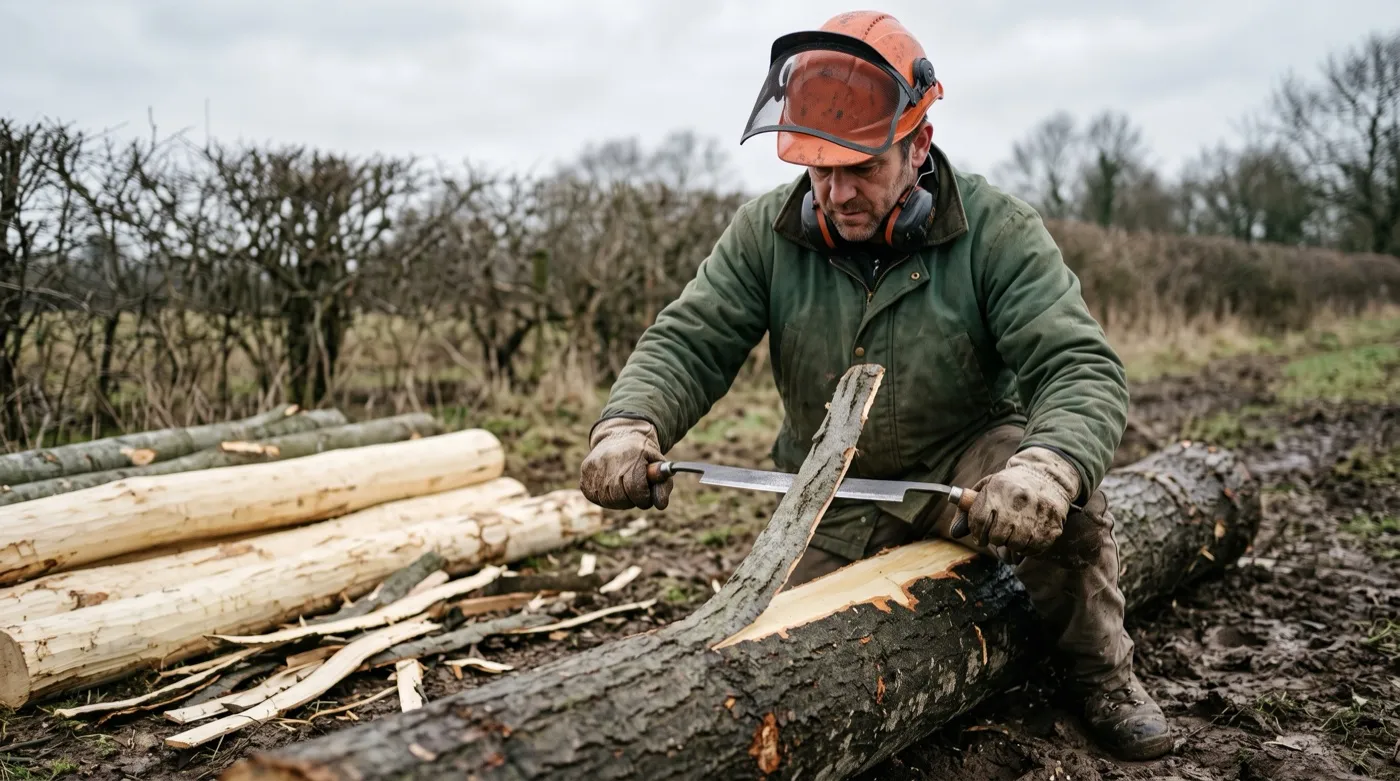 Sanitation felling done properly. The bark is stripped on site, because the beetles breed in the layer between bark and wood.
The gold standard for a garden elm is sanitation felling over winter, with the bark burnt or stripped on site, followed by replanting a resistant cultivar. That combination is the only one that both protects the elms around you and puts an elm back. Everything above it on a wish list, injection especially, is an orchard and heritage-tree tool that does not survive contact with a domestic budget.
Brighton’s elms and the cultivars worth planting
One British city still has its elms, and how it managed that tells you what actually works.
Brighton and Hove holds the National Elm Collection, roughly 17,000 trees, the largest surviving population of mature elm in Europe. Two pieces of luck and one piece of discipline explain it. The South Downs form a barrier to the north and the sea lies to the south, so beetle ingress is limited. The discipline is a sanitation regime running since the early 1970s: suspect trees inspected, confirmed cases felled and destroyed fast, elm wood movement controlled. It is not invulnerable. The Preston Twins in Preston Park, a pair of English elms of roughly 400 years thought to be among the oldest in the world, lost one of the pair to the disease in 2019.
The other route back is breeding. The Conservation Foundation’s Great British Elm Experiment propagated cuttings from mature elms that had survived in the wild and distributed thousands of young trees to schools and community groups. Results are mixed, honestly: some of those survivors were lucky rather than resistant.
The reliable cultivars are hybrids involving Asian elm species that evolved alongside the fungus. ‘New Horizon’, ‘Lutece’ and ‘Sapporo Autumn Gold’ all hold up well. They tolerate infection instead of strangling their own water vessels with tyloses.
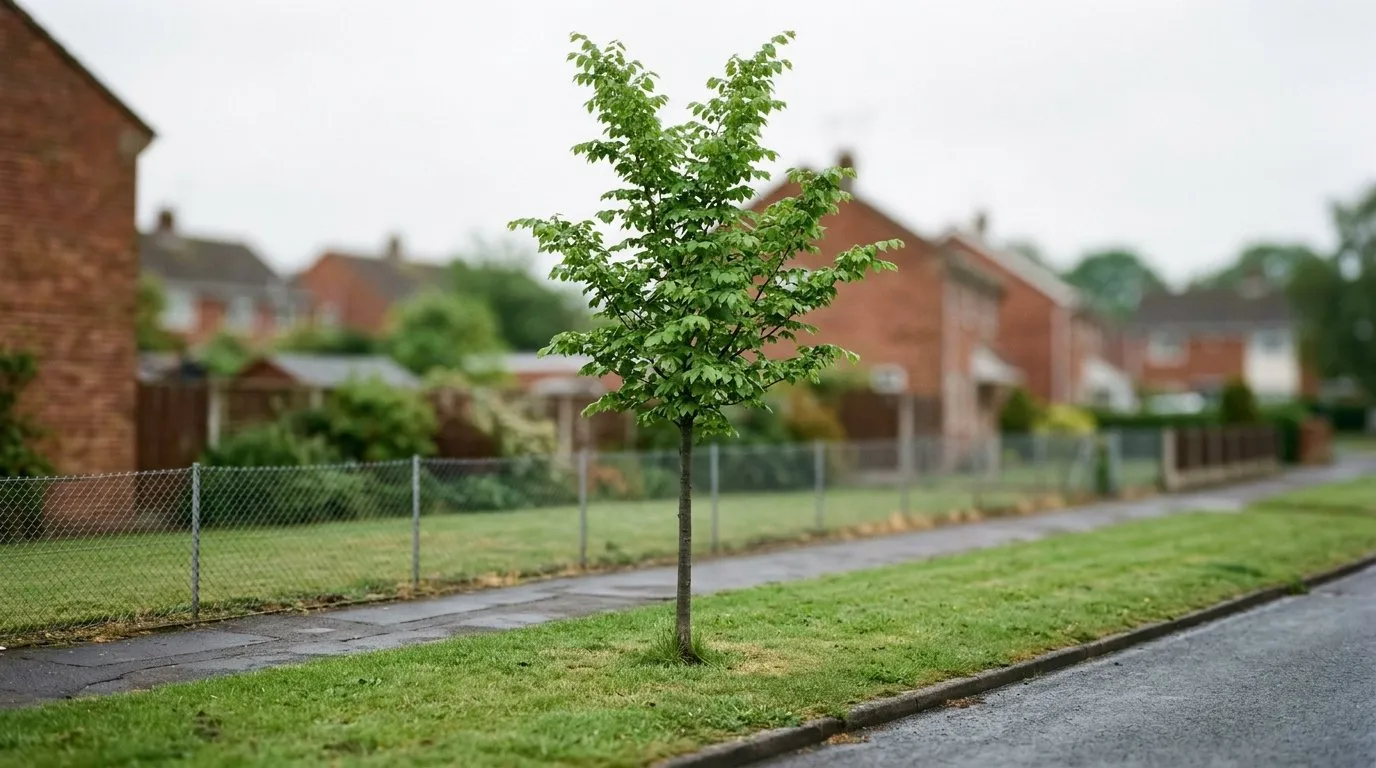 A resistant cultivar in Brighton. Note the narrower, more upright crown: it is not a visual match for English elm, but it lives.
The root cause nobody addresses
Blaming the fungus is easy and slightly wrong. Ophiostoma novo-ulmi is the agent. The cause is a monoculture with a beetle nursery attached, and that is what makes the disease permanent rather than a passing epidemic.
Three things lock it in place. First, clonal English elm across lowland Britain meant near-zero genetic diversity, so no natural resistance could be selected for. Second, the elm’s habit of suckering guarantees a constant supply of young stems that reach beetle-breeding size every 15 to 20 years, feeding the beetle population forever. Third, bark-on elm wood sitting in gardens, yards and hedge bottoms provides breeding sites that no beetle would otherwise find.
The reason the root cause gets missed is that the beetle is visible and the genetics are not. People reach for traps and sprays because they can see the insect. Nobody sprays their way out of a monoculture.
Permanent prevention is therefore genetic and physical, not chemical. Plant diverse, resistant cultivars rather than more of the same clone. Never keep bark-on elm timber. Buy UK-grown stock so the next pathogen does not arrive in a crate. If you are choosing a replacement tree for a garden-sized plot, our roundup of the best small native trees covers species that fill the gap while a resistant elm establishes.
Elm watch calendar month by month
Elm work is dictated by the beetle year, not by the gardener. Everything destructive happens between November and March, before emergence. Everything diagnostic happens between June and August, while the crown still shows you something. Sightings can be logged with Forest Research through TreeAlert, which is how the national picture stays current.
| Month | What to do |
|---|---|
| January | Fell confirmed cases. Debark or burn all elm wood before spring. Best month for trenching root grafts. |
| February | Finish felling and destroying infected wood. Plant bare-root resistant elms. |
| March | Complete all elm wood disposal. Last safe window before beetle emergence. |
| April | Check for elm wood you have missed. Nothing to see in the crown yet. |
| May | Beetles begin emerging near 20C. Do not fell now unless the wood goes straight on a fire. |
| June | First flagging appears. Start weekly crown checks on any elm you value. |
| July | Peak flagging month. Cut twigs and run the ring test on anything suspicious. |
| August | Second beetle generation flies in warm years. Map every affected tree now. |
| September | Confirm diagnoses. Get quotes for winter felling while access is dry. |
| October | Leaf fall masks symptoms. Mark trees you identified in summer with tape. |
| November | Felling season opens. Prioritise trees within 10m of healthy elms. |
| December | Fell, debark, burn. Order resistant stock for February planting. |
Common mistakes with a suspect elm
- Cutting the twig lengthways. The stain sits in the outer 1-2mm and reads as a dotted ring only on a clean cross-section. Slice along the grain and you will see nothing and conclude wrongly.
- Testing one twig. Staining is patchy. Cut three or four from flagging branches plus one control from a green branch, and compare them side by side.
- Waiting to see if it recovers. It will not, and every month you wait leaves a breeding site standing. Fell between November and March, before the May emergence.
- Keeping the logs. Bark-on elm stacked by the shed is a beetle nursery. Debark it or burn it. Never move it to another site or sell it as firewood with the bark on.
- Felling the sick tree and stopping there. If a healthy elm stands within 10m, their roots are probably grafted. Sever the link with a 1m trench or expect the neighbour to flag next summer.
- Replanting the same thing. Putting another English elm in the gap repeats the experiment with the same clone. Plant a resistant cultivar or a different species.
What this tree still asks of gardeners
Dutch elm disease is the rare garden problem where honest advice is mostly about acceptance. You cannot cure it. You can identify it in ten minutes with a pair of secateurs, and you can stop your dead tree from killing someone else’s.
Now you can tell a flagging elm from a stressed one, read our ash dieback identification guide for the disease doing to ash exactly what this one did to elm.
Frequently asked questions
How do I know if my elm has Dutch elm disease?
Cut a wilting twig across and look for a brown ring inside the sapwood. Flagging branches from June, leaves that yellow then brown and hang on rather than drop, and shoot tips curled into a shepherd’s crook all point the same way. The ring test is what confirms it: a dotted brown circle 1-2mm inside the bark on a clean cross-section. A pale, unstained cut face means the wilt has another cause.
Can Dutch elm disease be cured?
No. Once a branch is wilting, no treatment available to a gardener will save the tree. Fungicide injected into the trunk can protect a healthy high-value elm for two to three years, at roughly £200-600 a time through a specialist arboriculturist. It does almost nothing once more than about 5% of the crown has flagged, and it must be repeated forever.
Why do elms still grow in UK hedgerows if the disease killed them all?
Elm suckers from its roots, so the root system outlives the tree above it. Those suckers grow away happily for 15 to 20 years. Once the stems pass roughly 5m tall and the bark thickens enough for beetles to breed in, the disease finds them and they die back. The roots then sucker again. Most hedgerow elm never lives long enough to flower and set seed.
Do I have to report Dutch elm disease?
Not in most of Britain, because the disease is endemic and unrestricted. Some places are different: Brighton and Hove runs a control regime around its National Elm Collection, and parts of Scotland have operated control zones. Ask your local council before you fell, move or store any elm wood. Logging sightings with Forest Research through TreeAlert still helps keep the national picture current.
Are there elm trees resistant to Dutch elm disease?
Yes. Modern cultivars such as ‘Lutece’, ‘New Horizon’ and ‘Sapporo Autumn Gold’ resist it reliably. They are hybrids involving Asian elm species that co-evolved with the fungus, so they tolerate infection rather than blocking their own water vessels. None is a visual match for English elm: expect a narrower, more upright crown. Barcham Trees and Hillier both stock them as standards.
Can I burn or move logs from an elm that died of the disease?
Burn them or strip the bark off on site, and never store bark-on elm logs. The beetles breed in the layer between bark and wood, then emerge in May carrying spores. A stack of bark-on elm by the shed is a beetle nursery aimed at every elm within a mile. Debarked elm is perfectly safe to season and burn.
What is the difference between Dutch elm disease and elm zigzag sawfly damage?
Dutch elm disease wilts whole branches; zigzag sawfly chews zigzag trails through leaves. Sawfly damage is visible on the leaf blade itself, eaten inward from the edge in a distinctive zigzag, and the leaf stays green either side of the trail. Disease-killed leaves yellow and wilt as a complete branch, with no feeding damage at all.
Our team produces practical UK gardening guidance from source research, contributor records and established horticultural practice. Editorial standards are overseen by Matt W.