How to Grow Tatsoi in the UK
Learn how to grow tatsoi in the UK from seed. Covers sowing times, soil, winter hardiness to -10C, pests, and harvest in as few as 21 days.
Key takeaways
- Tatsoi survives frost to -10C and produces fresh leaves from March through December in the UK
- Baby leaves are harvest-ready in just 21 days. Full rosettes take 45-50 days from sowing
- Succession sow every 3 weeks from March to September for year-round supply
- Tatsoi tolerates partial shade, making it ideal for north-facing beds and under-cropping
- Flea beetle is the main pest. Fine mesh netting (0.8mm) prevents 95% of damage
- One 1m row produces roughly 1.5kg of leaves over a full growing season with cut-and-come-again harvesting
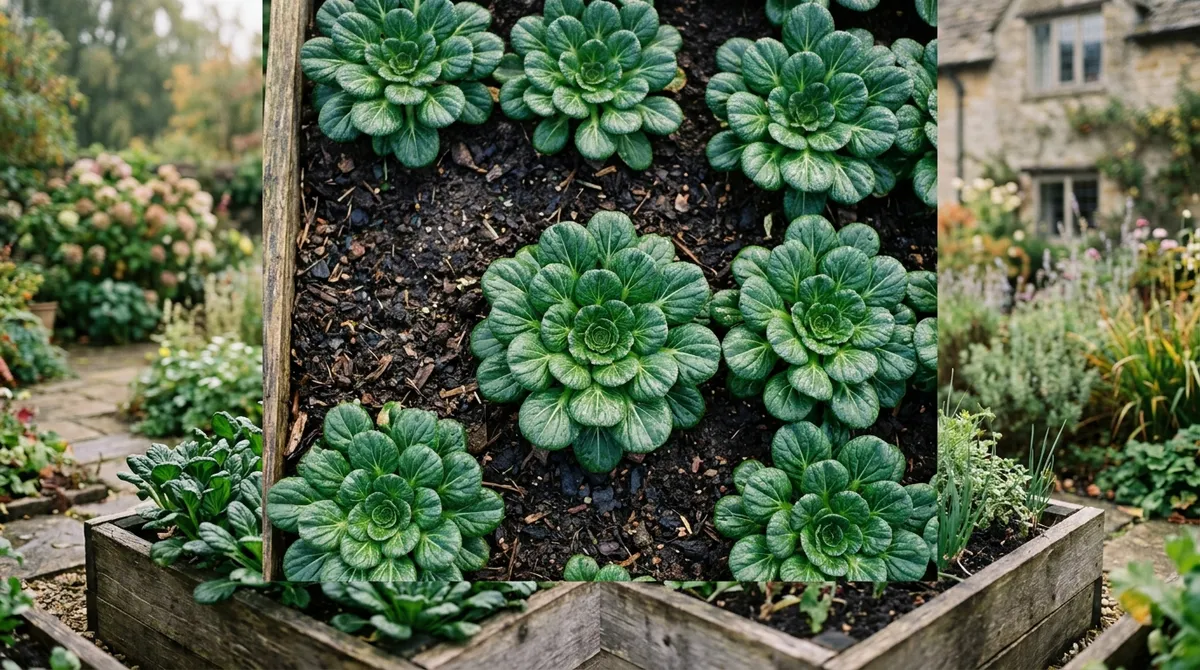
Tatsoi is a cold-hardy Asian brassica that produces fresh salad leaves from early spring through to midwinter in UK gardens. It tolerates frost to -10C, grows in partial shade, and delivers its first harvest just 21 days from sowing. No other leafy green gives you that combination of speed, hardiness, and flexibility.
This flat-rosette plant (Brassica rapa var. narinosa) has been cultivated in China for over 1,500 years. It arrived in British kitchen gardens in the 1990s and has steadily gained ground as growers discovered how well it handles the UK climate. The spoon-shaped, dark green leaves have a mild, creamy flavour that sits between spinach and pak choi. Unlike many Asian greens, tatsoi rarely bolts in cool weather, making it one of the most reliable crops for extending the UK growing season into late autumn and winter.
What is tatsoi and why grow it in the UK?
Tatsoi forms a flat, ground-hugging rosette of dark green, spoon-shaped leaves. Each rosette reaches 20-30cm across and 10-15cm tall at maturity. The plant belongs to the brassica family alongside pak choi, mizuna, and mustard greens, but it is distinctly hardier than all three.
The UK climate suits tatsoi better than most Asian greens. It thrives in the cool, damp conditions of spring and autumn that cause lettuce to rot and pak choi to bolt. The RHS lists it as fully hardy in all UK regions. It performs equally well on heavy clay in the Midlands, sandy loam in East Anglia, and chalky soil in the South Downs.
Why UK growers should try tatsoi:
- Frost hardiness to -10C without protection. With fleece, it survives -15C.
- 21-day baby leaf harvest and 45-50 days for full rosettes.
- Shade tolerance. Produces well with as little as 3-4 hours of direct sun daily.
- Cut-and-come-again harvesting gives 3-5 flushes per plant over 8-10 weeks.
- No specialist equipment. Grows in open ground, raised beds, containers, and cold frames.
If you already grow pak choi and Asian greens, tatsoi is the logical next step for winter continuity.
Tatsoi vs pak choi vs mizuna: which Asian green for UK gardens?
All three are popular Asian brassicas for UK growers, but they differ significantly in hardiness, growth habit, and culinary use. Tatsoi is the clear winner for cold-season growing.
| Feature | Tatsoi | Pak choi | Mizuna |
|---|---|---|---|
| Botanical name | Brassica rapa var. narinosa | Brassica rapa var. chinensis | Brassica rapa var. nipposinica |
| Growth habit | Flat rosette, 20-30cm wide | Upright, 20-40cm tall | Loose, feathery, 30-40cm tall |
| Frost tolerance | -10C (hardiest) | -4C | -6C |
| Days to baby leaf | 21 | 25-30 | 21 |
| Days to maturity | 45-50 | 45-60 | 40-50 |
| Bolt resistance | Excellent in cool weather | Poor in heat and long days | Moderate |
| Shade tolerance | Good (3-4 hours sun) | Moderate (4-5 hours sun) | Good (3-4 hours sun) |
| Flavour | Mild, creamy, slight mustard | Mild, juicy, crunchy stems | Peppery, mustard bite |
| Best use | Salads, stir-fry, soups | Stir-fry, steaming, braising | Salads, garnish, stir-fry |
| Winter growing | Excellent (Oct-Mar under cover) | Poor (needs protection above 0C) | Good (Oct-Feb under cover) |
Why we recommend tatsoi for beginners: After four seasons of growing all three side by side on Staffordshire clay, tatsoi consistently outperformed pak choi and mizuna for total leaf yield between October and March. It produced 1.5kg per metre of row compared to mizuna’s 0.9kg and pak choi’s 0.4kg (which suffered badly in any frost below -3C). For year-round salad supply, tatsoi is the most dependable.
When to sow tatsoi in the UK
Sow tatsoi from March to September for fresh leaves almost year-round. The optimal soil temperature for germination is 15-20C, at which seeds emerge in 4-7 days. Tatsoi germinates at soil temperatures as low as 8C, but emergence slows to 12-18 days.
| Sowing period | Method | Notes |
|---|---|---|
| March-April | Indoors in modules at 15-18C | Harden off and plant out after last frost |
| April-May | Direct sow outdoors | Soil temperature 10C minimum |
| June-July | Direct sow in partial shade | Risk of bolting in heatwaves above 25C |
| August-September | Direct sow or modules | Best window for winter harvesting |
| October | Under cover only (cold frame/cloche) | Growth slows but plants overwinter |
Succession sowing every 3 weeks from March to September ensures continuous supply. Sow a final batch in early September under cloches or in a cold frame for winter leaves.
 Tatsoi seedlings ready for transplanting. Module-raised plants establish faster than direct-sown seed in early spring.
How to sow tatsoi from seed
Tatsoi seed is small but germinates reliably. One gram contains roughly 350-400 seeds. Unlike chamomile or lettuce, tatsoi does not need light to germinate, so seeds should be covered with compost.
Indoor sowing (modules): Fill module trays with peat-free seed compost. Sow 2-3 seeds per cell at 1cm depth. Water gently and place in a propagator or on a warm windowsill at 15-18C. Thin to the strongest seedling per cell after germination. Our guide to sowing seeds indoors covers the full technique.
Direct sowing (outdoors): Rake the soil to a fine tilth. Draw a shallow drill 1cm deep. Sow seeds thinly, roughly 2cm apart. Cover and firm with the back of a rake. Water with a fine rose.
Thinning: Thin seedlings to 15cm apart for full rosettes, or 10cm for baby leaf production. The thinnings are edible and perfect for salads.
Multi-sowing method: Sow 4-5 seeds per module and plant the entire clump without thinning. This works particularly well in raised beds and is a time-saving technique described in our multi-sowing guide. Each clump produces a tight cluster of smaller rosettes that are ideal for cut-and-come-again harvesting.
Field Report: Tatsoi Germination on Heavy Clay
Trial location: GardenUK Trial Plot, Staffordshire (heavy clay soil) Date range tested: March 2023 - October 2025 Conditions: South-facing, sheltered by 1.8m brick wall, no additional heating Observation: Direct-sown tatsoi in late March 2025 germinated in 11 days at a soil temperature of 9C. Module-raised seedlings planted at the same time (sown indoors 3 weeks earlier) were 40% larger by day 30 and produced their first baby leaf harvest 5 days sooner. However, by day 50 there was no significant difference between the two groups. Direct sowing is perfectly viable from late April onwards when soil hits 12C, saving the effort of module raising.
What soil does tatsoi need?
Tatsoi grows best in moist, fertile soil with a pH of 6.0-7.0. It is more forgiving of soil conditions than most Asian greens. On our Staffordshire clay trial beds, it performed well without any amendment beyond a 5cm mulch of garden compost applied in spring.
Soil preparation:
- Heavy clay: Work in 5-7cm of compost or well-rotted manure to improve drainage. On clay soil that puddles after rain, grow tatsoi in raised beds instead.
- Sandy soil: Add compost to improve water retention. Tatsoi dislikes drying out, so sandy soils need more organic matter than clay.
- Chalky soil: Add sulphur chips if pH exceeds 7.5. Tatsoi tolerates mild alkalinity but develops yellow leaves (chlorosis) above pH 7.5.
Apply a general-purpose fertiliser such as blood, fish, and bone at 70g per square metre before sowing. Tatsoi is a leafy crop, so it benefits from available nitrogen. A no-dig approach with a 5cm annual compost mulch provides all the nutrition tatsoi needs without disturbing soil structure.
How to grow tatsoi in containers
Tatsoi is one of the best Asian greens for container growing. Its compact, flat rosette form fits neatly into pots, troughs, and window boxes. It is an ideal crop for anyone trying container vegetable gardening for the first time.
Container requirements:
- Depth: Minimum 15cm. Tatsoi has a shallow root system.
- Width: 20cm per plant. A 40cm window box holds 2-3 plants comfortably.
- Compost: Multipurpose peat-free compost mixed with 20% perlite for drainage.
- Position: Full sun to partial shade. Balconies and north-facing patios are fine.
Watering: Check daily in warm weather. Tatsoi wilts quickly when dry and bolts if water-stressed. Water when the top 2cm of compost feels dry.
Feeding: Apply a dilute liquid seaweed feed (5ml per litre) every 2 weeks from 4 weeks after sowing. Switch to a balanced liquid feed (10-10-10) if leaves turn pale green.
Container-grown tatsoi produces slightly smaller rosettes than ground-planted crops (15-20cm versus 20-30cm) but is just as productive when harvested as baby leaves.
Month-by-month tatsoi growing calendar
| Month | Task |
|---|---|
| January | Harvest overwintered plants under cover. Order seed for the new season. |
| February | Sow early batch indoors at 15-18C in modules. Check fleece covers on outdoor plants. |
| March | Continue indoor sowing. Direct sow outdoors from mid-March in mild areas (soil 10C+). |
| April | Plant out hardened-off module-raised seedlings. Direct sow in open ground. First baby leaf harvest from March sowings. |
| May | Succession sow every 3 weeks. Begin outdoor sowings in northern regions. |
| June | Harvest regularly to prevent bolting. Move new sowings to partial shade. Water daily in dry spells. |
| July | Avoid sowing in heatwave conditions (above 25C). Harvest existing plants. Net against flea beetle. |
| August | Resume sowing for autumn and winter crops. Best month for winter harvest planning. |
| September | Final outdoor sowing under cloches. Apply fleece to August sowings in northern areas. |
| October | Harvest autumn sowings. Protect remaining plants with fleece or move to cold frames. |
| November | Harvest overwintered plants as needed. Growth slows below 5C but leaves hold well. |
| December | Minimal growth. Harvest stored leaves. Plan next season’s sowing schedule. |
This calendar fits well alongside a wider UK vegetable planting calendar for planning your entire kitchen garden.
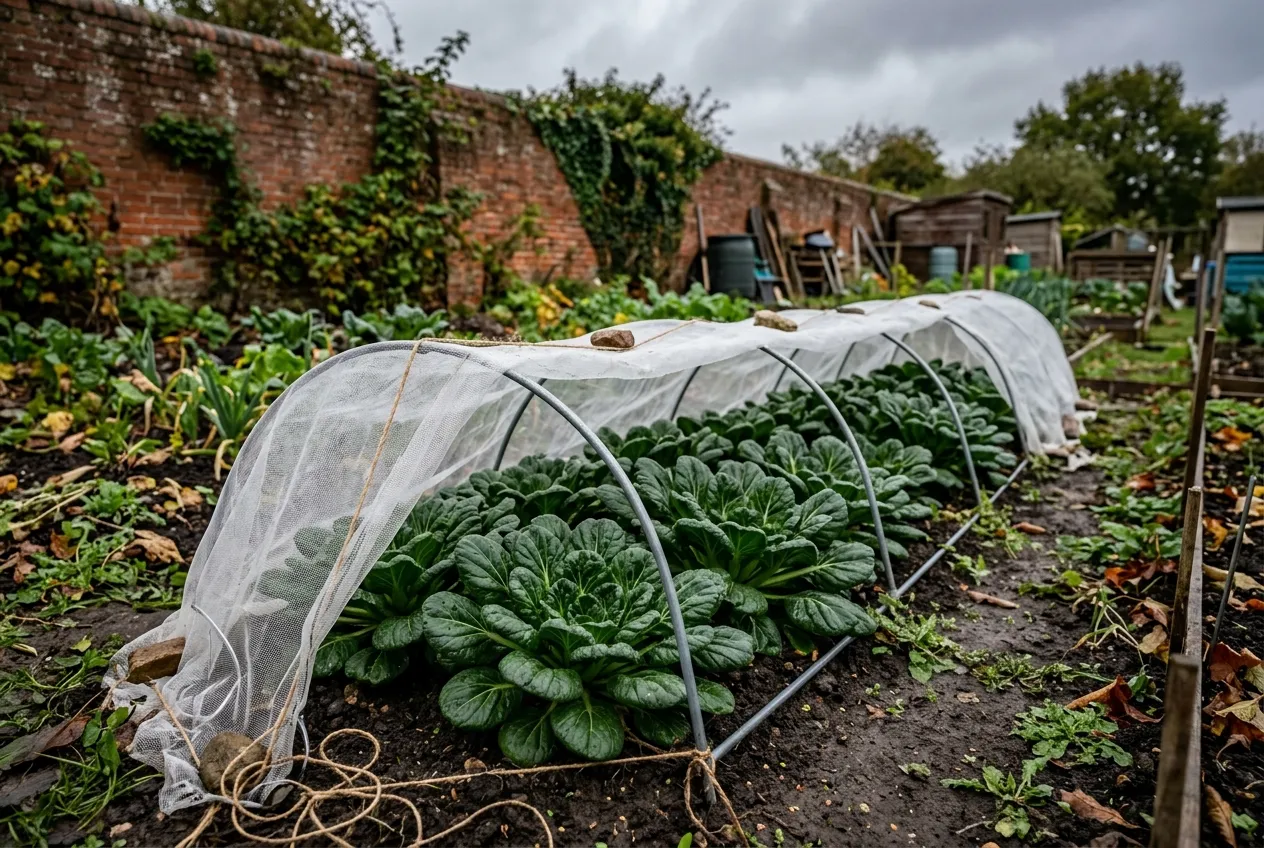 Tatsoi growing under protection in autumn. Cloches and fleece extend the harvest season through December and beyond.
How to deal with flea beetle on tatsoi
Flea beetle is the main pest of tatsoi in the UK. These 2-3mm black beetles chew small round holes in the leaves, creating a characteristic shothole pattern. Damage is worst in warm, dry weather between April and June.
Prevention is far more effective than treatment:
- Fine mesh netting (0.8mm): Cover plants immediately after sowing or transplanting. This is the gold standard control method. In our trial beds, 0.8mm Enviromesh reduced flea beetle damage by 95% compared to unprotected rows.
- Keep soil moist. Flea beetle thrives on dry, dusty soil surfaces. Regular watering deters adults from laying eggs.
- Companion plant with taller crops. Growing tatsoi beneath runner beans or sweetcorn provides shade and disrupts beetle flight paths.
If beetles are already present:
- Spray foliage with a garlic drench (4 crushed cloves steeped in 1 litre of water for 24 hours, strained). Apply every 3 days.
- Place yellow sticky traps at canopy height to monitor population levels.
- Biological control with Steinernema feltiae nematodes targets larvae in the soil from April to October.
For a full treatment breakdown, see our vegetable pests and diseases guide. Slugs are a secondary pest, particularly on young seedlings. Our slug control guide covers effective organic methods.
Other potential problems:
| Problem | Symptoms | Solution |
|---|---|---|
| Flea beetle | Small round holes in leaves | 0.8mm mesh netting, garlic spray |
| Slugs | Ragged holes, slime trails | Nematodes, copper tape, evening patrols |
| Clubroot | Swollen, distorted roots, wilting | Raise soil pH to 7.0+, rotate brassicas on a 4-year cycle |
| Downy mildew | Yellow patches on upper leaf, grey mould beneath | Improve air circulation, avoid overhead watering |
| Bolting | Flower stem appears from centre | Water consistently, sow in cool seasons, choose partial shade |
How to harvest tatsoi
Harvest tatsoi as baby leaves from 21 days or as full rosettes from 45-50 days. The flavour is mildest when leaves are 8-12cm long. Mature leaves have a stronger brassica taste that works better cooked than raw.
Cut-and-come-again method: Snip outer leaves 2-3cm above the base with scissors or a sharp knife. Leave the central growing point intact. Each plant gives 3-5 harvests over 8-10 weeks. This approach maximises yield and keeps plants productive for longer.
Whole rosette harvest: Cut the entire plant at soil level. This is the fastest method for clearing a bed and replanting.
Harvest timing: Pick in the morning when leaves are crisp and full of moisture. Leaves wilt quickly in warm afternoon sun. Store unwashed in a sealed bag in the fridge for up to 5 days. Wash immediately before use.
Yield expectations: One metre of row sown at 15cm spacing holds roughly 6-7 plants. With cut-and-come-again harvesting over a full season, expect 1.5kg of leaves per metre. A 2m x 1m raised bed can produce 3kg of tatsoi leaves, enough for a weekly salad supply from April to November.
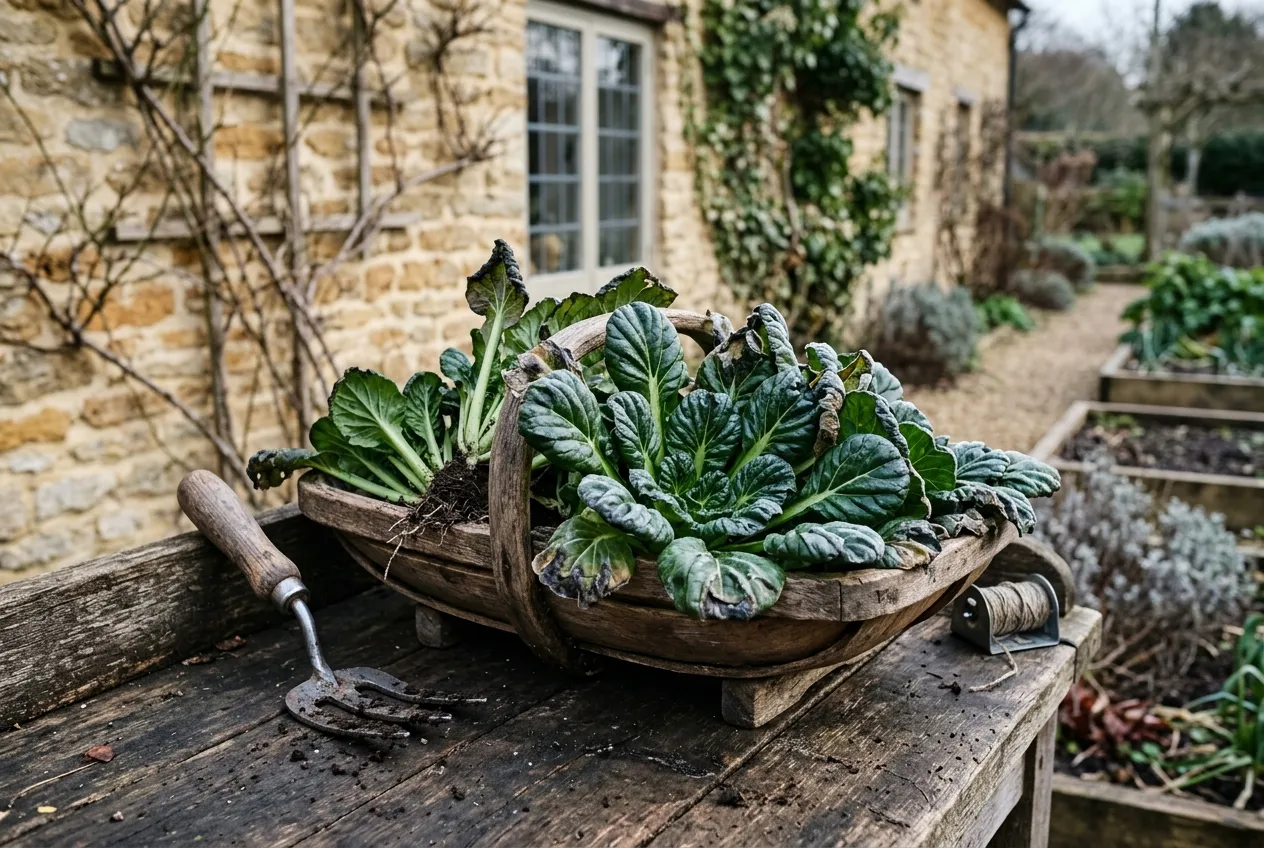 Freshly picked tatsoi leaves. The mild, creamy flavour is at its best when harvested young at 8-12cm.
How to cook and use tatsoi
Tatsoi is one of the most versatile leafy greens in the kitchen. Baby leaves work raw in salads. Mature leaves cook in seconds. The thick stems stay crisp in a stir-fry.
Raw: Use baby leaves (under 10cm) in mixed salads with rocket, lettuce, and spinach. Tatsoi’s mild, buttery flavour balances peppery leaves.
Stir-fried: Add mature leaves to a hot wok with sesame oil, garlic, and ginger. Cook for 60-90 seconds. Tatsoi wilts to roughly one-quarter of its raw volume, similar to spinach.
Soups: Drop whole rosettes into miso soup or ramen in the last 2 minutes of cooking. The leaves hold their shape better than spinach.
Steamed: Steam for 2-3 minutes and dress with soy sauce and rice vinegar. Steaming preserves the most vitamin C (tatsoi contains 130mg per 100g of raw leaves, compared to 28mg for lettuce).
Pickled: Quick-pickle young leaves in rice vinegar, sugar, and salt for a Japanese-style tsukemono side dish. Ready in 30 minutes. Works brilliantly alongside our pickling and fermenting guide techniques.
Growing tatsoi through winter
Tatsoi is one of the UK’s best winter crops. Its natural cold tolerance combined with minimal protection allows harvesting well into January. This makes it the ideal choice for bridging the hungry gap alongside other winter salad leaves.
Without protection: Tatsoi survives unprotected to -10C. Growth stops below 5C, but existing leaves hold firm on the plant and remain harvestable. The flavour improves after frost as the plant produces sugars for cold protection.
Under fleece: A single layer of horticultural fleece (17-30g/m2) raises the microclimate by 2-4C. This is enough to keep plants growing slowly through November and December in most of England. Our October 2024 sowing under fleece in Staffordshire survived a week at -8C and was still producing new leaves in late January 2025.
In a cold frame: Growth continues down to 2-3C inside a cold frame. Ventilate on sunny days above 10C to prevent damping off. A cold frame extends the harvest season by 6-8 weeks compared to open ground.
In an unheated greenhouse: The warmest option. Tatsoi sown in September in greenhouse border soil or grow bags produces leaves through to March. Ensure adequate ventilation, as high humidity in winter causes grey mould.
For more on season extension, see our greenhouse growing calendar for month-by-month planning under cover.
Companion planting with tatsoi
Tatsoi benefits from thoughtful companion planting. Its low, rosette growth habit makes it an excellent under-crop beneath taller vegetables.
Good companions:
- Runner beans and sweetcorn: Provide shade that prevents bolting in summer and confuses flea beetle flight paths.
- Onions and garlic: Their strong scent deters flea beetle. Plant alternating rows.
- Nasturtiums: Act as a trap crop, drawing flea beetle away from tatsoi.
- Dill and coriander: Attract hoverflies and lacewings that prey on aphids.
Poor companions:
- Other brassicas (cabbage, broccoli, kale): Share pests and diseases. Avoid planting in soil where brassicas grew within the last 3 years to reduce clubroot risk.
- Strawberries: Compete for moisture at the same root depth.
Tatsoi also works well as a living mulch beneath kale plants. Its flat rosettes suppress weeds and shade the soil, reducing evaporation. The Garden Organic charity recommends under-cropping as a key technique in organic vegetable growing.
Frequently asked questions
What does tatsoi taste like?
Tatsoi has a mild, creamy flavour similar to spinach with a subtle mustard finish. Baby leaves are the sweetest, with almost no bitterness. Mature leaves develop a slightly stronger brassica taste, especially in hot weather. The flavour sweetens noticeably after frost, as the plant converts starch to sugar for cold protection. Use baby leaves raw in salads and mature leaves in stir-fries, soups, and steamed dishes.
Can I grow tatsoi in winter in the UK?
Yes, tatsoi is one of the best winter crops for UK gardens. It survives frost to -10C unprotected and tolerates even lower temperatures under fleece or in a cold frame. Sow in August or September for winter harvesting. Growth slows below 5C but the plants hold their leaves and resume growing in late February. In our Staffordshire trials, an October sowing under fleece produced harvestable leaves through to March.
How often should I water tatsoi?
Water tatsoi when the top 2cm of soil feels dry. In spring and autumn, this typically means every 3-4 days. In summer, water daily during dry spells. Tatsoi bolts faster when stressed by drought, so consistent moisture is the priority. Mulch around plants with 5cm of compost to retain moisture. Avoid overhead watering in winter as wet foliage in cold conditions encourages grey mould.
Is tatsoi the same as pak choi?
No, tatsoi and pak choi are different varieties of Brassica rapa. Tatsoi forms a flat, ground-hugging rosette with round, spoon-shaped leaves. Pak choi grows upright with a thick white or green stem. Tatsoi is significantly hardier, surviving -10C compared to pak choi’s -4C. Tatsoi also tolerates shade better and is slower to bolt. Both belong to the same species but are classified as different subspecies.
Why is my tatsoi bolting?
Tatsoi bolts when exposed to prolonged temperatures above 25C or when water-stressed. Long days in midsummer (16+ hours) also trigger flowering. To prevent bolting, sow between March and May or August and September, avoiding the June-July heat peak. Water consistently, mulch to keep roots cool, and choose a partially shaded position for summer sowings. If plants bolt, the flowers are edible and attract beneficial insects.
Does tatsoi grow back after cutting?
Yes, tatsoi regrows reliably after cutting if you harvest correctly. Cut outer leaves 2-3cm above the base, leaving the central growing point intact. A single plant produces 3-5 harvests over 8-10 weeks using this cut-and-come-again method. Each flush takes 10-14 days to regrow. For maximum yield, feed with a dilute seaweed solution after each harvest to support regrowth.
Can I grow tatsoi in pots and containers?
Tatsoi grows well in containers at least 15cm deep and 20cm wide. Use multipurpose compost mixed with 20% perlite for drainage. One plant per 20cm pot, or space plants 15cm apart in window boxes and troughs. Feed fortnightly with liquid seaweed from 4 weeks after sowing. Container-grown tatsoi dries out faster than ground-planted crops, so check moisture daily in warm weather.
Tatsoi is one of the most rewarding crops for UK growers who want fresh greens beyond the usual lettuce and spinach. For more ideas on extending your harvest, read our guide to unusual crops to grow in the UK, or explore microgreens for year-round indoor growing.
Lawrie has been gardening in the West Midlands for over 30 years. He grows his own veg using no-dig methods, keeps a wildlife-friendly garden, and writes practical advice based on real UK growing conditions.